The universe has never been a quiet, static backdrop—it’s a laboratory of extremes. Every few months, new data from space telescopes, planetary probes, and gravitational-wave observatories adds another twist to what we thought was possible. Planets rain glass, stars stretch like taffy, and entire worlds glow with auroras so huge they could swallow Earth whole.
Below are five recent and mind-bending discoveries and facts that show how strange, active, and wonderfully unpredictable our cosmos really is.
A Planet Where It Literally Rains Glass Sideways
Imagine standing on a world where the sky is a deep, cobalt blue, the air is thick and scorching, and shards of glass slice past you at thousands of kilometers per hour. That’s not science fiction—that’s an actual exoplanet.
Astronomers studying the hot Jupiter HD 189733b found evidence of a bizarre weather system: clouds made from silicate particles and winds that roar at over 7,000 km/h. These conditions likely create storms of molten glass that condense and fall as razor-sharp rain, driven sideways by ferocious winds.
This planet orbits so close to its star that its “year” is just over two Earth days. The intense radiation puffs up its atmosphere and strips it away, while the planet’s deep blue color—once mistaken for an “Earth-like” hue—is actually caused by haze and silicate clouds, not oceans or sky like ours.
HD 189733b is a reminder that “Earth-sized” or “blue” doesn’t necessarily mean “Earth-like.” In the catalog of exoplanets, familiar labels hide profoundly alien realities.
A World So Hot Its Rocks Melt Into Vast Lava Oceans
If HD 189733b is about lethal weather, K2-141b is about ultimate geology.
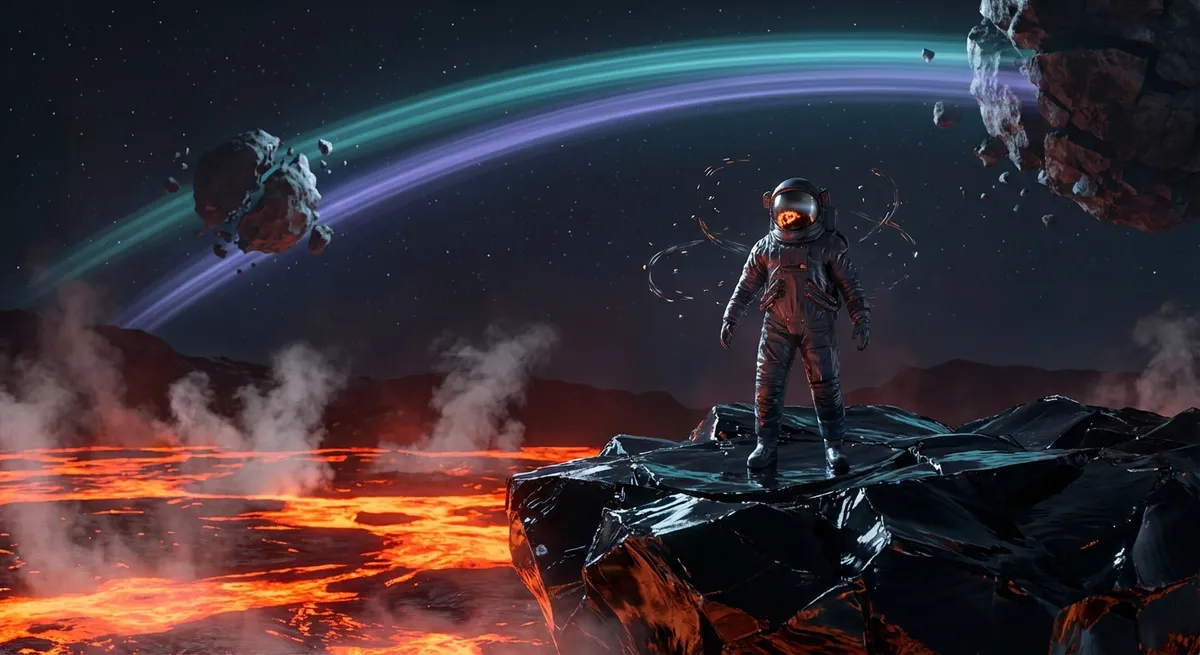
K2-141b is a planet that orbits so close to its star that one side is locked in perpetual daylight at temperatures above 3,000°C—hot enough to vaporize rock. The night side, in contrast, plunges to –200°C. On the day side, rock literally evaporates into a mineral-rich atmosphere. Winds then carry that vapor to the dark side, where it cools, condenses, and falls as “rock rain” that eventually flows back as lava.
This creates a full “rock cycle” in the atmosphere: rock → vapor → clouds → rock rain → lava oceans.
Simulations suggest these lava oceans could be hundreds of kilometers deep. K2-141b is like a cross between a planet and a blast furnace—a snapshot of what young rocky worlds might look like before they cool and stabilize. It offers a glimpse into extreme planetary evolution that our own early Earth may have brushed up against long ago.
Auroras That Dwarf Earth’s: Giant Light Shows on Alien Worlds
Earth’s auroras are already spectacular, but compared to some worlds in our solar system, they’re tiny.
On Jupiter, auroras rage constantly around the poles, powered not only by the solar wind but also by the planet’s enormous magnetic field and the volcanic moon Io. Io spews charged particles into space, feeding Jupiter’s magnetosphere and supercharging these polar light shows. The Hubble Space Telescope has captured immense auroral ovals that are larger than Earth itself.
Even more astonishing: astronomers have detected aurora-like radio emissions from brown dwarfs—objects that are larger than planets but too small to ignite sustained nuclear fusion like stars. These emissions suggest huge magnetic fields and auroras thousands of times more powerful than Earth’s.
And beyond our solar system, in 2023 and 2024, radio observations revealed signs of star–planet magnetic interactions that may trigger aurora-like processes on exoplanets. If we could see them up close, those skies might blaze with curtains of charged particles, swirling across entire hemispheres.
Auroras, once thought of as pretty lights above the poles, are now recognized as powerful signposts of magnetic fields, star-planet interactions, and space weather on an interstellar scale.
Stars That Stretch, Shatter, and Ring Spacetime Like a Bell
Not all drama in the universe happens on planets. Some of the most extreme physics unfolds when dense stellar corpses collide.
Neutron stars—the ultra-compact remnants of massive stars—pack more mass than our Sun into a sphere about the size of a city. When two neutron stars spiral into each other, their collision releases both light and ripples in spacetime itself: gravitational waves.
In 2017, observatories including LIGO and Virgo detected gravitational waves from a neutron star merger dubbed GW170817 and, almost simultaneously, telescopes worldwide caught the accompanying flash of light, followed by a radioactive afterglow. This event became a cosmic laboratory, confirming that such collisions are factories for heavy elements like gold, platinum, and uranium.
More recently, new gravitational-wave detections suggest we’re only seeing the beginning of a vast, unseen population of colliding black holes and neutron stars. Each event momentarily warps spacetime, like ringing a cosmic bell. By studying the pattern of these waves, scientists can probe the interior structure of neutron stars—matter so dense that a teaspoon would weigh billions of tons.
These stellar smashups turn abstract theories of gravity and nuclear physics into events we can measure across hundreds of millions of light-years.
A “Dark” Universe: Most of What Exists Is Still Invisible
Perhaps the most astonishing fact about the universe is how little of it we truly see.
All the stars, planets, gas, dust, and galaxies we can observe make up only about 5% of the universe’s total energy-matter content. The rest appears to be:
- Dark matter (~27%): Invisible material that doesn’t emit or absorb light, but exerts gravity. It acts like a hidden scaffolding, shaping how galaxies form and cluster.
- Dark energy (~68%): A mysterious component causing the expansion of the universe to accelerate over time.
Dark matter reveals itself indirectly: galaxies spin too fast and contain too little visible mass to hold themselves together without some invisible glue. Gravitational lensing—where clusters of galaxies bend light from more distant ones—also exposes unseen mass.
Dark energy emerged from measurements of distant supernovae in the late 1990s, which showed that the universe’s expansion isn’t slowing down as expected; it’s speeding up. Current and upcoming missions like ESA’s Euclid and NASA’s Nancy Grace Roman Space Telescope are designed to map this dark side of the cosmos with unprecedented precision.
In other words, everything we’ve ever seen—every nebula photo, every exoplanet discovery, every galaxy cluster—comes from the minority component of reality. Most of the universe is still a shadow on the wall.
Conclusion
From glass rain and lava oceans to planet-sized auroras, colliding stars, and an overwhelmingly “dark” cosmos, modern space science keeps pushing the boundary between the possible and the unimaginable. Each discovery is not just a cool fact—it’s a new clue about how the universe builds worlds, recycles stars, and hides most of its own contents from view.
We don’t just live in space; we live inside an ongoing experiment written in gravity, plasma, and time. The more closely we look, the stranger—and more beautiful—that experiment becomes.
Sources
- [NASA Exoplanet Exploration – HD 189733 b](https://exoplanets.nasa.gov/exoplanet-catalog/3050/hd-189733-b/) – NASA’s overview of the glass-rain hot Jupiter, including key parameters and discovery data
- [McGill University – “Scientists unravel the mysteries of an extreme exoplanet” (K2-141b)](https://www.mcgill.ca/newsroom/channels/news/scientists-unravel-mysteries-extreme-exoplanet-325455) – Research summary describing the rock-vapor atmosphere and lava oceans of K2-141b
- [NASA Hubble – “Hubble Captures Vivid Auroras in Jupiter’s Atmosphere”](https://www.nasa.gov/image-feature/goddard/2016/hubble-captures-vivid-auroras-in-jupiters-atmosphere) – Details and imagery of Jupiter’s immense auroras and their drivers
- [LIGO – “GW170817: Observation of Gravitational Waves from a Binary Neutron Star Inspiral”](https://www.ligo.org/science/Publication-GW170817/) – Official description of the first neutron star merger detection and its scientific impact
- [NASA – “Dark Energy, Dark Matter”](https://science.nasa.gov/astrophysics/focus-areas/what-is-dark-energy/) – Accessible explanation of dark matter and dark energy and how we infer their existence
Key Takeaway
The most important thing to remember from this article is that this information can change how you think about Space News.