In the past, “space tech” meant rockets, satellites, and heroic landings on distant worlds. Now, a quieter revolution is unfolding: we’re learning how to build in space itself. From 3D‑printing habitats on the Moon to growing crystals in orbit and assembling telescopes too big to launch in one piece, engineers are turning the cosmos into a workshop. The universe is no longer just a destination—it’s becoming a construction site, a factory, and a laboratory, all in one.
The Shift from Launching to Building
For decades, our strategy was simple: build everything on Earth, strap it to a rocket, and hope it survives the ride. That approach is powerful—but it’s also brutally limiting.
Rockets are loud, violent, and small compared to what we’d like to send into space. Every bolt, panel, and circuit has to fit inside a metal tube and endure crushing acceleration and intense vibrations. That means telescopes can’t be as wide as we want, habitats can’t be as roomy as we imagine, and space stations must fold like origami.
A new approach is emerging: instead of launching finished products, we launch toolkits. Robotic arms, 3D printers, autonomous builders, and in‑space foundries can assemble structures after they’ve escaped Earth’s gravity. This doesn’t just change what we send up—it changes what’s even possible to dream up.
Space is becoming a place where we do engineering, not just where we use it.
Building with Moon Dust and Martian Soil
If we ever want to live beyond Earth, launching every brick, wall, and beam from our planet is financially impossible. The solution sounds like science fiction: make your building materials from the dirt under your boots.
On the Moon and Mars, that “dirt” is called regolith—a mix of crushed rock, glassy grains, and dust that’s razor‑sharp compared to Earth’s weathered sand. Space agencies and startups are experimenting with ways to turn this gritty powder into solid structures.
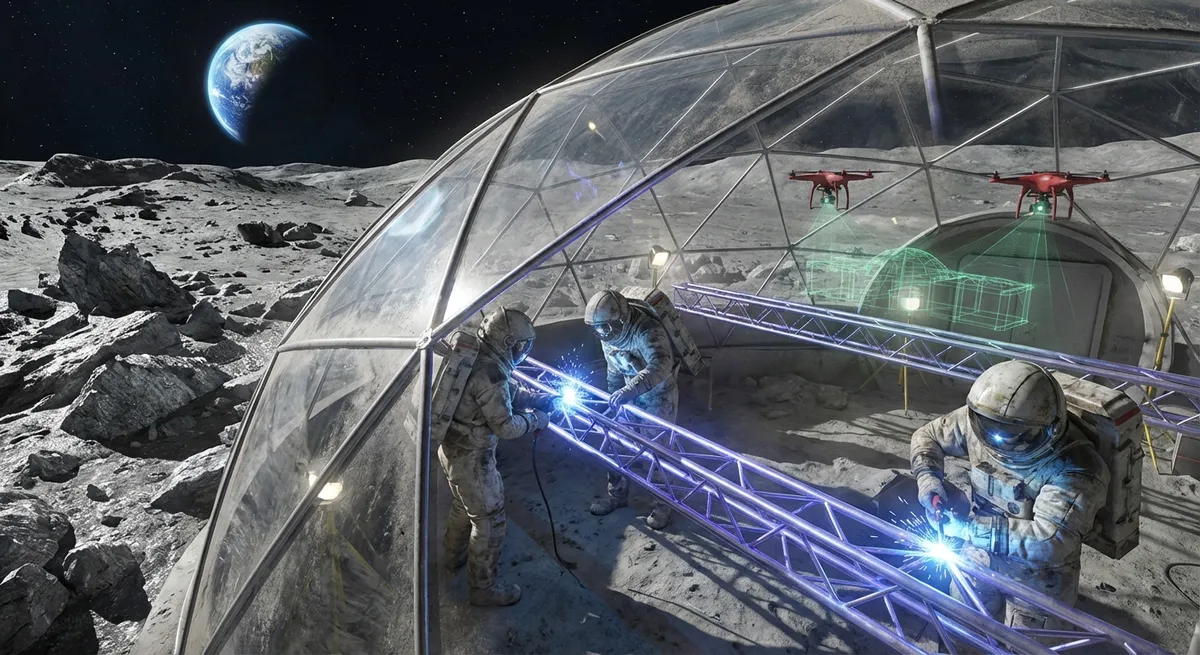
One approach: bake regolith with concentrated sunlight, essentially using a giant solar magnifying glass to melt the grains into tough ceramic tiles. Another: mix simulated lunar soil with a binding agent and 3D-print it layer by layer into walls, arches, and even landing pads.
Engineers have already tested robotic “construction arms” that could print shelter segments while humans are still on Earth. Imagine arriving at the Moon and finding your base already standing, robot‑built from local rock.
Amazing Fact #1: ESA‑funded experiments have demonstrated that simulated lunar soil can be 3D‑printed into blocks strong enough to function as building elements—no water required, just binding agents and heat.
Factories in Orbit: Manufacturing Things Earth Can’t
Orbit is more than an empty backdrop—it’s a unique industrial environment. Weightlessness, near‑perfect vacuum, and extreme temperature swings sound hostile, but for certain processes, they’re priceless.
In microgravity, hot and cold fluids don’t separate like they do on Earth, crystals can grow more uniformly, and materials don’t sag under their own weight. This means we can sometimes make better stuff in orbit than we ever could in a terrestrial factory.
On the International Space Station (ISS), scientists have grown high‑purity protein crystals to help design new drugs, tested advanced metal alloys, and produced ultra‑clear optical fibers from a glassy material called ZBLAN. On Earth, gravity causes imperfections; in orbit, those defects can almost vanish.
The future vision: self‑contained “space factories” that take raw materials—perhaps harvested from asteroids or old satellites—and turn them into high‑value products, from specialized fibers and semiconductors to components for giant telescopes or solar farms.
Amazing Fact #2: Experiments on the ISS have shown that ZBLAN fiber made in microgravity can be significantly more transparent than its Earth‑made counterpart, potentially enabling faster and lower‑loss data transmission.
Giant Telescopes That Assemble Themselves
Consider our current space telescopes as “ships in a bottle.” Engineers design them to fold into a rocket, then unfurl like mechanical flowers once in orbit. That worked for the James Webb Space Telescope (JWST), but the process was hair‑raisingly complex; one stuck hinge could have doomed the mission.
The next generation of observatories may be too large to launch in one piece at all. Instead, we might send them up as kits of parts—mirrors, trusses, instruments—then let robots do the assembly in orbit.
NASA and commercial partners have already tested robotic arms that can dock with satellites and refuel them. The same skills—seeing, gripping, aligning, bolting—are exactly what we need to build larger structures. Picture a telescope with a mirror tens of meters across, assembled by machines that don’t care about zero‑g or darkness.
Once we master this, we’re not limited by rocket fairings anymore. We’re limited only by how clever our in‑space builders can be.
Amazing Fact #3: The planned Nancy Grace Roman Space Telescope will test advanced coronagraph technology that, when combined with future large, assembled‑in‑space mirrors, could directly image Earth‑like exoplanets around distant stars.
Space Habitats: Cities in Slow Motion
When you hear “space station,” you might picture the ISS—a long tube with solar wings and occasional cargo ships. But future habitats could look more like rotating wheels, sprawling modules, or even vast, slowly turning cylinders that create artificial gravity by spin.
Companies and space agencies are exploring inflatable modules—compact at launch, spacious once expanded. These balloon‑like habitats are made of layered, high‑strength materials and can offer a surprising amount of protection from micrometeoroids and radiation.
Over time, modular stations could grow like orbital cities: add a new lab here, a greenhouse there, a crew quarter elsewhere, all stitched together by docking ports and robotic cranes. Habitats in lunar orbit might act as staging hubs for landings. Martian orbit could host “waystations” for travelers and explorers.
Space will start to resemble a network of interconnected “towns,” each built not from poured concrete but from stitched fabric, metal ribs, printed panels, and perhaps, one day, asteroid‑mined metals.
Amazing Fact #4: The BEAM (Bigelow Expandable Activity Module), attached to the ISS since 2016, has demonstrated that inflatable space habitats can withstand micrometeoroid impacts and radiation while maintaining structural integrity over years.
Recycling the Cosmos: Space Junk as Raw Material
There’s a problem in orbit: debris.
Dead satellites, spent rocket stages, and shards from past collisions now zip around Earth at tens of thousands of kilometers per hour. Each fragment is a potential bullet. But to an engineer who wants to build in space, this junk also looks like something else: free metal, electronics, and structural parts.
Instead of just removing debris, future missions could harvest it. Robotic “tugs” might capture old satellites, slice off panels, melt down aluminum, and reuse it as feedstock for 3D printers. Copper wiring could be reprocessed; structural beams could be reforged.
Think of it as orbit‑level urban mining: turning a dangerous cloud of trash into a valuable supply chain for construction. Your future space telescope might literally be built from yesterday’s defunct communications satellite.
Amazing Fact #5: ESA’s upcoming ClearSpace‑1 mission aims to capture and deorbit a defunct rocket upper stage, demonstrating the kind of close‑up, controlled capture that could eventually evolve into in‑space recycling and dismantling operations.
The Ethics of Building Beyond Earth
As our tools become more powerful, so do our responsibilities.
Mining an asteroid might feel harmless—no ecosystems, no forests—but altering its orbit without care could pose risks. Extracting resources on the Moon or Mars raises questions about ownership: Who gets to dig where? Who sets the rules? International space law is still catching up with our technology.
Biological contamination is another concern. If we carry terrestrial microbes to Mars, we could accidentally seed another world with Earth life—or confuse future scientists searching for native Martian organisms. Even in pure engineering projects, every drill, printer, or rover must be sterilized and planned with planetary protection in mind.
Building in space is not just a technical puzzle; it’s a moral one. We’re learning how to shape worlds. The challenge is to do it with care.
Conclusion
We often talk about “exploring space,” as if we were just hikers with better boots. But we are on the edge of something more ambitious: participating in space.
We are learning to bake Moon dust into bricks, coax perfect fibers out of weightlessness, assemble telescopes in the quiet dark of orbit, and grow habitats like slow‑motion cities around our planet. The cosmos is becoming our workshop, and every new tool extends what we can imagine.
Somewhere in the not‑too‑distant future, a child will look up at a bright point of light in the night sky, and their parent won’t say, “That’s a satellite we launched.” They’ll say, “That’s a place we built.”
Sources
- NASA – In-Space Manufacturing – Overview of 3D printing and manufacturing experiments aboard the ISS
- European Space Agency – 3D Printing a Moon Base – Details on using lunar regolith simulant and 3D printing techniques to create structures
- NASA – Bigelow Expandable Activity Module (BEAM) – Information on the inflatable BEAM habitat and its performance on the ISS
- ESA – ClearSpace-1 Mission – Description of ESA’s active debris removal mission and its implications for future in‑space servicing and recycling
- NASA – Space Manufacturing and Materials Processing – Research summary on using microgravity for advanced materials and manufacturing in space
Key Takeaway
The most important thing to remember from this article is that this information can change how you think about Space Tech.