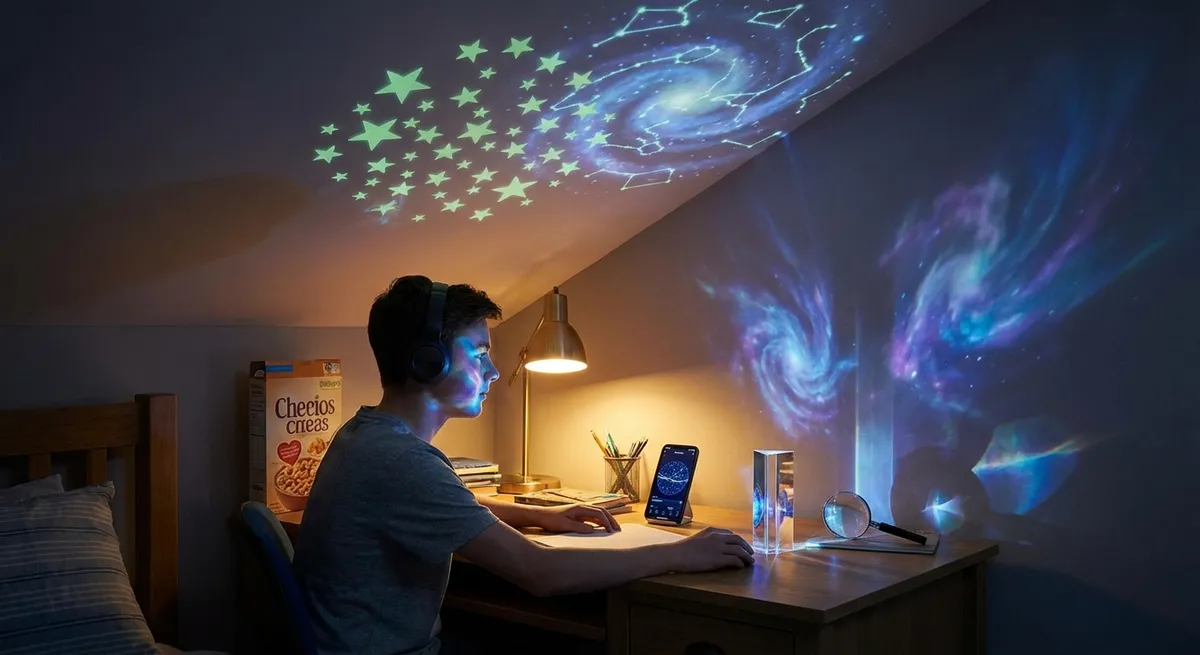
Look around your room. Nothing’s floating, the walls look solid, the clock ticks forward. It feels like a quiet, ordinary corner of Earth. Yet almost everything you experience—light, time, gravity, even the atoms in your body—is tangled up with phenomena that stretch across the universe. Astronomy isn’t just about distant galaxies and dramatic telescope photos; it’s quietly encoded into your phone, your GPS, your body, and even the way you see the color of the sky.
Let’s pull the cosmic thread running through everyday life and uncover five astonishing ways the universe is far less “out there” and far more “right here” than it seems.
Stardust in Your Blood: How Dying Stars Built Your Body
If you want to meet an ancient star, look in a mirror.
The iron in your blood, the calcium in your bones, the oxygen in your lungs—almost all the heavy elements that make you possible were forged in the cores of long‑dead stars. In their final stages, stars fuse lighter elements like hydrogen and helium into heavier ones, building up layers like an onion. When a massive star can no longer support its own weight, it collapses and explodes in a supernova, blasting those newly minted elements into space.
Over millions of years, these enriched clouds mix, cool, and collapse into new stars, planets, and eventually, chemistry complex enough to form life. Your body is a historical record of stellar violence: carbon from a star that may have exploded billions of years before the Sun formed, nitrogen that once drifted in a cold cloud between stars, and iron that was compressed to unimaginable densities before being thrown back into the galaxy.
Every time you breathe, you’re using oxygen atoms with a cosmic travel history older than the Earth itself. Astronomy isn’t just about looking up; it’s baked into your biology.
Time Isn’t the Same Everywhere: GPS and Einstein’s Sky
Your phone’s map app secretly performs a relativistic magic trick.
Global Positioning System (GPS) satellites orbit about 20,000 kilometers above Earth, carrying ultra-precise atomic clocks. To tell you where you are, your device measures how long radio signals from several satellites take to arrive. But here’s the twist: time actually passes at a different rate up there than it does down here.
Einstein’s theory of relativity predicts two important effects:
- Special relativity: Moving clocks tick slower. Satellites whizzing around Earth experience this.
- General relativity: Clocks in weaker gravity tick faster. Being farther from Earth’s mass, satellites feel weaker gravity than you do on the surface.
Together, these effects cause satellite clocks to run faster than clocks on Earth by about 38 microseconds per day. That sounds tiny, but if engineers didn’t correct for it, GPS positions would drift by kilometers each day. Your navigation system only works because we treat time as a flexible quantity shaped by motion and gravity, exactly as astronomers and physicists discovered by studying the universe.
Every time your map reroutes you, you’re using a pocket-sized application of cosmic physics.
You’re Glowing in Microwave Light: The Universe’s Afterglow on TV Screens
For much of the 20th century, the early universe was a mystery. Then astronomers discovered that space is filled with a faint glow of microwave radiation coming from every direction: the relic afterglow of the Big Bang.
This cosmic microwave background (CMB) is the cooled-down light released when the universe was only about 380,000 years old, long before any stars or galaxies formed. It’s a baby picture of the cosmos that maps tiny temperature variations—small ripples in density that would later grow into galaxies and clusters.
Here’s the eerie part: for decades, ordinary television sets could accidentally pick up a tiny fraction of this cosmic signal as static. When engineers first detected the CMB in the 1960s, they thought it was pigeon droppings in their antenna. It turned out to be evidence that the universe had a hot, dense beginning.
Today, precision measurements of the CMB give us some of the most accurate numbers in all of science: the age of the universe (about 13.8 billion years), its composition (mostly dark energy and dark matter), and how fast it’s expanding. The faint hiss that once blended into TV snow is actually the universe whispering its origin story.
Why the Sky Isn’t Violet: The Physics of Color Above Your Head
On paper, physics predicts that Earth’s daytime sky should be brighter at shorter wavelengths, which would bias it toward violet rather than blue. So why do you see a blue dome, not a purple one?
The answer leads straight into astrophysics concepts used to interpret starlight.
Sunlight is made of many wavelengths, from red to violet. As light travels through Earth’s atmosphere, air molecules scatter shorter wavelengths more efficiently than longer ones—a process called Rayleigh scattering. This boosts the blue and violet part of the spectrum. But:
- The Sun emits slightly less violet than blue.
- Our eyes are less sensitive to violet than to blue.
- Some violet light is absorbed higher in the atmosphere.
The net result: our brains register the scattered light overhead as blue.
Astronomers use the same physics on a much grander scale. By examining how starlight is absorbed and scattered by interstellar gas and dust, they can infer the composition and structure of distant clouds and galaxies. The simple beauty of a blue sky is a local example of the same light‑matter interactions astronomers decode in nebulae and exoplanet atmospheres.
You don’t need a telescope to see scattering in action—just look up.
A Planetary Secret in Your Day Length: Earth’s Invisible Dance
You probably think a day is 24 hours because “that’s just how long it takes Earth to spin once.” That’s close—but not quite true, and the difference reveals a subtle astronomical dance.
There are actually two relevant measures:
- Sidereal day: How long Earth takes to rotate 360° relative to distant stars.
- Solar day: How long it takes for the Sun to return to the same point in the sky (noon to noon).
Earth orbits the Sun while it spins, so by the time it has rotated once relative to the stars, it has also moved a little along its orbit. That means Earth has to rotate a bit more for the Sun to appear in the same position. The sidereal day is about 23 hours 56 minutes; the solar day is about 24 hours.
Astronomers use sidereal time to point telescopes at precise coordinates, because the stars return to the same positions slightly earlier each night. Your life, however, runs on solar time—how the Sun appears to move across the sky. That four-minute discrepancy accumulates through the year, giving us a shifting night sky and seasonal constellations.
Every clock you own is quietly negotiating between Earth’s rotation, its orbit, and our decision to define “day” by the Sun instead of the stars.
Conclusion
Astronomy isn’t confined to observatories and dramatic space missions. It pulses through your bloodstream, guides your car through city streets, flickers as background noise in old televisions, colors the sky you grew up under, and ticks away in the definition of a “day.”
We live on a small planet in a vast universe, but that doesn’t mean the cosmos is distant. The universe is woven into the most ordinary parts of your life—your technology, your body, your sense of time and color. To study astronomy is to realize that “space” isn’t somewhere else; it’s the context for everything you are and everything you use.
Next time you check your GPS, watch a sunset, or feel your pulse, remember: you’re not just in the universe—the universe is in you.
Sources
- [NASA – StarChild: The Universe’s First Stars](https://starchild.gsfc.nasa.gov/docs/StarChild/questions/question63.html) – Explains how elements are formed in stars and dispersed by supernovae
- [NASA – Relativity and GPS](https://www.nasa.gov/centers/goddard/information/relativity.html) – Overview of how Einstein’s relativity is essential for accurate satellite navigation
- [Planck Mission – Cosmic Microwave Background](https://www.esa.int/Science_Exploration/Space_Science/Planck) – European Space Agency page on measuring the CMB and what it reveals about the early universe
- [NASA – Why Is the Sky Blue?](https://spaceplace.nasa.gov/blue-sky/en/) – Accessible explanation of Rayleigh scattering and atmospheric effects on sunlight
- [U.S. Naval Observatory – Sidereal Time](https://aa.usno.navy.mil/faq/sidereal_time) – Technical but clear description of sidereal vs. solar day and how astronomers use them
Key Takeaway
The most important thing to remember from this article is that this information can change how you think about Astronomy.