Every so often, space science crosses a line that makes the universe feel fundamentally different than it did the day before. A new kind of planet is found, a never‑before‑seen cosmic explosion goes off, or a spacecraft flies through a place humans had only imagined on movie screens.
Here are five recent breakthroughs and discoveries that don’t just add trivia to your brain—they actually change how we picture reality, from planets made of “super-Earth stuff” to black holes acting like cosmic particle accelerators.
A Planet So Light It’s Almost a Cosmic Balloon
Astronomers recently confirmed a new class of “super‑puff” exoplanets—worlds so fluffy they’re closer to giant cotton balls than to rocky planets like Earth.
Super‑puffs have masses not much larger than Earth or Neptune, but diameters close to Jupiter’s, giving them densities lower than cotton candy. One standout is a planet in the Kepler‑51 system that’s about the size of Jupiter yet less than one percent of its mass. It’s essentially a massive hydrogen‑helium cloud barely held together by gravity.
What’s astonishing is how such planets manage to keep their atmospheres from being stripped away by their stars. Current models suggest they formed far from their stars as icy worlds, then migrated inward, swelling as their atmospheres heated and expanded. These planets challenge our theories of how planetary systems build themselves—especially because we don’t have anything even vaguely similar in our own solar system.
The Hubble Space Telescope and ground‑based observatories are now dissecting their atmospheres. Early results hint at hazes and clouds that could be blocking key chemical fingerprints, forcing scientists to rethink how they interpret exoplanet spectra. In other words, these “planetary balloons” aren’t just oddities—they’re forcing a rewrite of our exoplanet playbook.
A Black Hole That Spins Space Itself Like a Tornado
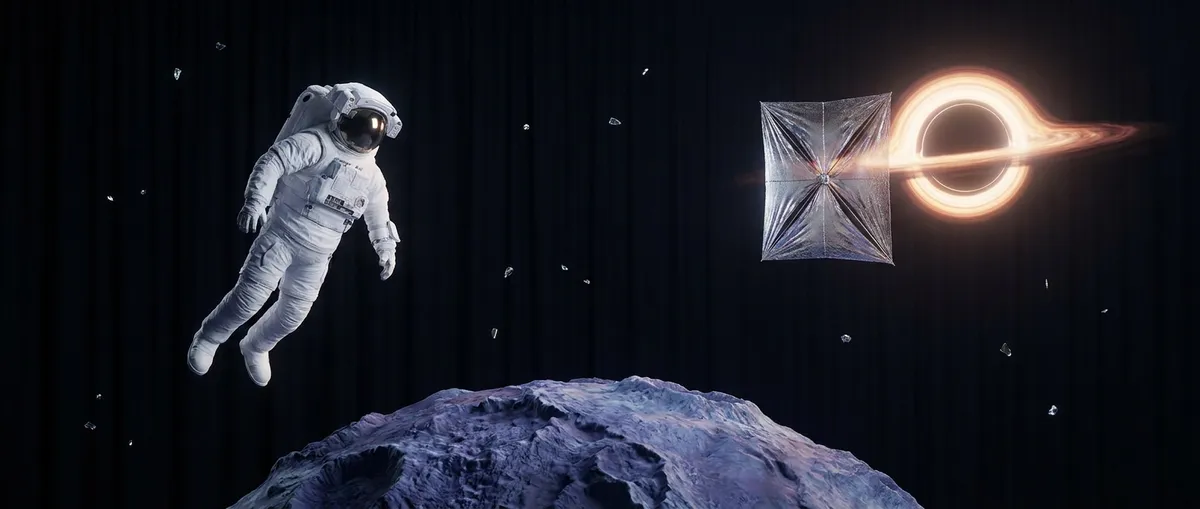
Black holes don’t just sit and swallow. Some of them spin so fast they drag spacetime around with them, a phenomenon predicted by Einstein known as “frame dragging.” Recently, astronomers obtained some of the clearest evidence yet of this effect near a stellar‑mass black hole.
Using NASA’s NICER instrument on the International Space Station, researchers studied X‑ray flashes from hot gas spiraling into a black hole. The timing of those flashes shows that the inner regions of the disk are wobbling—precessing—because spacetime itself is being twisted by the black hole’s rotation.
The result is like watching water swirl around a drain that is itself spinning so fast it drags the pool with it. This behavior lets scientists estimate how rapidly the black hole is rotating and how close the inner edge of the accretion disk lies to the point of no return.
Why it matters: these observations test general relativity in one of the most extreme laboratories nature offers. If the data ever deviate from Einstein’s predictions, it could hint at new physics. For now, relativity is holding strong, but the level of precision we’re reaching means black holes are becoming not just cosmic monsters—but precise tools for probing the fundamental structure of reality.
The Faint Fossil Glow of the First Stars
Hidden in the sky is a faint cosmic background of infrared light—an ancient glow thought to be partly from the very first stars and galaxies that ever formed. That glow has been notoriously hard to untangle from nearer, brighter sources like dust and modern galaxies. Recently, though, missions such as NASA’s New Horizons (far from Earth’s bright sky glow) and new analyses of space‑telescope data have sharpened our picture of this “cosmic fossil light.”
When scientists subtract all the known sources—foreground stars, galaxies, and dust—they’re left with an excess of diffuse infrared light. That excess may be the signature of the universe’s “Cosmic Dawn,” when the first generations of stars burned hydrogen for the first time and flooded space with ultraviolet radiation.
This matters because we can’t directly see most of these first stars individually; they’re too faint and too far away. But their collective light, smeared across the sky, encodes information about how quickly matter clumped into the first galaxies and how those early systems ionized the primordial hydrogen fog around them.
The James Webb Space Telescope (JWST) is now beginning to resolve some of these ultra‑distant galaxies, finding surprisingly massive systems less than a billion years after the Big Bang. That suggests galaxy formation got off to a faster, more efficient start than many models predicted. The faint infrared background and JWST’s early galaxies are basically two sides of the same story—the universe’s first attempt at turning darkness into structure.
A Hidden Ocean World Reveals Itself in the Outer Solar System
For decades, scientists suspected that beneath the icy crusts of some outer moons, entire global oceans might exist—dark, salty seas warmed from within by tidal flexing and radioactive decay. Recent data from NASA’s Juno mission, orbiting Jupiter, have strengthened the case that Ganymede, the largest moon in the solar system, doesn’t just have an ocean—it may have a whole layered “ocean sandwich” beneath its surface.
Magnetic field measurements and gravity data, combined with modeling of how ice behaves at extreme pressures, suggest Ganymede likely hosts multiple stacked layers of ice and liquid water, some possibly enriched with salts and minerals. That means water could be in contact with a rocky seafloor—exactly the kind of interface where life‑friendly chemistry can flourish, as we see at Earth’s deep‑sea hydrothermal vents.
Ganymede isn’t alone. Europa and Callisto (also around Jupiter), as well as Saturn’s Enceladus and Titan, all show growing evidence of underground oceans. Plumes from Enceladus contain organics and complex chemistry; Titan has methane lakes on the surface and possibly a subsurface water ocean.
Why this is huge: the “habitable real estate” in our solar system suddenly expands from one planet (Earth) to a whole archipelago of hidden ocean worlds. Instead of only looking at Earth‑like planets in the “habitable zone,” astrobiologists now consider any place with long‑lived liquid water, energy, and basic chemistry a potential cradle for life—even if it’s buried under kilometers of ice in perpetual darkness.
A New Map of Dark Matter’s Invisible Skeleton
Everything we see in the universe—stars, gas, planets, nebulae—is just the luminous “paint” on top of a much larger invisible structure made of dark matter. Recently, astronomers created some of the most detailed maps yet of this dark matter skeleton, using a technique called weak gravitational lensing.
As light from distant galaxies travels to us, its path is subtly distorted by the gravity of dark matter along the way. By carefully measuring the shapes of millions of galaxies, surveys like the Dark Energy Survey (DES) and the Hyper Suprime‑Cam Subaru Strategic Program can reconstruct where dark matter is hiding.
The latest results show a web‑like structure stretching across hundreds of millions of light‑years—vast filaments connecting giant clusters, with huge cosmic voids in between. Intriguingly, some measurements suggest the universe’s matter might be slightly less clumpy than the simplest models predict, potentially hinting at new wrinkles in our understanding of dark energy or gravity.
These maps are like X‑rays of the cosmos: they reveal the underlying bones that determine how galaxies form and cluster. As more data come in from upcoming missions such as the European Space Agency’s Euclid and NASA’s Nancy Grace Roman Space Telescope, we’ll be able to test whether our standard model of cosmology truly holds—or whether the dark components of the universe are stranger than we thought.
Conclusion
From planets lighter than foam to moons hiding whole oceans and black holes twisting spacetime, the universe keeps revealing that its “normal” is far more extreme than our imagination’s default settings. These discoveries aren’t isolated headlines; together, they’re stitching a new story about how structure emerges, how worlds form, and where life might take root.
We’re living in a moment when telescopes can watch the afterglow of the first stars, spacecraft can taste the chemistry of alien oceans, and cosmic maps can chart matter we can’t even see. The universe has always been this weird; we’re just finally building the tools sharp enough to notice.
Sources
- NASA – Kepler and the Discovery of Low-Density “Super-Puff” Exoplanets – Overview of unusually low‑density exoplanets and how Hubble observations challenge formation models
- NASA – NICER Reveals X-ray Light Echoes Near a Black Hole – Explanation of how X‑ray timing is used to study spinning black holes and test general relativity
- NASA – First Stars and Cosmic Dawn – Background on the era of the first stars and how astronomers probe it using faint background light and JWST
- NASA – Ocean Worlds in Our Solar System – Summary of evidence for subsurface oceans on moons like Europa, Ganymede, Enceladus, and Titan, and their astrobiological significance
- Dark Energy Survey – Mapping Dark Matter with Weak Lensing – Description of how galaxy shape distortions are used to map dark matter and test cosmological models
Key Takeaway
The most important thing to remember from this article is that this information can change how you think about Space News.