The quiet moons of our Solar System are having a moment. While social media scrolls past rockets and Mars memes, a subtler revolution is unfolding: space agencies are zeroing in on dark, icy worlds that might actually be better places to hunt for life than Mars itself. With NASA’s Europa Clipper preparing for launch, SpaceX’s Falcon Heavy lined up as the delivery vehicle, and new data pouring in from missions like Juno and JWST, we’re living through a golden age of “moon science.”
These aren’t just pretty dots in the sky. Many of these moons may hide global oceans, active geology, and chemical energy—exactly the ingredients astrobiologists dream about. Below are five astonishing, right now facts and discoveries that explain why the biggest story in astronomy might be happening around giant planets, not just on them.
Europa: NASA Is About to Visit an Ocean World Without Drilling a Single Hole
Jupiter’s moon Europa looks like a cracked billiard ball coated in ice, but underneath that frozen shell, NASA scientists are almost certain there’s a global saltwater ocean—possibly containing more water than all of Earth’s oceans combined. That’s why NASA’s Europa Clipper mission, currently in final preparation for launch in late 2024/2025 on a SpaceX Falcon Heavy, is such a big deal. Instead of landing or drilling, Europa Clipper will perform nearly 50 close flybys, swooping just tens of kilometers above the surface while using radar, magnetometers, spectrometers, and cameras to “X-ray” the moon from orbit.
Why now? Recent measurements from the Juno spacecraft at Jupiter, combined with Hubble observations of possible water plumes, have strengthened the case that Europa’s ice crust might be thin enough in places for ocean material to reach space. If those plumes are real and active when Clipper arrives, the spacecraft could literally fly through the spray of an alien ocean and analyze its chemistry without ever touching down. Scientists will look for organics, salts, and energy gradients—precisely the stuff needed for life. In other words, NASA may soon taste an extraterrestrial sea using a robotic “drive-by” rather than a drill.
JWST Just Turned Pitiful Dots Into Atmospheric Worlds
For years, exoplanets—planets orbiting other stars—were mostly known through numbers on graphs and tiny dips in starlight. That changed in a big way with the James Webb Space Telescope (JWST). Since becoming fully operational, JWST has started transforming those dots into physical places with temperature profiles, cloud patterns, and even chemical fingerprints. Using its ultra-sensitive infrared instruments, JWST can watch starlight filter through a planet’s atmosphere during a transit and decode what gases are present.
In the past few months alone, JWST results have hinted at water vapor, carbon dioxide, methane, and even possible disequilibrium chemistry on several worlds, including hot Jupiters and mini-Neptunes. One especially fascinating trend: some planets that were expected to be simple “gas balls” are showing signs of complex weather systems, hazes, and unexpected molecular ratios. While there’s no confirmed biosignature yet, JWST is teaching astronomers what “normal” alien atmospheres look like—crucial for recognizing something truly weird when we finally see it. For the first time, we’re not just counting exoplanets. We’re characterizing them.
Saturn’s Moon Enceladus Is Spraying Clues About Life Into Space
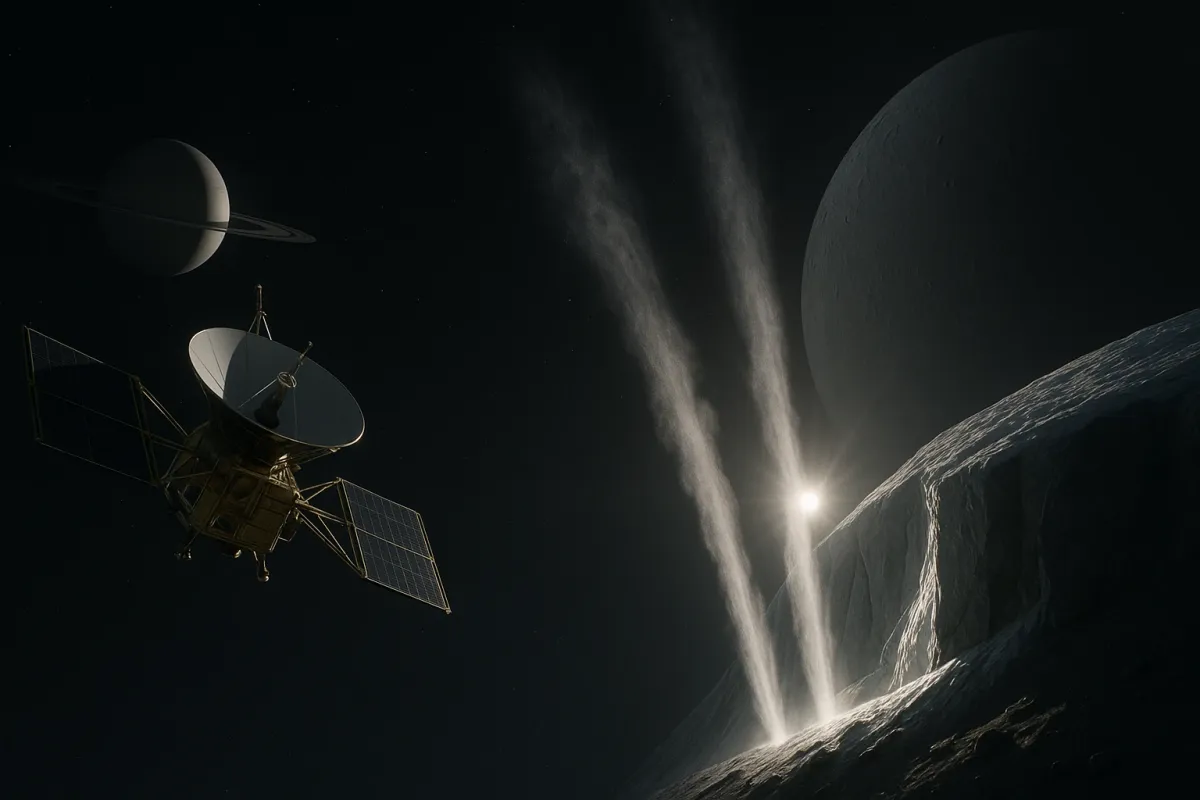
If Europa is the mysterious ocean world, Enceladus, a small moon of Saturn, is the overachiever that won’t stop showing off. The Cassini spacecraft, which orbited Saturn until 2017, discovered towering geysers blasting from Enceladus’s south pole, ejecting ice and vapor hundreds of kilometers into space. More recent reanalysis of Cassini’s data, published over the last couple of years and still driving active debate today, suggests that those plumes contain not just water and simple organics, but also phosphorus-bearing compounds—a key ingredient for DNA, cell membranes, and energy-carrying molecules like ATP in terrestrial life.
This is wild for two reasons. First, it implies that Enceladus’s hidden ocean is in intimate contact with a rocky core, where water-rock reactions can provide energy and nutrients. Second, Cassini literally flew through this material and “sniffed” it with its instruments, demonstrating a model for future missions. The discovery has made Enceladus a frontrunner for upcoming life-hunting missions currently under study by NASA and ESA. In the meantime, astronomers continue to use Earth-based telescopes and theoretical models to refine what Cassini found—turning an icy dot in Saturn’s rings into one of the most promising habitats beyond Earth, right now.
Black Holes Are Getting “Weather Reports” Thanks to New Observations
Black holes used to be portrayed as featureless cosmic drains. Today, they’re starting to look more like extreme meteorological systems. With data from the Event Horizon Telescope (EHT), X-ray missions like NASA’s Chandra and ESA’s XMM-Newton, and radio observatories across the world, astronomers are now tracking flickers, flares, and magnetic storms in the plasma swirling around these monsters. Recent EHT work on Sagittarius A\ (the black hole at the center of the Milky Way) has revealed patterns in polarization—basically the orientation of light waves—that map magnetic fields near the event horizon.
These measurements, combined with computer simulations running on some of the world’s biggest supercomputers, suggest that black holes can flip between different accretion “modes,” like changing weather patterns. Sometimes they gulp matter violently, launching powerful jets; other times they sip more quietly, glowing softly in radio and X-rays. Ongoing observations this year are focused on catching Sgr A\ and its cousins in the act of switching states. The result is a new kind of astrophysics where we no longer treat black holes as static, but as dynamic, evolving systems whose “climate” can be monitored over hours, days, and months—live, from 26,000 light-years away.
“Dark” Galaxies and Hidden Structure: We’re Finding What We Couldn’t See Before
For decades, cosmologists have insisted most of the universe is made of dark matter and dark energy, even though no one has directly detected either. What’s changing now is our ability to see the gravitational fingerprints of this invisible scaffolding in exquisite detail. With new wide-field sky surveys like the Dark Energy Survey, Euclid (ESA’s dark universe mission launched in 2023), and improved data from Gaia and Vera C. Rubin Observatory (currently ramping up testing), astronomers are mapping how galaxies and galaxy clusters are distributed through space with unprecedented precision.
Early Euclid results and recent gravitational lensing studies have begun to highlight “dark” or low-luminosity galaxies—objects rich in dark matter but poor in starlight—that were effectively invisible to past surveys. These ghostly structures bend and distort background light, betraying their presence. At the same time, simulations are being tuned to match these new maps, testing whether our standard model of cosmology still holds up on the smallest and largest scales. We’re essentially watching the cosmic web come into focus in near-real time, and with every new data release, the universe looks less like a random scattering of islands and more like a finely woven, gravity-shaped tapestry.
Conclusion
Space exploration in 2025 isn’t just about planting flags or posting rocket launch clips. It’s about peeling back layers of invisibility: oceans beneath ice, atmospheres around distant worlds, chemistry inside geysers, magnetized storms around black holes, and dark skeletons holding galaxies together. Missions like Europa Clipper, telescopes like JWST, and surveys like Euclid are turning our Solar System and the wider universe from a static star chart into a living, evolving story.
If you’ve ever stared up at the night sky and felt like you were looking at a flat backdrop, this is your moment. The curtain is lifting. The moons have oceans, the dots have air, the void has weather, and the darkness has structure. The cosmos isn’t just out there—it’s unfolding, right now, and we’re finally tuned in.
Key Takeaway
The most important thing to remember from this article is that following these steps can lead to great results.