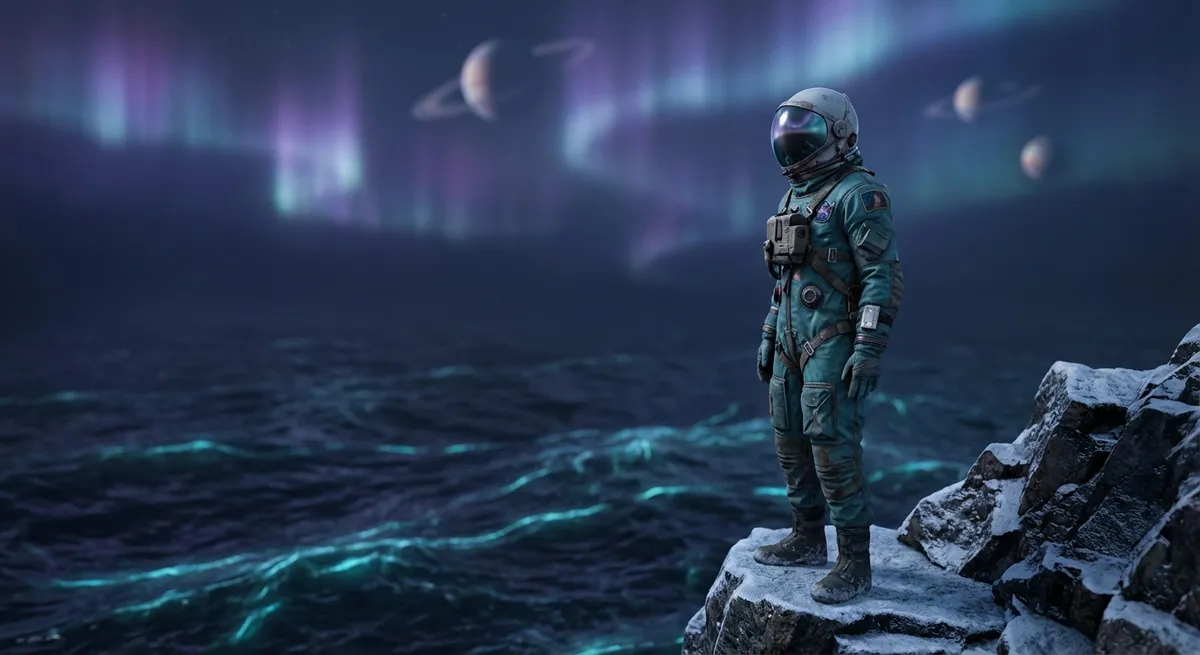
Beneath layers of ice, inside rings of gas giants, and in the dim glow of distant red stars, something remarkable is happening: oceans are turning up everywhere. Not calm, Earth-like seas, but boiling, churning, chemically active worlds that stretch for thousands of kilometers underground. Recent space missions and telescope observations are rewriting a quiet assumption humanity carried for centuries—that Earth’s oceans are special. Space agencies are now seriously considering that our planet may be just one of many water worlds in the galaxy, and that life might actually favor these hidden seas.
In today’s wave of space news, scientists are uncovering oceans in places we once thought were frozen, dead, or utterly hostile. Here are five of the most astonishing discoveries reshaping how we think about where life could exist—and what kinds of worlds we should be looking at next.
1. Enceladus: The Tiny Moon That Sprays an Ocean into Space
Enceladus, a small icy moon of Saturn, should have been a geologic nobody. It’s only about 500 kilometers across—smaller than many countries on Earth. But when NASA’s Cassini spacecraft flew past it, the instruments witnessed something nobody expected: enormous geysers blasting water-rich plumes hundreds of kilometers above the surface, like a cosmic fountain venting a hidden sea.
Those plumes gave scientists a rare gift: a direct sample of an alien ocean, no drilling required. Cassini flew through them and detected water vapor, ice grains, organic molecules, and salts—ingredients you would expect from an ocean in contact with rock, like Earth’s deep seafloor. Even more astonishing, later analyses detected hydrogen gas in the plumes, a strong hint of hydrothermal vents on the seafloor of Enceladus’s global ocean. On Earth, such vents are home to dense ecosystems of microbes and strange animals that don’t need sunlight, only chemistry. That’s why Enceladus went from obscure iceball to one of the most compelling places in the solar system to look for life.
2. Europa’s Restless Ice Shell May Be Hiding an Earth-Sized Ocean
Jupiter’s moon Europa has long been suspected to hold an ocean beneath its bright, scarred surface, but recent measurements have turned that suspicion into a near certainty. Observations from the Hubble Space Telescope and previous spacecraft show hints of water vapor plumes, while the chaotic, cracked ice patterns on its surface are best explained by a warm, mobile ocean layer beneath a relatively thin shell of ice.
What makes Europa especially intriguing is the sheer scale of that ocean. Estimates suggest it could contain more than twice as much water as all of Earth’s oceans combined, squeezed into a layer tens to perhaps over a hundred kilometers deep. Jupiter’s immense gravity flexes Europa as it orbits, generating internal heat that keeps the ocean from freezing solid. This constant tidal kneading could power circulation, mixing nutrients and energy the way currents and tides do on Earth. NASA’s Europa Clipper mission, launching in the mid-2020s, is designed to map the ice shell, study the chemistry of the surface and possible plumes, and hunt for signs that Europa’s ocean might be not just wet, but habitable.
3. Earth-Sized “Water Worlds” May Be Common Around Other Stars
For a long time, the classic image of a habitable planet was a rocky world in the “Goldilocks zone,” where liquid water can exist on the surface—basically, other Earths orbiting Sun-like stars. But as exoplanet discoveries have piled up, a new picture is emerging. Many of the worlds we’re finding around other stars, especially the so-called “sub-Neptunes” and “mini-Neptunes,” may be rich in water—not just with oceans on the surface, but potentially with deep layers of high-pressure water and ice phases unlike anything we have on Earth.
Analyses from NASA’s TESS and ESA’s CHEOPS missions, combined with data from the Hubble and James Webb Space Telescopes, suggest that some exoplanets have densities too low to be purely rock and too high to be just gas. One compelling explanation: these are water-rich worlds with global oceans hundreds or even thousands of kilometers deep, capped by atmospheres of steam and hydrogen. While we don’t yet know how friendly such extreme oceans would be to life as we know it, they broaden the playing field dramatically. Instead of searching only for Earth clones, astronomers are now modeling how life might arise on planets with no continents, no shallow seas—just endless, alien blue.
4. TRAPPIST-1’s Compact System Hints at Ocean Planets in a Rhythmic Dance
The TRAPPIST-1 system, located about 40 light-years away, has captured astronomers’ imaginations since seven Earth-sized planets were discovered tightly packed around a cool red dwarf star. Several of these worlds orbit in or near the star’s habitable zone, where temperatures could allow liquid water on their surfaces—if the right atmospheres and conditions exist. Recent analyses using the James Webb Space Telescope and precision measurements of their orbits suggest that some of these planets may be low-density enough to contain significant water or volatile-rich layers.
What’s striking about TRAPPIST-1 is how dynamically tuned it is. The planets are in a kind of orbital resonance, tugging regularly on each other’s paths in a cosmic metronome. Those gravitational interactions could generate internal heating, much like Jupiter’s moons experience, potentially maintaining subsurface oceans or preventing the planets from freezing entirely, even if their stars are faint. While we still don’t know precisely how wet any individual TRAPPIST-1 planet is, the system has become a template for studying rocky worlds orbiting small, cool stars—which are the most common stars in the Milky Way. If ocean-bearing planets are going to be common anywhere, they’re statistically most likely to be found in systems like this.
5. Hidden Oceans on Dwarf Planets: Ceres and Beyond
Not so long ago, dwarf planets were considered leftovers—small, inactive chunks of rock and ice quietly orbiting in the asteroid belt or the Kuiper Belt. But missions like NASA’s Dawn spacecraft to Ceres have upended that view. Dawn’s observations found evidence that Ceres, the largest object in the asteroid belt, once hosted a global subsurface ocean, and may still have patches of briny liquid today. Bright salt deposits on its surface, likely left behind as liquid water reached the surface and evaporated, are fingerprints of a world that has been chemically active for billions of years.
This idea doesn’t end with Ceres. Other icy dwarf planets—like Pluto and possibly Eris—show surface geology hinting at past or present internal oceans as well. Cracked terrains, smooth plains, and signs of recent resurfacing point to heat and movement under the ice. The more we look, the more it appears that oceans can survive in small bodies, insulated by thick ice and warmed by radioactive decay and past tidal interactions. That means the potential for habitable environments is not limited to big planets or moons. The solar system might be dotted with “ocean embers”—small worlds quietly carrying liquid water in the dark.
Conclusion
A generation ago, Earth’s oceans felt like a cosmic exception—a lucky accident on a small blue world orbiting a middle-aged star. Now, as spacecraft probe our neighboring moons and telescopes dissect the light of far-off planets, a different pattern is emerging: water is not rare, and oceans may be one of the universe’s favorite tricks.
From Enceladus’s skyward plumes to Europa’s vast hidden seas, from water-rich exoplanets to the surprising inner warmth of dwarf planets, the storyline of modern space news is converging on a radical idea: the galaxy could be teeming with habitats. Not all will be gentle or familiar, but many may offer the three fundamentals life seems to love—liquid water, energy, and time. As new missions launch and new data streams in, each discovery adds another echo to a growing chorus suggesting that Earth is not a solitary blue dot in a desert of rock, but one oasis among many in an ocean-rich universe.
Sources
- [NASA – Cassini Mission to Saturn: Enceladus](https://solarsystem.nasa.gov/moons/saturn-moons/enceladus/in-depth/) – Detailed overview of Enceladus, its plumes, and evidence for a subsurface ocean
- [NASA – Europa Clipper Mission](https://europa.nasa.gov/) – Mission information on planned investigations of Europa’s ocean, ice shell, and habitability
- [NASA Exoplanet Exploration – Water Worlds and Ocean Planets](https://exoplanets.nasa.gov/news/1710/water-worlds-the-ocean-planets-of-our-galaxy/) – Discussion of possible water-rich exoplanets and how scientists identify them
- [ESA – TRAPPIST-1 Planetary System](https://www.esa.int/Science_Exploration/Space_Science/Trappist-1) – Overview of the TRAPPIST-1 system and why it’s important for studying potentially habitable worlds
- [NASA – Dawn Mission to Ceres](https://dawn.jpl.nasa.gov/news/news-detail.html?id=6968) – Findings from Dawn suggesting past and possibly present briny liquids and ocean remnants on Ceres
Key Takeaway
The most important thing to remember from this article is that this information can change how you think about Space News.