Astronomy began with what human eyes could see—bright stars pinned against a velvet sky. But the modern universe is not just a picture; it’s a conversation. Space is constantly humming, crackling, and whispering in forms our eyes can’t detect: invisible light, ghostly particles, ripples in spacetime itself.
Today, astronomers are less like stargazers and more like cosmic linguists, decoding messages the universe sends without a single photon of visible light. Below are five astonishing ways we’ve learned to “listen” to the cosmos—each one a discovery that reshaped what we think space can do.
The Day We Heard Space Itself Stretch and Sigh
For most of history, space was silent. Then, in 2015, detectors in Louisiana and Washington registered something that had never been heard before: a tiny, rising “chirp” in spacetime. Two black holes, about 1.3 billion light-years away, had collided. Their catastrophic merger sent out gravitational waves—ripples in spacetime that LIGO (Laser Interferometer Gravitational-Wave Observatory) finally caught.
This signal was unimaginably subtle: LIGO detected a distortion thousands of times smaller than the width of a proton. Yet from that faint ripple, scientists could reconstruct the entire event—the masses of the black holes, how they spiraled together, even their final, fused black hole.
That detection confirmed a key prediction of Einstein’s general relativity, made a century earlier, and it launched a new era: gravitational-wave astronomy. We no longer just see the universe; we feel its movements. Since then, we’ve detected multiple black hole mergers, neutron star collisions, and are now planning next-generation observatories in space (like ESA’s LISA mission) to listen to even fainter echoes from the deep cosmos.
Invisible Beacons: Galaxies That Glow Without Any Light Our Eyes Can See
The night sky looks pretty full. But if you could see in radio waves, X-rays, or gamma rays, it would explode into an entirely different landscape. Some of the brightest objects in the universe barely register in visible light.
Take quasars—supermassive black holes at the centers of distant galaxies, devouring matter and blasting radiation from their surroundings. Many of them are so far away that to ordinary eyes, they’re dim points or completely invisible. Yet in radio or X-ray wavelengths, they burn like cosmic lighthouses, outshining entire galaxies.
Then there are “dark galaxies,” stuffed with dark matter and gas but forming very few stars. They hardly glow in visible light at all. Only through clever use of radio telescopes—tracing cold hydrogen gas—or by measuring subtle gravitational effects do astronomers uncover them.
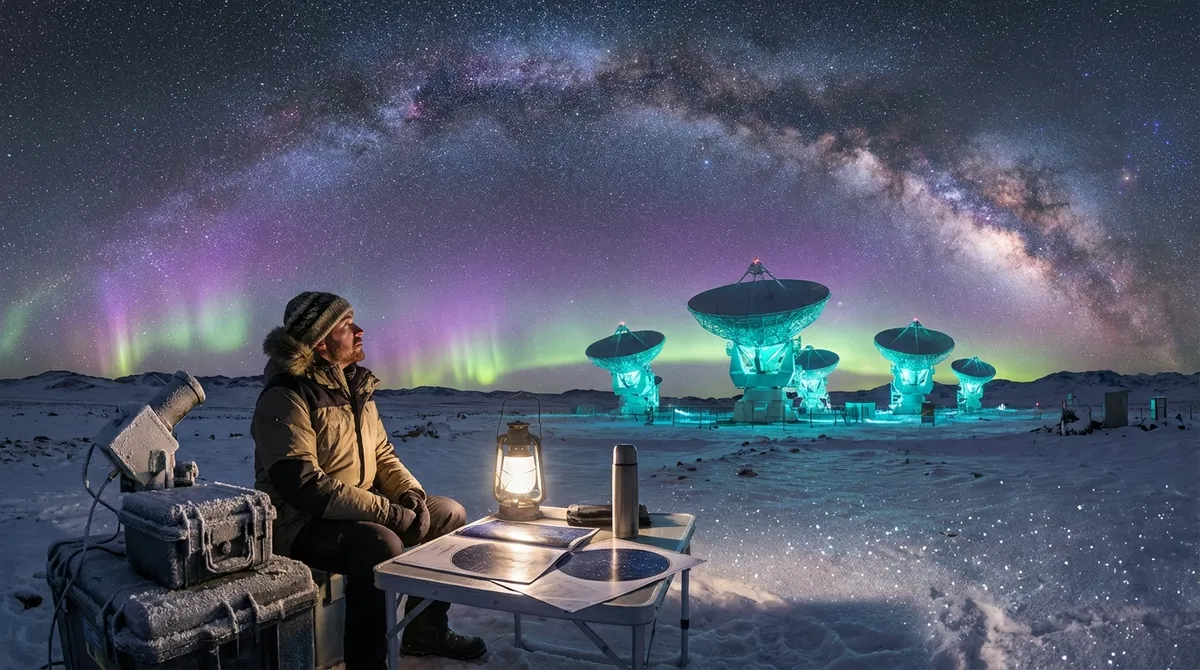
Modern observatories like the James Webb Space Telescope, Chandra X-ray Observatory, and ALMA (Atacama Large Millimeter/submillimeter Array) are revealing a universe where the “bright” and “dark” are flipped: the most important structures often live in wavelengths human vision never evolved to see. The visible night sky is just the surface gloss of a much richer, hidden cosmos.
Ghost Particles That Fly Through Planets Like They’re Not There
Every second, trillions of neutrinos stream through your body like a cosmic wind—and you feel nothing. These “ghost particles” are incredibly light, electrically neutral, and barely interact with matter. A block of lead a light-year thick would still let many of them slip through unscathed.
So why do astronomers care? Because neutrinos come from some of the universe’s most extreme events: nuclear reactions in stars, radioactive decay in supernovae, and violent processes around black holes. They are messengers that can escape from dense, opaque regions where light gets trapped.
In 1987, a star exploded in a nearby galaxy—the famous supernova SN 1987A. Before telescopes saw it brighten, a handful of neutrino detectors buried deep underground quietly recorded a sudden burst of neutrinos. That flash of ghost particles gave scientists a rare, direct probe of the star’s collapsing core and confirmed key theories about how massive stars die.
Today, giant instruments like IceCube in Antarctica turn entire cubic kilometers of ice into neutrino observatories, waiting for the rare interactions that produce a faint flash of light. When we detect those flashes, we’re reading a message that has passed through entire stars, galaxies, and planets without being stopped—a whisper from regions light can’t escape.
The Cosmic Microwave Background: Afterglow of a 13.8-Billion-Year-Old Explosion
If you could tune your senses to microwaves, the entire sky would glow with a faint, almost uniform haze. This is the cosmic microwave background (CMB), the leftover radiation from the Big Bang, now cooled to just 2.7 degrees above absolute zero.
Discovered accidentally in 1965 by Arno Penzias and Robert Wilson, the CMB is literally the oldest light we can see—released when the universe was only about 380,000 years old. Back then, the cosmos was a hot, opaque fog of particles. As it expanded and cooled, it became transparent, and light was finally free to travel. That light, stretched by billions of years of expansion, is what we detect today as microwaves.
Satellite missions like COBE, WMAP, and Planck have mapped this afterglow in exquisite detail. It’s not perfectly smooth; it has tiny temperature variations, like a cosmic fingerprint. Those minuscule fluctuations encode information about the early universe’s contents, curvature, and future. From them, we’ve learned that normal matter is only a small fraction of what exists, dark matter dominates gravity on galactic scales, and dark energy is accelerating cosmic expansion.
The CMB is the universe’s baby photo—and the most precise clue we have to its origin story.
Fast Radio Bursts: Millisecond Mysteries from the Deep Sky
Imagine a radio signal so powerful that, for a few thousandths of a second, it outshines entire galaxies in radio waves—then vanishes. That’s a fast radio burst (FRB), one of the universe’s strangest and most exciting puzzles.
The first FRB was discovered in 2007 in old telescope data. Since then, astronomers have found hundreds more: some occur once and never repeat; others flash again and again with odd rhythms. We’ve traced a few back to distant galaxies, often in regions of intense star formation.
What makes them? Leading suspects include magnetars—neutron stars with magnetic fields a thousand trillion times stronger than Earth’s—snapping and rearranging their fields in colossal bursts. But the full story remains unsettled, and each new detection adds another piece to the puzzle.
FRBs are more than just curiosities. Because their signals travel through the thin gas between galaxies, they pick up a kind of “dispersion signature” that tells us how much matter they’ve traversed. That means FRBs might help solve another cosmic mystery: where much of the ordinary matter in the universe is hiding, dispersed so thinly in intergalactic space that it’s nearly impossible to detect by other means.
Conclusion
The universe is not a silent, frozen backdrop—it’s an active, multi-channel broadcast. Gravitational waves murmur from colliding black holes. Neutrinos slip through the densest stellar cores. Microwave afterglow tells us how everything began. Invisible wavelengths reveal galaxies that normal eyes miss. And brief, brilliant radio flashes hint at exotic stellar engines we’re only starting to understand.
Astronomy has become the art of listening in every way we can: with detectors buried in ice, telescopes tuned to invisible colors, and instruments sensitive enough to feel spacetime ripple. As we add more “senses” to our cosmic toolkit, the universe grows stranger, richer, and more interconnected than we ever imagined.
Somewhere out there, another wave, flash, or ghostly particle is already on its way—carrying a new story about how the cosmos works. Our job is simple and endlessly profound: learn how to hear it.
Sources
- LIGO Scientific Collaboration – Gravitational Wave Discoveries – Overview of the first direct detection of gravitational waves and its implications
- NASA – Cosmic Microwave Background – Explanation of the CMB and how tiny fluctuations reveal the early universe’s properties
- IceCube Neutrino Observatory – Science Overview – How IceCube detects neutrinos and what they tell us about cosmic accelerators
- NASA Chandra X-ray Observatory – Quasars – Description of quasars and how X-ray observations uncover their extreme nature
- CSIRO – Fast Radio Bursts – Background on FRBs, leading theories, and recent discoveries
Key Takeaway
The most important thing to remember from this article is that this information can change how you think about Astronomy.