Space looks silent. Black. Empty. But that’s an illusion born of human eyes.
Our telescopes began with glass and visible light, so we grew up thinking the universe is mostly what we can see. It isn’t. The cosmos is constantly humming, rippling, flashing, and whispering in forms our bodies were never built to detect: radio waves, X‑rays, gravitational waves, neutrinos, and more.
This “invisible conversation” between stars, black holes, and galaxies is where modern astronomy now lives. And some of the strangest, most mind‑bending discoveries of the last few decades have come from listening beyond light.
Let’s step into that hidden conversation—and along the way, uncover five astonishing facts that completely reshape how we think about cosmic events.
The Universe Is Loud in Radio, Even Where It Looks Empty
When you look up at the night sky, most of it appears blank. But tuned to radio waves, the “empty” parts of space light up with structure and activity.
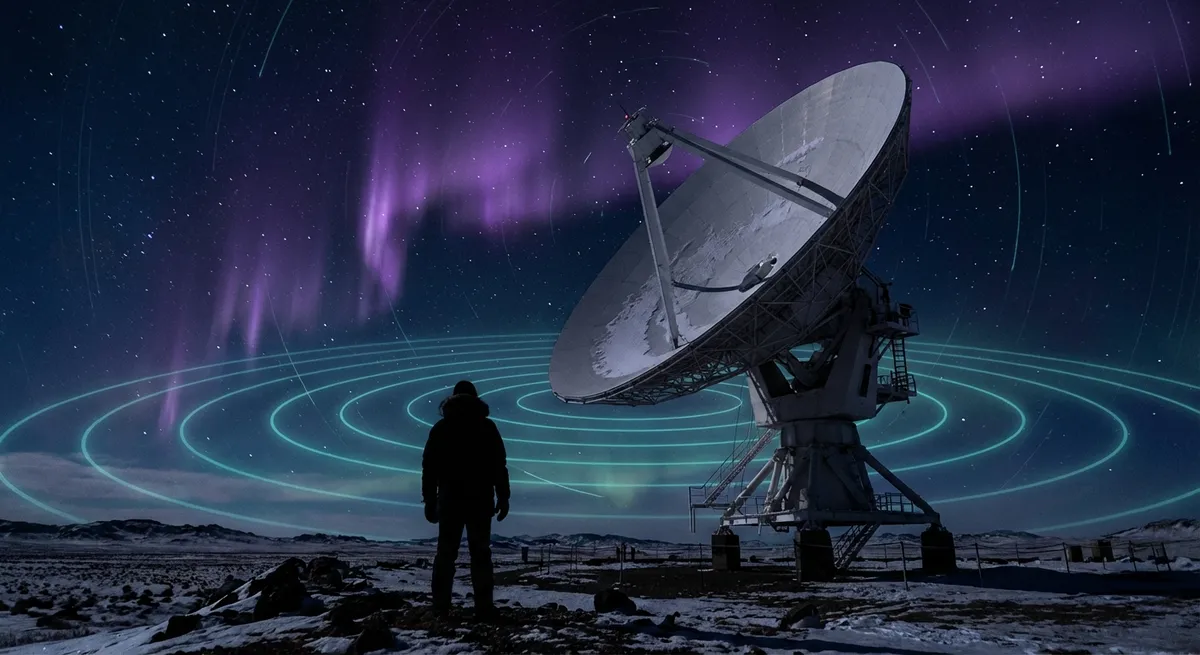
Radio telescopes—essentially giant, ultra-sensitive satellite dishes—pick up emissions from cold hydrogen gas, magnetic fields twisting around black holes, and the relic glow of the Big Bang itself. Where your eyes see darkness, a radio astronomer sees glowing filaments, bubbles, and jets.
One of the most dramatic examples is the Milky Way’s center. In visible light, it’s hidden behind thick clouds of dust. In radio, it becomes a stormy, tangled region of supernova remnants, star-forming clouds, and the influence of our central black hole, Sagittarius A*.
Amazing Fact #1: We have mapped the “skeleton” of our own galaxy using radio waves from neutral hydrogen, revealing that the Milky Way isn’t just a simple spiral—it’s warped, twisted, and threaded with huge, faint structures that are almost invisible in ordinary light.
These radio maps show giant arcs and bubbles extending tens of thousands of light‑years, evidence of past outbursts and feedback from stars and black holes. The calm band of the Milky Way you see from Earth is really the surface of a storm.
Gravitational Waves: The Universe’s Ripples in Spacetime
In 1916, Albert Einstein predicted something that sounded almost untestable: when massive objects accelerate—like two black holes orbiting each other—they send out ripples in spacetime itself, known as gravitational waves. For a century, it stayed a beautiful idea on paper.
That changed in 2015, when the LIGO observatory picked up a faint, rising "chirp" in its data. It was the signal from two black holes, each about 30 times the mass of the Sun, colliding over a billion light‑years away. In that brief moment, they released more energy in gravitational waves than all the stars in the observable universe emit in light.
Amazing Fact #2: The distortion those black holes caused on Earth was smaller than a proton’s width—yet we measured it.
Gravitational wave detectors work by sending lasers down long vacuum tunnels and watching for minuscule changes in distance. When a wave passes, it stretches space itself, and the laser interference pattern shifts. This is astronomy without light at all: we’re literally feeling the universe flex.
Since that first detection, we’ve “heard” dozens of collisions between black holes and neutron stars. Each is a catastrophic cosmic event, invisible to the human eye yet now unmistakable in the fabric of spacetime.
Neutrinos: Ghost Messengers from Cataclysmic Explosions
If light is the universe’s photograph, neutrinos are its urgent text messages. These nearly massless particles hardly interact with anything. Trillions of them are passing through your body every second, mostly from the Sun, and you feel nothing.
But when a truly violent cosmic event happens—a star collapsing in a supernova, matter being devoured by a black hole—neutrinos can be launched across the cosmos and straight through galaxies, planets, and you. Very occasionally, we catch one.
Detectors like IceCube at the South Pole use huge volumes of ice and sensitive light sensors buried deep under the surface. When a rare neutrino collides with an atom, it produces a tiny flash of light. By tracing that flash, scientists can determine where the neutrino came from.
Amazing Fact #3: In 2017, scientists traced a single high‑energy neutrino back to a distant galaxy hosting a supermassive black hole with a powerful jet—a “blazar.” This was the first solid evidence tying a specific neutrino to a known cosmic engine.
That one particle had traveled billions of years, almost completely undisturbed, to tell us: “There’s something incredibly energetic happening over there.” It’s like a cosmic notification from an event so extreme that even light doesn’t tell the full story.
Fast Radio Bursts: Millisecond Mysteries from the Deep Sky
Every so often, the universe blinks at us—hard. Fast radio bursts (FRBs) are ultra‑brief, incredibly powerful radio flashes that last milliseconds but can outshine entire galaxies in radio energy during that instant.
They were first discovered in 2007, and for years no one knew what caused them. Were they magnetars (hyper‑magnetized neutron stars)? Collapsing stars? Aliens? (Almost certainly not aliens—but the mystery was wild enough to entertain all kinds of ideas.)
We now know that some FRBs repeat, while others appear to be one‑time events. Several have been traced back to specific galaxies, including dwarf galaxies with intense star formation and environments that can create exotic, highly magnetized neutron stars.
Amazing Fact #4: One fast radio burst released more energy in a few milliseconds than our Sun emits in several days.
FRBs are opening a new way to probe the universe. As their radio waves travel across billions of light‑years, they pass through clouds of ionized gas and intergalactic plasma. The way those signals are distorted lets scientists measure the “cosmic web” of matter that’s otherwise almost impossible to map.
So FRBs are not just wild fireworks; they’re also tools. Each one is a fast, sharp flash that doubles as a probe of the invisible medium filling the universe.
The Afterglow of the Big Bang Is Everywhere Around You
Long before stars, galaxies, or black holes, the entire universe was a hot, dense plasma. When it finally cooled enough for atoms to form, light was freed to travel. That ancient glow is still here, filling all of space as the cosmic microwave background (CMB).
We can’t see it with our eyes, but microwave telescopes can. The CMB looks almost perfectly uniform—but not quite. It’s mottled with tiny temperature differences, like subtle ripples frozen into the universe when it was only about 380,000 years old.
Amazing Fact #5: Your TV “static” and radio noise include a small contribution from the cosmic microwave background—the literal afterglow of the Big Bang that has been traveling for 13.8 billion years.
Satellite missions like COBE, WMAP, and Planck have mapped the CMB with exquisite precision. Those faint fluctuations in temperature and density are the seeds from which all large‑scale structure—galaxies, clusters, cosmic filaments—would eventually grow under gravity.
The CMB is the oldest “image” we have of the universe, but it’s more than a picture: it’s a data‑rich snapshot that tells us the age, composition, and geometry of the cosmos. By decoding this fossil light, we’re reading the universe’s baby photos and its long‑term fate at the same time.
A New Era: Multi‑Messenger Astronomy
For most of human history, astronomy meant “looking up” with eyes or telescopes. Now, it’s becoming “listening,” “feeling,” and “catching” every kind of messenger the cosmos sends: light, gravitational waves, neutrinos, and cosmic rays.
This is called multi‑messenger astronomy, and it fundamentally changes how we study cosmic events. Instead of relying on one kind of signal, we combine them to build a fuller, more precise picture.
A landmark example came in 2017, when two neutron stars collided in a galaxy 130 million light‑years away. First, LIGO and Virgo detected the gravitational waves from their spiraling dance. Just seconds later, space telescopes picked up a burst of gamma rays. Over the next days and weeks, observatories all across the spectrum—X‑ray, optical, infrared, radio—watched the fading glow.
By blending all that data, scientists confirmed something long suspected: collisions of neutron stars forge heavy elements like gold and platinum. The jewelry you wear and the electronics in your devices quite literally trace back to catastrophic cosmic mergers.
In other words, we are not just stardust—we are also collision debris.
Conclusion
The universe is not a silent, dark void dotted with a few bright stars. It is a dynamic, multi‑layered orchestra of signals:
- Radio waves sketch out the hidden bones of galaxies.
- Gravitational waves let us feel black holes collide across billions of light‑years.
- Neutrinos carry direct messages from the hearts of cataclysms.
- Fast radio bursts flash like cosmic lighthouses, probing the matter between galaxies.
- The cosmic microwave background quietly bathes us in the relic glow of the Big Bang.
Every time we invent a new way to listen—beyond visible light—we uncover a fresh side of reality, often stranger and more intricate than we imagined.
We’re still at the beginning of this new era. More sensitive detectors, more coordinated sky surveys, and more inventive analysis techniques will almost certainly reveal cosmic events we haven’t even named yet.
If the visible sky already fills us with wonder, remember: it’s just the surface. The real conversation of the universe is happening in waves and particles all around you, all the time. We’ve only just started to tune in.
Sources
- [LIGO Scientific Collaboration – Gravitational Wave Discoveries](https://www.ligo.org/science/discoveries.php) – Official overview of gravitational‑wave detections and their astrophysical significance
- [NASA – Cosmic Microwave Background (CMB)](https://map.gsfc.nasa.gov/universe/bb_tests_cmb.html) – Educational material on the CMB, its discovery, and what it tells us about the early universe
- [IceCube Neutrino Observatory – Multimessenger Astronomy](https://icecube.wisc.edu/science/multimessenger/) – Explanation of how neutrinos are used to study extreme cosmic events and their sources
- [CHIME/FRB Project – Fast Radio Bursts](https://chime-experiment.ca/en) – Information on fast radio bursts and the CHIME telescope’s role in detecting and characterizing them
- [ESA Planck Mission – Planck Reveals an Almost Perfect Universe](https://www.esa.int/Science_Exploration/Space_Science/Planck/Planck_reveals_an_almost_perfect_Universe) – Summary of key results from the Planck satellite’s mapping of the cosmic microwave background
Key Takeaway
The most important thing to remember from this article is that this information can change how you think about Cosmic Events.