The universe is not a silent, empty abyss—it’s a vast conversation happening in waves, particles, ripples, and radiation, much of it completely invisible to human eyes. For most of history, astronomy was about seeing: looking through lenses, mapping the stars, tracking their motion across the sky. But modern astronomy has slipped beyond light. We now listen to black holes colliding, feel the aftershocks of the Big Bang, and trace ghostlike particles that fly through entire planets as if they were smoke.
These new cosmic “senses” have revealed a universe far stranger and more dynamic than the star maps of old. Below are five remarkable discoveries or facts that show how the cosmos speaks in ways we’re only just learning to interpret.
The Universe’s Baby Picture Is Frozen in Microwave Light
Long before stars formed, before galaxies spun themselves into spirals, the universe was a hot, dense fog of particles—a glowing plasma. About 380,000 years after the Big Bang, it cooled enough for atoms to form and light to finally travel freely. That first escaping light is still around us today, stretched by cosmic expansion into a faint glow of microwave radiation called the cosmic microwave background (CMB).
Think of the CMB as the universe’s baby picture, a fossil snapshot from when it was less than a million years old. Satellites like COBE, WMAP, and Planck have mapped this background in astonishing detail, revealing tiny temperature variations, only millionths of a degree different. Yet those tiny ripples are the seeds from which all cosmic structure—galaxies, clusters, and superclusters—eventually grew.
Even more astonishing: the CMB is incredibly uniform. In every direction we point our telescopes, we see nearly the same temperature. That uniformity sparked deep questions: How did such distant regions get so similar? Why does the universe look the same at the largest scales? Exploring that puzzle led to the idea of cosmic inflation, a brief, explosive expansion in the earliest fractions of a second, when the universe may have ballooned faster than light.
The CMB, whispering in microwave frequencies, doesn’t just tell us where we came from—it constrains the age, shape, and composition of the universe. By reading its pattern, cosmologists estimate that the universe is about 13.8 billion years old, made mostly of dark matter and dark energy—forms of matter and energy we still hardly understand.
Amazing Fact #1: The entire sky glows with the afterglow of the Big Bang, and your home microwave oven operates at nearly the same frequency as this cosmic background radiation.
Gravitational Waves: Listening to Black Holes Collide
For a long time, gravity was something we felt but couldn’t really hear. Albert Einstein predicted in 1916 that massive accelerating objects—like black holes or neutron stars spiraling together—should send ripples through space-time itself, called gravitational waves. But for nearly a century, these ripples were pure theory.
That changed in 2015, when the LIGO observatories in the United States made a stunning detection: a brief, faint chirp in their detectors caused by two black holes merging over a billion light-years away. Space itself had stretched and squeezed by less than the width of a proton as the wave passed Earth—but thanks to exquisitely sensitive lasers and mirrors, we noticed.
With that single event, astronomy gained a new sense. Instead of just observing light, we could now listen to the violent dance of dark, invisible objects. Since then, dozens of gravitational-wave events have been recorded by LIGO and its European partner Virgo: black hole mergers, neutron star collisions, and possibly even more exotic encounters.
These waves carry information that light alone can’t provide. Black hole collisions, for example, are often invisible to telescopes, but their gravitational waves reveal their masses, spins, and distances. Some neutron star mergers produce both gravitational waves and a flash of light, letting us watch the same event with two different “cosmic senses” at once. That combination helped confirm that such mergers forge heavy elements like gold and platinum.
We are now on the verge of a new frontier: future detectors could pick up a constant background hum of gravitational waves from countless distant mergers, or even a relic signal from the earliest moments after the Big Bang.
Amazing Fact #2: The first black holes we ever “saw” were not detected by light at all, but by the tiny stretching of space-time as their gravitational waves rolled through Earth.
Neutrino Messengers: Ghost Particles from Cosmic Catastrophes
Every second, trillions of neutrinos—tiny, nearly massless particles—pass through your body without a trace. They barely interact with anything, which makes them frustrating to catch but priceless as cosmic messengers: they can escape from places where light gets trapped, like the hearts of exploding stars.
Neutrino astronomy began in 1987, when detectors in Japan and the United States observed a burst of neutrinos from a supernova in the Large Magellanic Cloud—Supernova 1987A. Those few particles arrived hours before the visible light from the explosion, announcing the death of a massive star in almost real time. They had traveled 168,000 light-years, barely interacting with anything along the way.
Modern detectors like IceCube, embedded in a cubic kilometer of Antarctic ice, and Super-Kamiokande in Japan are designed to spot the rare occasions when a neutrino collides with matter and produces a brief flash of light. By tracing the directions and energies of those flashes, astronomers can link neutrinos back to their cosmic sources: exploding stars, active galaxies, or perhaps the most powerful particle accelerators in the universe.
In 2018, IceCube traced a high-energy neutrino back to a distant blazar—a galaxy whose central supermassive black hole shoots a jet of particles straight at Earth. That event showed that some of the most energetic particles hitting Earth are accelerated in the extreme environments around black holes.
Neutrinos bring news from extreme environments that light alone cannot decode. Combined with gravitational waves and traditional telescopes, they’re part of an emerging field called multi-messenger astronomy, where the universe is studied with many different “languages” at once.
Amazing Fact #3: A single high-energy neutrino detected in Antarctic ice has been linked to a distant galaxy powered by a feeding supermassive black hole—like receiving a subatomic postcard from billions of light-years away.
Hidden Matter: Mapping the Invisible Skeleton of the Cosmos
Look at any beautiful image of a spiral galaxy, a glittering star cluster, or a glowing nebula, and it’s easy to believe you’re seeing the bulk of what’s out there. But the astonishing truth is that most of the universe doesn’t shine at all.
Astronomers discovered this by carefully measuring how galaxies rotate. According to the visible matter alone—stars, gas, dust—the outer regions of galaxies should rotate more slowly than the inner ones. Instead, they spin at nearly constant speed, as if held together by an unseen gravitational glue. The same invisible mass shows up in galaxy clusters and in the patterns of the cosmic microwave background.
We call this unseen material dark matter. It doesn’t emit, absorb, or reflect light, but its gravity shapes almost everything. Using galaxies as test particles and gravitational lensing (where mass bends light like a lens), astronomers can map where dark matter gathers. It forms an immense cosmic web—a three-dimensional skeleton of filaments and nodes—on which galaxies form like dewdrops.
Dark matter is likely made of some new kind of particle—beyond the familiar protons, neutrons, and electrons—but its exact nature is still unknown. Experiments deep underground, in space, and at particle colliders are all hunting for a direct detection.
Even stranger, the acceleration of the universe’s expansion suggests there is something else out there: dark energy, a mysterious form of energy that acts as a kind of negative gravity, pushing space apart. Combined, dark matter and dark energy account for about 95% of the universe’s total content.
Amazing Fact #4: Everything we can see—stars, planets, gas, dust, and you—makes up only about 5% of the universe. The rest is invisible dark matter and dark energy, detected only through their gravitational fingerprints.
Black Holes Painted in Radio: A Shadow on the Edge of Physics
For decades, black holes were mathematical creatures: regions of space where gravity is so strong that not even light can escape. We inferred their presence from the behavior of nearby stars and gas but never truly saw one. That changed in 2019, when the Event Horizon Telescope (EHT) released an image that redefined what “seeing” means in astronomy.
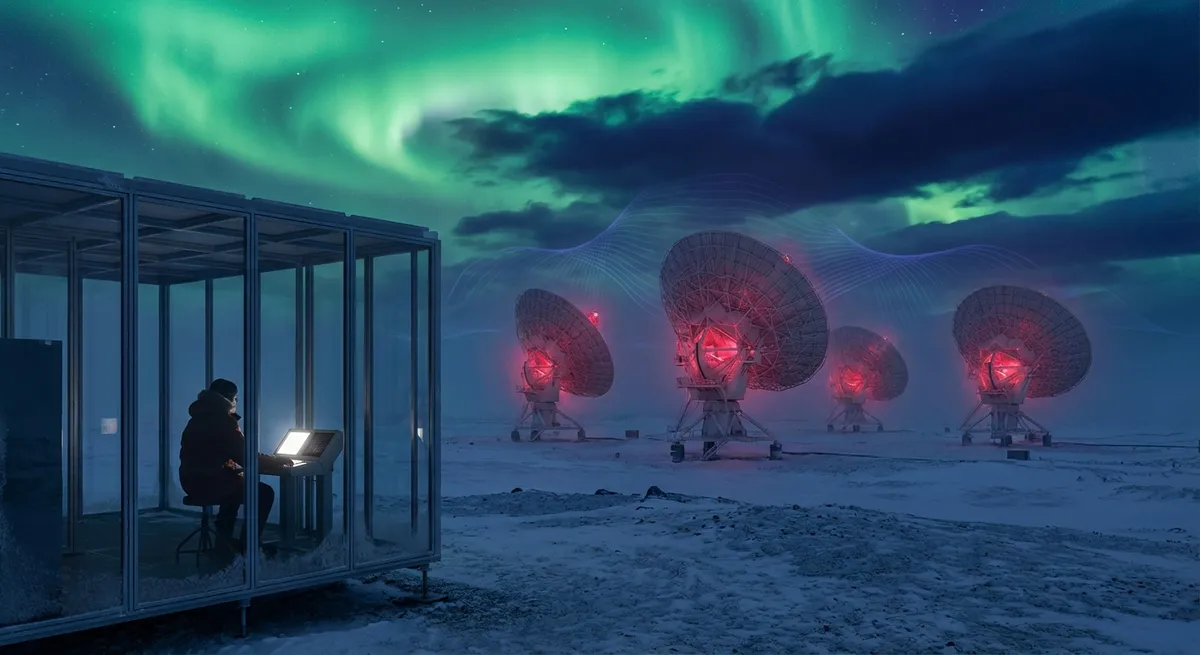
The EHT isn’t a single telescope; it’s a global network of radio observatories, synchronized and spread across Earth. By combining signals from sites in different countries, the EHT effectively created a planet-sized telescope, with a resolution sharp enough to read a newspaper in New York from Paris—if only the atmosphere and Earth’s curvature would cooperate.
Pointed at the galaxy Messier 87, 55 million light-years away, the EHT captured a glowing ring of radio-emitting gas swirling near the event horizon of a supermassive black hole. That ring surrounds a dark central shadow: the silhouette of the black hole’s event horizon, where escape becomes impossible.
The image was more than iconic—it was a stress test for Einstein’s theory of general relativity under the most extreme conditions nature can produce. The size and shape of the shadow matched predictions nearly perfectly, strengthening our confidence in the theory while still leaving room for new physics in even more precise measurements.
The same technique later revealed Sagittarius A*, the black hole at the center of our own Milky Way. We now have direct images of the very edge of space-time’s point of no return. These aren’t photographs in the everyday sense; they are reconstructions from carefully correlated radio signals, processed through complex algorithms. But they give us the closest look yet at the boundary between our universe and the unknowable interior of a black hole.
Amazing Fact #5: To “photograph” a black hole, astronomers linked radio telescopes across Earth into a virtual instrument the size of the planet—turning our world itself into a giant eye on the cosmos.
Conclusion
Modern astronomy is no longer limited to what our eyes—or even our most powerful optical telescopes—can see. The cosmos is speaking in microwaves from the Big Bang, in gravitational waves from colliding black holes, in ghostly neutrinos from stellar explosions, in the gravitational pull of dark matter, and in radio whispers from the edge of black holes.
Each new way of sensing the universe has revealed something astonishing: that our visible night sky is only a small, shimmering fraction of a far deeper reality. As detectors grow more sensitive and more creative, we will likely uncover even stranger forms of cosmic communication—subtle signals that are, at this very moment, washing through our planet unnoticed.
In learning to listen to the universe without relying on light alone, we’re not just collecting data. We’re expanding the very idea of what it means to observe. And with every new messenger we catch, the cosmos feels a little less distant—and a lot more alive.
Sources
- [NASA – Cosmic Microwave Background](https://map.gsfc.nasa.gov/universe/bb_tests_cmb.html) – Overview of the CMB and how it reveals the early universe
- [LIGO – Gravitational Waves and Discoveries](https://www.ligo.caltech.edu/page/what-are-gw) – Explanation of gravitational waves and key detection milestones
- [IceCube Neutrino Observatory – Science](https://icecube.wisc.edu/science/high-energy-neutrinos/) – How high-energy neutrinos are detected and what they tell us about the cosmos
- [ESA – Planck Mission Results](https://www.esa.int/Science_Exploration/Space_Science/Planck) – Detailed findings on cosmology, dark matter, and dark energy from CMB measurements
- [Event Horizon Telescope – First Black Hole Image](https://eventhorizontelescope.org/first-black-hole-image) – Official site explaining how the first black hole image was made and what it reveals
Key Takeaway
The most important thing to remember from this article is that this information can change how you think about Astronomy.