The universe is not silent—it hums, glows, ripples, and flashes with clues about where everything came from and where it’s going. Above our heads, space looks calm. In reality, it’s more like an ongoing experiment that started 13.8 billion years ago and never stopped running.
From galaxies that act like time machines to planets raining glass sideways, astronomy keeps revealing how strange “reality” really is. Below are five discoveries and facts that turn the night sky into a living, evolving story—one we’re only just learning to read.
The Sky Is a Fossil: Cosmic Microwave Background
Every time you look at a patch of clear, dark sky, you’re staring through a thin veil that hides the afterglow of the Big Bang.
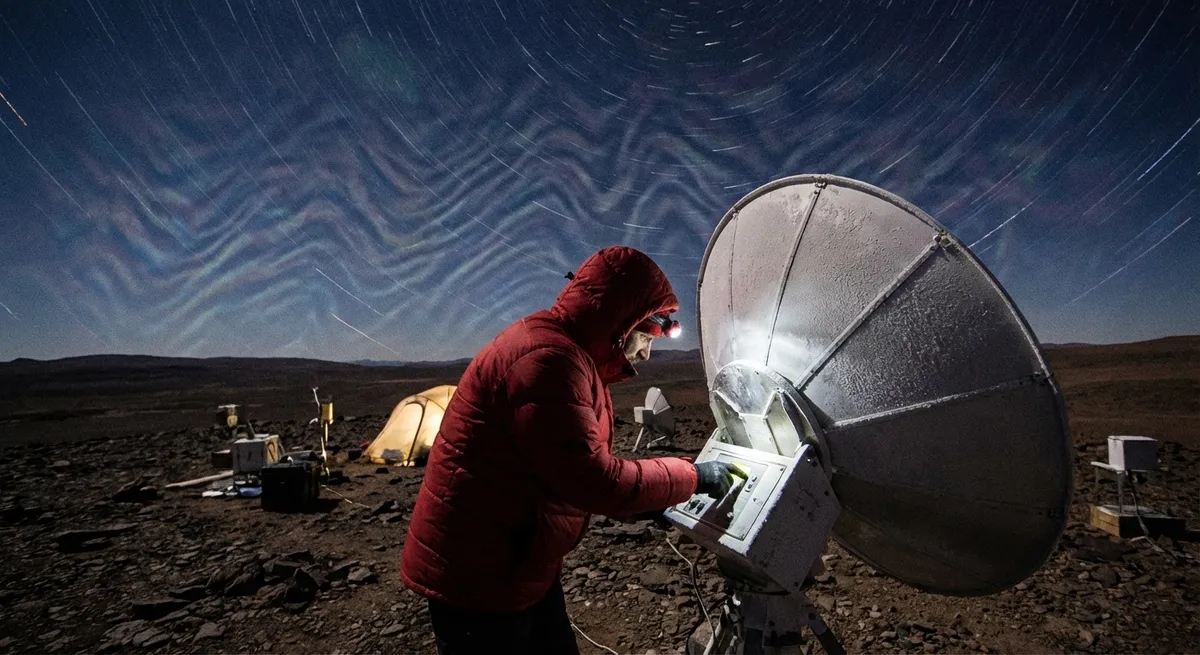
The cosmic microwave background (CMB) is faint microwave radiation that fills all of space, discovered accidentally in 1965 by Arno Penzias and Robert Wilson. They thought it was noise from pigeon droppings in their radio antenna. It turned out to be the oldest light we can see—emitted when the universe was only about 380,000 years old.
Before that moment, the universe was a hot, opaque plasma where light couldn’t travel freely. As the cosmos expanded and cooled, electrons and protons combined into neutral atoms, the fog lifted, and light finally broke free. That light has been traveling ever since, stretched by cosmic expansion into microwave wavelengths.
Modern telescopes like Planck and WMAP have mapped tiny temperature variations in the CMB—ripples just a few millionths of a degree different from one spot to another. Those ripples are the seeds from which galaxies and galaxy clusters eventually formed.
When astronomers study this faint radiation, they’re effectively reading the universe’s baby photos, encoded in a nearly perfect, all-sky glow.
Galaxies as Time Machines: Looking Back Billions of Years
In space, distance and time are the same kind of measurement. When you look at the Moon, you see it as it was 1.3 seconds ago. The Sun? About 8 minutes in the past. For distant galaxies, that time delay becomes incredible.
The James Webb Space Telescope (JWST) and other observatories can see galaxies whose light has been traveling for over 13 billion years. These aren’t just faraway smudges—they are cosmic time capsules, showing the universe as it was when it was less than a billion years old.
This time-travel effect happens because light has a finite speed: about 300,000 kilometers per second. The farther away something is, the longer its light takes to reach us. Looking deeper into space is literally looking further back in time.
Recent JWST observations have revealed surprisingly massive, well-structured galaxies earlier than many cosmological models predicted. That’s forcing astronomers to refine their ideas about how quickly matter can clump together, how fast stars form, and what role dark matter plays in building the cosmic web.
So the night sky is not one single snapshot—it’s a layered archive. Every star and galaxy glows with a slightly different “now,” and astronomers are learning to line those snapshots up into a cosmic timeline.
Planets Are Wild: Glass Rain, Lava Oceans, and Diamond Worlds
Our solar system used to define what we thought a planet could be. Then we started finding planets around other stars—exoplanets—and everything became much stranger.
Using techniques like the transit method (watching a star dim slightly as a planet passes in front) and radial velocity (measuring how a star wobbles from a planet’s gravity), astronomers have identified thousands of exoplanets. They come in astonishing varieties:
- Hot Jupiters: Gas giants orbiting so close to their stars that a “year” can last only a few days. Their atmospheres can reach thousands of degrees, sometimes evaporating into space.
- Lava worlds: Planets with surfaces hot enough to melt rock. Some may have oceans of magma instead of water.
- Glass-rain planets: A famous example, HD 189733 b, likely has violent winds and may experience silicate rain—tiny glass particles blown sideways at thousands of kilometers per hour.
- Super-Earths and mini-Neptunes: Planet classes we don’t even have in our own solar system, ranging from rocky giants to puffy gas-rich worlds.
There are even theoretical carbon-rich planets that could form deep, diamond-like layers under extreme pressure.
Every new exoplanet discovery expands the menu of what’s physically possible. Somewhere in that strange menagerie, there may be worlds with the right conditions for life—or types of habitability we haven’t even imagined yet.
Space Is Not Still: Gravitational Waves Reveal a Rumbling Universe
Einstein predicted them in 1916. A century later, we finally heard them.
Gravitational waves are ripples in spacetime itself, created when massive objects like black holes or neutron stars collide and merge. These ripples radiate outward at the speed of light, stretching and squeezing space by unimaginably tiny amounts.
In 2015, the LIGO observatory detected gravitational waves from a pair of merging black holes over a billion light-years away. The distortion LIGO measured was smaller than a fraction of the width of a proton—yet it carried more energy in a brief moment than all the stars in the observable universe emit as light in the same time.
Since then, gravitational-wave detectors have observed multiple collisions, including neutron star mergers. Those neutron star events are especially dramatic: they don’t just send out gravitational waves, they also forge heavy elements like gold and platinum in titanic nuclear reactions.
Even more recently, by tracking subtle timing shifts in pulses from rapidly spinning neutron stars called pulsars, astronomers have found evidence for a background hum of low-frequency gravitational waves stretching across the cosmos. That may be the signature of supermassive black hole pairs slowly spiraling together in distant galaxies.
The takeaway: space is not a silent vacuum. On the fabric of spacetime itself, the universe is constantly ringing.
The Universe Is Mostly Invisible: Dark Matter and Dark Energy
All the stars, planets, gas, and dust—everything we can see—make up only a tiny fraction of what exists.
Astronomers now estimate that:
- Normal matter (the stuff that makes atoms and you) is about 5% of the universe.
- Dark matter is roughly 27%.
- Dark energy takes up the remaining 68%.
We know dark matter exists because of its gravitational effects. Galaxies rotate so fast that, by ordinary physics, they should fly apart unless there’s extra unseen mass holding them together. We see similar evidence in how galaxies cluster together and how light bends (gravitational lensing) around galaxy clusters. Something heavy is there—but it doesn’t emit or absorb light the way ordinary matter does.
Dark energy is even stranger. In the late 1990s, two independent teams studying distant supernovae discovered that the expansion of the universe is accelerating, not slowing down. To explain this cosmic speed-up, cosmologists proposed dark energy: a mysterious form of energy built into the fabric of space that drives galaxies apart faster and faster.
These two “dark” components dominate the cosmic budget, yet we don’t know their true nature. They are like the missing chapters of the universe’s operating manual. Astronomy is now as much about what we can’t see directly as what we can—and the quest to understand dark matter and dark energy sits at the center of modern cosmology.
Conclusion
The universe is not just a backdrop of stars; it’s a dynamic, evolving system full of echoes, fossils, storms, and mysteries.
The faint whisper of the Big Bang still bathes us in microwaves. Light from ancient galaxies arrives as messages from a younger cosmos. Planets defy imagination with boiling skies and oceans of rock. Spacetime itself vibrates with the mergers of invisible titans. And underneath it all, most of what exists is hidden in forms we barely understand.
Astronomy turns the night sky from a flat ceiling into a layered story—one in which every photon, every ripple, and every orbit is a clue. The more we learn, the more the universe feels less like empty space and more like a living, changing tapestry we’re only just beginning to decode.
Sources
- NASA – Cosmic Microwave Background – Overview of the CMB and how it supports the Big Bang model
- ESA – James Webb Space Telescope Discoveries – Updates and explanations of JWST observations of early galaxies
- NASA Exoplanet Exploration – Database and educational material on exoplanet types and discoveries
- LIGO Scientific Collaboration – Details on the first gravitational wave detection and its significance
- NASA – Dark Energy, Dark Matter – Introduction to dark matter and dark energy and how we infer their existence
Key Takeaway
The most important thing to remember from this article is that this information can change how you think about Astronomy.