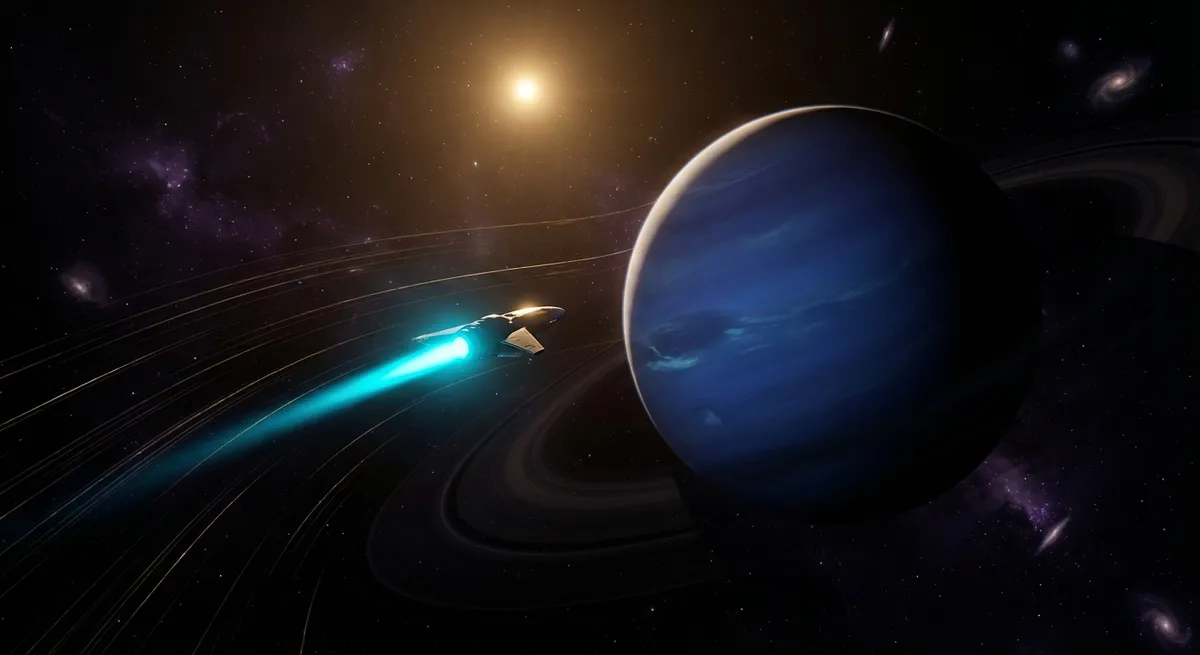
Most spacecraft don’t roar through the Solar System on raw rocket power alone. Their fuel tanks are tiny compared to the distances they need to cross. Instead, they pull off a quiet cosmic heist: they steal motion from planets.
This hidden trick, called a gravity assist, is one of the most powerful—and counterintuitive—technologies in space exploration. It lets fragile human-built machines surf the moving mass of worlds, gaining enormous speed for free. Along the way, these missions have delivered some of the most astonishing space discoveries of our time.
The Solar System Is a Giant Moving Machine
We often imagine the Solar System as a static diagram: Sun in the center, planets in neat rings, labels politely attached. In reality, it’s a kinetic machine.
Every planet is orbiting the Sun at staggering speeds. Earth, for example, is hurtling through space at about 30 km per second (over 100,000 km/h). Jupiter races along at about 13 km per second. None of this motion is obvious from the ground, but spacecraft engineers see it as a vast reservoir of energy.
A gravity assist maneuver works because motion is relative. When a spacecraft falls toward a moving planet and swings around it, the planet’s gravity bends the craft’s path—and the planet’s motion adds (or subtracts) speed. To the spacecraft, it feels like a dramatic speed boost or slowdown. To the planet, which is millions of times more massive, the change is effectively zero.
The Solar System, in other words, isn’t just a collection of destinations. It’s a network of moving launch pads.
How Spacecraft “Borrow” Speed Without Breaking Physics
Gravity assists sound like science fiction: a spacecraft swoops past a planet, slingshots away, and suddenly it’s much faster. But nothing mystical happens—just a brilliant use of orbital mechanics.
Here’s the core idea, simplified:
- A spacecraft approaches a planet that is already orbiting the Sun.
- It falls into the planet’s gravity well and accelerates as it gets closer.
- Instead of crashing, it flies behind (or in front of) the planet in the direction of the planet’s travel.
- The planet’s gravity bends the spacecraft’s trajectory.
- Because the planet is moving, the spacecraft leaves with a different speed than it had on arrival—faster if it passed “behind,” slower if it passed “ahead.”
From far away, relative to the Sun, the spacecraft has gained or lost energy. That energy came from the planet’s orbital motion around the Sun. Technically, the planet is slowed down or sped up by an almost immeasurable amount.
Engineers treat gravity assists like precision bank shots in billiards. A tiny timing error can mean missing a planet completely—or slamming into it. Hitting the desired “aim point” near a planet might require timing accurate to minutes or even seconds after a journey of years.
This technique isn’t optional for many missions. Without gravity assists, some of history’s most ambitious journeys would have been impossible with current rockets.
Voyager: Turning One Launch into a Grand Tour
The Voyager missions are a masterclass in using the Solar System’s clockwork to our advantage.
In the late 1970s, NASA noticed a rare planetary alignment: Jupiter, Saturn, Uranus, and Neptune would all line up along a convenient path. This configuration only happens roughly once every 176 years. By threading a route through these moving worlds and using multiple gravity assists, a single spacecraft could visit all four giant planets on one trip.
Voyager 2 did exactly that.
- It launched in 1977 with a rocket that, on its own, could not possibly reach the far outer planets.
- A gravity assist at Jupiter boosted its speed and bent its course toward Saturn.
- Another at Saturn redirected it toward Uranus.
- A third at Uranus flung it on to Neptune.
Each planetary flyby added energy and changed direction, like stepping from one speeding train to another—except the “trains” are worlds the size of thousands of Earths.
Amazing Space Fact #1:
Voyager 2 is the only spacecraft ever to visit Uranus and Neptune up close. It turned a single launch into a four-planet odyssey thanks to gravity assists.
The discoveries it returned reshaped planetary science:
- Active volcanoes on Jupiter’s moon Io.
- Geysers on Neptune’s moon Triton.
- Complex ring systems around Jupiter, Saturn, Uranus, and Neptune.
A well-planned path through moving planets didn’t just save fuel; it expanded humanity’s entire map of the Solar System.
Gravity Assists Don’t Just Speed Up—They Can Fall Sunward
It’s easy to imagine that gravity assists are all about going faster and farther. But sometimes the hardest place to reach isn’t far away—it’s the Sun.
To orbit close to the Sun, a spacecraft must lose a vast amount of speed relative to the Sun. Earth’s orbital motion gives every departing spacecraft a strong sideways push, whether we like it or not. Escaping the Solar System is actually easier than dropping inward toward the star at the center.
NASA’s Parker Solar Probe solved this problem in a counterintuitive way: by using Venus, over and over, as a cosmic brake.
- The spacecraft launched with a powerful rocket, but that only got it started.
- It repeatedly flies by Venus, passing in front of the planet’s motion.
- Each time, Venus steals a tiny bit of the probe’s orbital speed around the Sun.
- This lets the probe spiral inward, diving closer on each pass.
Amazing Space Fact #2:
Parker Solar Probe is the fastest human-made object in history, reaching speeds over 430,000 miles per hour (about 700,000 km/h) near the Sun—yet it achieved this record-breaking speed by losing energy via gravity assists.
By carefully giving up orbital energy to Venus, the probe falls deeper into the Sun’s gravity, trading orbital speed around the Sun for raw plunge speed past it. It samples plasma, magnetic fields, and dust in an environment no previous mission could safely reach.
Gravity assists, it turns out, aren’t just a cosmic gas pedal. They’re also our best brake.
When Gravity Assists Create Entirely New Worlds
Sometimes the clever use of gravity assistance doesn’t just move a spacecraft—it creates a whole new kind of mission.
Consider Cassini, the spacecraft that orbited Saturn from 2004 to 2017. Before it ever reached Saturn, Cassini used gravity assists from Venus (twice), Earth, and Jupiter. These carefully planned boosts let a heavy, instrument-packed spacecraft reach Saturn without an impossibly huge rocket.
Once it arrived, Saturn’s moons became miniature “assist stations.” Cassini used flybys of Titan, Saturn’s largest moon, to reshape its orbit over and over:
- Raising and lowering its distance from Saturn.
- Tilting its orbit out of Saturn’s ring plane.
- Steering it to close passes with moons like Enceladus.
Amazing Space Fact #3:
Cassini used Titan’s gravity so effectively that it was able to orbit Saturn for 13 years and complete well over 100 targeted moon flybys, all with the same main engine it launched with.
Without these moon-based gravity assists, Cassini would have run out of fuel long before completing its scientific agenda, which included:
- Discovering water-rich plumes erupting from Enceladus’s south pole—one of the best potential habitats for life beyond Earth.
- Mapping Titan’s methane lakes and seas.
- Flying daringly close to the gap between Saturn and its innermost rings near the end of the mission.
Using moons as orbital “stepping stones” turned a single arrival into a long-term exploration campaign. Gravity assists weren’t just a way to get there; they became the mission’s primary tool for staying and exploring.
Speed Records and Deep Space: Gravity Assists at Their Limits
For spacecraft that are truly leaving the Solar System, gravity assists are the difference between “interesting mission” and “interstellar pioneer.”
New Horizons, the spacecraft that flew past Pluto in 2015, is a good example. It didn’t have the luxury of a decades-long, multi-planet tour like Voyager, but it still needed to cross billions of kilometers in under ten years.
The solution: a high-energy launch plus a powerful Jupiter gravity assist.
- New Horizons launched in 2006 on one of the most powerful Atlas V rockets ever flown.
- Even so, it needed a speed boost.
- A carefully timed flyby of Jupiter in 2007 increased its velocity by about 4 km/s and bent its path toward Pluto.
Amazing Space Fact #4:
New Horizons crossed the distance from Earth to Jupiter in just 13 months—faster than any mission before it—thanks to a well-tuned Jupiter gravity assist.
That extra kick cut about three years off its flight time to Pluto and the Kuiper Belt. It captured:
- The first detailed images of Pluto’s mountains of water ice and its vast nitrogen plains.
- The surprising complexity of Pluto’s atmosphere and weather.
- A follow-up flyby of Arrokoth, one of the most primitive objects we’ve ever visited.
Each gravity assist saves years of travel time on missions like these—years that matter when power systems fade and moving parts wear out in deep space.
Surprising Discovery: Planets Aren’t the Only Objects That Help
We tend to think of planets as the main players in gravity assist maneuvers, but anything with mass can bend a spacecraft’s path: moons, dwarf planets, even comets and asteroids.
So far, most gravitational “stepping stones” have been large worlds or major moons, but mission planners are increasingly considering more exotic targets as space navigation becomes more precise. Even small gravity nudges can matter over long distances.
And then there’s the grandest idea of all: using the Sun itself in a gravity-aided maneuver—combined with sunlight, not just gravity.
Amazing Space Fact #5:
The Planetary Society’s LightSail 2 spacecraft demonstrated controlled flight using sunlight pressure as propulsion, changing its orbit around Earth by reorienting its sail to “tack” against photons.
While LightSail 2 didn’t use a traditional gravity assist, it proved a related principle: orbital paths can be reshaped without burning fuel, using only environmental forces—gravity or light—if you understand the physics well enough. Future deep-space missions might combine solar sails with planetary gravity assists to explore far beyond the reach of conventional rockets.
The universe is full of subtle pushes and pulls. Space tech is learning to use all of them.
Why Gravity Assists Point to the Future of Space Travel
Gravity assists are a preview of how spaceflight will continue to evolve: less brute force, more strategy.
- Rockets: Still essential to escape Earth’s gravity.
- Gravity assists: Turn limited fuel into vast reach by using the motion of planets and moons.
- Future concepts: Solar sails, electric propulsion, and perhaps one day gravitational slingshots around exotic objects like neutron stars or black holes (in theory, extremely powerful—but far beyond current capability).
What’s striking is that gravity assists cost nothing in fuel and require no new hardware. They are pure intellect—an exploitation of how the Solar System already moves.
For readers of Orbit Roo, this is where cosmic wonder meets engineering elegance: tiny machines, flung into a vast gravitational dance, using worlds as partners to cross oceans of darkness. Every time a spacecraft steals a bit of speed from a planet, it’s a reminder that understanding the rules of the cosmos lets us do extraordinary things with surprisingly little.
Conclusion
Space tech isn’t just about bigger rockets or stronger engines. It’s about learning to navigate a universe that is already in motion—and letting that motion work for us.
From Voyager’s grand tour powered by planetary assists, to Parker Solar Probe’s repeated dives past Venus, to Cassini’s intricate ballet around Saturn’s moons, gravity assists have quietly underpinned some of humanity’s greatest explorations. And as missions like New Horizons and LightSail show, we are only beginning to learn how to surf the gravitational and radiative currents of space.
In a cosmos built on orbits, curves, and momentum, our most powerful engine might not be a thruster at all—but a clever trajectory.
Sources
- NASA: Gravity Assist – A Beginner’s Guide to Interplanetary Travel - Explains the basic physics and history of gravity assist maneuvers in planetary missions
- NASA Voyager Mission Page - Details on Voyager 1 and 2 trajectories, gravity assists, and major discoveries during the Grand Tour
- NASA Parker Solar Probe Mission Overview - Describes how repeated Venus gravity assists enable Parker Solar Probe’s close approaches to the Sun
- NASA Cassini Mission to Saturn - Mission summary highlighting use of gravity assists at Venus, Earth, Jupiter, and Titan, plus key scientific findings
- The Planetary Society: LightSail 2 Mission - Covers how LightSail 2 used solar sailing to change its orbit, illustrating fuel-free orbital maneuvers
Key Takeaway
The most important thing to remember from this article is that this information can change how you think about Space Tech.