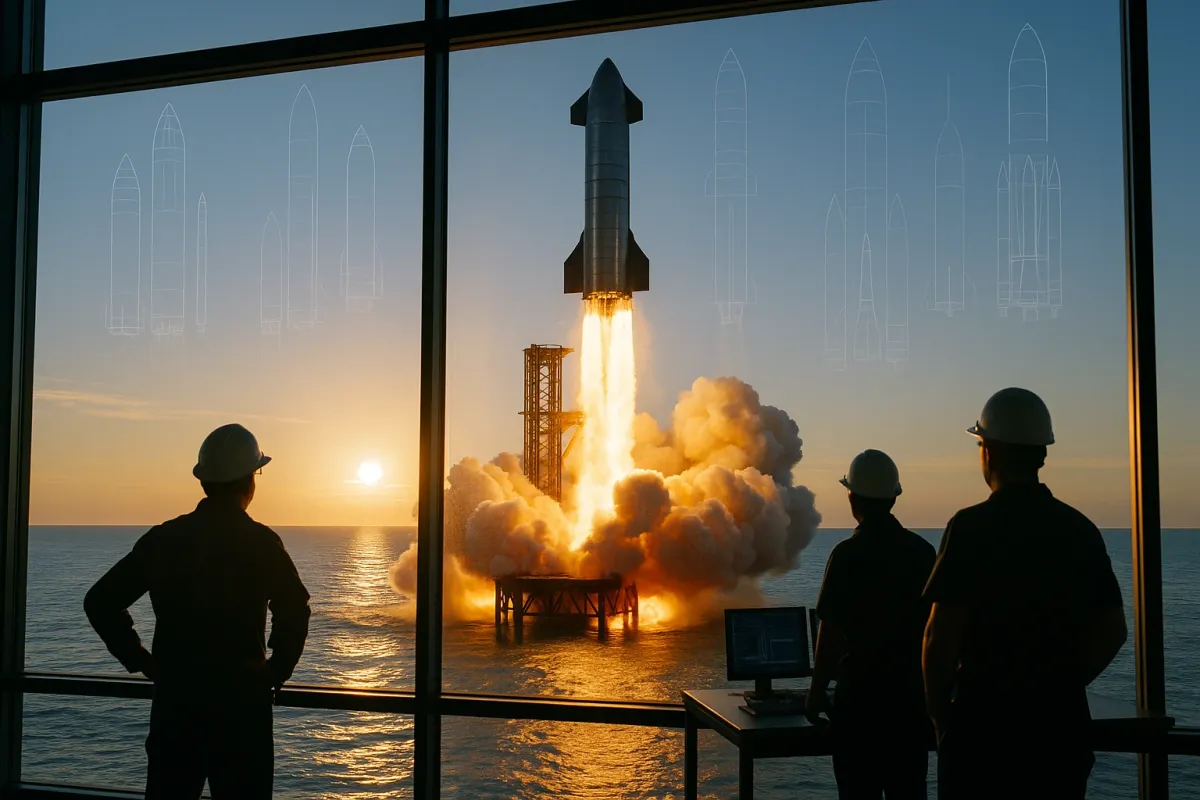
SpaceX’s Starship just stepped a little closer to becoming the workhorse of the space age, and the timing is wild: we’re watching, in real time, the moment when rockets stop being disposable fireworks and start behaving more like airplanes. Each new test flight is a live‑streamed engineering thriller, and under all the dust plumes and camera shake, something quietly revolutionary is happening: space tech is beginning to industrialize.
This isn’t just about “a bigger rocket.” Starship’s test campaign is forcing engineers, regulators, and even space fans to rethink what launch vehicles can be, how quickly we can iterate them, and what they might enable once they stop being rare, bespoke machines. Let’s unpack what’s changing right now—and explore a few astonishing facts hiding beneath the headlines.
Starship’s “Rapid Reusability” Isn’t Just A Buzzword
Traditional rockets are basically single‑use sculptures: exquisite, expensive, and doomed the moment they ignite. NASA’s Saturn V, the Artemis SLS, and most commercial launchers are throwaway stacks—billions of dollars, one trip. SpaceX is trying to flip that logic on its head with Starship, designed to land, refuel, and fly again with airplane‑like cadence.
The engineering stakes are enormous. Starship’s stainless‑steel hull has to survive atmospheric reentry, belly‑flop through hypersonic air at Mach 20+, then pivot and fire its engines at the last second for a vertical landing. Every test flight this year has inched closer to that choreography working end‑to‑end. The latest attempt showed improved in‑flight stability, better stage separation, and more controlled reentry data than any previous flight. Each success matters because rapid reusability isn’t just “nice to have”—it’s the only realistic way to push launch costs down another order of magnitude. If a single Starship can fly dozens or hundreds of times, the economic model of going to space starts to look less like luxury tourism and more like logistics.
One Launch Could Replace An Entire Year Of Cargo Flights
Here’s a number that feels almost unfair: Starship, once fully operational, is designed to haul roughly 100–150 metric tons to low Earth orbit (LEO) in a single flight. That’s more than the payload capacity of every space shuttle launch in a busy year, delivered in one go. For comparison, SpaceX’s current workhorse, Falcon 9, maxes out at around 22.8 tons to LEO—and often flies with less.
Why does this matter right now? Because companies and space agencies are already planning missions that assume Starship‑level lift: swarms of broadband satellites, giant space telescopes larger than the James Webb, on‑orbit fuel depots, and pre‑positioned habitats for the Moon and Mars. NASA’s Artemis program, for instance, is banking on a customized lunar Starship variant to land astronauts on the Moon’s surface. That lander will need multiple Starship tanker flights to refuel in orbit—an architecture that only makes sense if ultra‑heavy‑lift launches become routine. In other words, Starship isn’t just a big rocket; it’s the backbone of a whole ecosystem that doesn’t really work without it.
Those “Fire‑Breathing” Raptor Engines Are Quietly Making Propellant History
Every test flight you see is powered by Raptor, SpaceX’s methane‑fueled rocket engine—and it’s quietly one of the most radical engines flying today. Instead of the kerosene or solid propellants used in many earlier rockets, Raptors burn liquid methane and liquid oxygen in what’s called a full‑flow staged combustion cycle, a brutally demanding design that squeezes maximum performance out of every drop of fuel.
This matters for two reasons. First, efficiency: higher performance per kilogram of propellant means more payload or higher orbits for the same mass. Second, and more futuristic, is in‑situ resource utilization. Methane and oxygen can be manufactured from water and carbon dioxide—exactly what you find on Mars. Engineers talk about “making your fuel there and flying home,” and that’s not science fiction hand‑waving. Lab‑scale demonstrations of Mars‑style propellant production are already running on Earth, and NASA’s MOXIE experiment on the Perseverance rover has already extracted oxygen from the Martian atmosphere. Starship plus Raptor is designed with that future in mind: refuel on another world, then leave.
Starship’s Heat Shield Is A Flying Materials Science Lab
If you’ve seen photos of Starship up close, you’ve probably noticed its checkered black‑and‑silver armor: thousands of individual heat‑shield tiles bolted to a steel skin. That patchwork is where some of the most intense space‑materials research on Earth is happening—at hypersonic speed. Every one of those recent test flights has been a data‑gathering run for how the tiles behave under realistic reentry conditions.
The numbers are brutal: during reentry, parts of the vehicle’s surface experience temperatures above 1,400°C (2,550°F). Tiles can crack, shear off, or flex differently than the underlying metal. By analyzing camera views, telemetry, and post‑flight inspections, SpaceX’s engineers are building a failure map in excruciating detail—where tiles fall off, where they survive, and how the shock waves move across Starship’s body. That information doesn’t just help Starship; it feeds into the broader field of hypersonics and advanced ceramics. Future spaceplanes, reusable upper stages, and even high‑speed point‑to‑point Earth transports will borrow heavily from what Starship’s tiles are teaching us right now.
Real‑Time Flight Data Is Turning Fans Into Informed Space Analysts
One of the strangest, most modern aspects of the Starship campaign is how public it is. You can watch entire test flights live, with multiple independent streams—from SpaceX’s official broadcast to YouTubers and local cameras scattered across South Texas. Within minutes, social media is full of slow‑motion replays, plume analyses, and on‑the‑fly reconstructions of what likely went right or wrong.
This is more than fandom. Open data and high‑visibility testing are creating a new kind of “citizen engineer” culture around spaceflight. Armchair analysts track engine ignition timing, breakup altitudes, entry burn profiles, and grid fin deflections with a rigor that used to be confined to internal aerospace reports. The feedback loop is fascinating: online reaction shapes public perception, which affects regulators and investors, which in turn influences how quickly companies can iterate hardware. SpaceX leans into this transparency, sharing key milestones and anomalies publicly. The result is that the global audience isn’t just watching; it’s learning how rockets fail, how they improve, and why iteration speed often matters more than getting everything perfect on the first try.
Conclusion
Starship’s latest test didn’t just move a prototype a bit higher or a bit faster; it nudged our entire idea of spaceflight toward something more scalable, more industrial, and ultimately more accessible. Between fully reusable stages, methane engines built with Mars in mind, heat shields that double as flying laboratories, and an open, internet‑native test culture, we’re seeing space tech grow out of its “heroic era” and into something closer to infrastructure.
The most astonishing part? These are not distant, speculative concepts—they’re happening in front of us, with each plume of exhaust over Boca Chica marking another data point on a very steep learning curve. If this pace holds, the next few years won’t just bring bigger rockets; they’ll bring a world where going to orbit feels less like a rare expedition and more like plugging into a planetary‑scale transport network. And from there, the rest of the Solar System starts to feel a little less remote.
Key Takeaway
The most important thing to remember from this article is that this information can change how you think about Space Tech.