Space technology used to mean skyscraper-sized rockets and room-filling computers. Now, some of the most powerful tools for exploring the universe are smaller than a notebook, lighter than a bottle of water, and sometimes thin as a sheet of paper.
Welcome to the era of miniaturized space tech—where spacecraft fit in backpacks, laboratories ride in shoeboxes, and “gravity” can be simulated on a microchip. This quiet revolution isn’t just cutting costs; it’s changing what we can actually ask the universe.
Along the way, you’ll discover five mind-bending space facts that only became possible because our tech got tiny, smart, and wildly precise.
From Bus-Sized Satellites to Backpack Observatories
For decades, going to space meant building something gigantic and expensive. A single communications satellite could weigh several tons, cost hundreds of millions of dollars, and take years to design. That model worked—if you had a government budget.
Then came CubeSats.
CubeSats are modular satellites built around a standardized unit: a cube 10 cm on each side, usually weighing about 1–1.3 kg. Stack a few together and you get slightly larger versions—still incredibly compact compared to traditional spacecraft. Because the shape, size, and mounting interfaces are standardized, engineers can design, test, and launch them much faster and cheaper.
Instead of one giant satellite doing everything, you can launch swarms of small satellites, each focusing on a specific job: imaging, communications, climate monitoring, or space science experiments. This “many small instead of one big” approach changes how we see our planet and our place in the cosmos.
Amazing Space Fact #1:
Some Earth-observing CubeSats can read license plate–level detail from orbit—not because they’re huge, but because advanced sensors and image-processing algorithms now fit into something the size of a cereal box. This level of miniaturization lets constellations of small satellites image nearly the entire planet multiple times per day, revolutionizing weather forecasting, agriculture monitoring, and disaster response.
The Space Internet You Don’t Think About (But Use Every Day)
Miniaturized satellites are quietly rebuilding the architecture of our digital lives.
Traditional communications satellites sit in geostationary orbit—about 36,000 km above Earth—which means high latency (signal delay) and expensive hardware. Newer low Earth orbit (LEO) constellations put thousands of smaller satellites much closer to Earth, around a few hundred kilometers up. The result: lower latency, more capacity, and the ability to beam internet nearly anywhere.
What’s changed isn’t just orbit selection—it’s the tech inside the satellites. Modern communication satellites use:
- Phased-array antennas that electronically steer beams without moving parts
- Software-defined radios that can be reprogrammed in orbit
- Onboard processing that routes traffic like an in-space router instead of a passive mirror
All of this fits into satellites small enough to launch in clusters—dozens or even hundreds at a time.
Amazing Space Fact #2:
Global navigation systems like GPS are so precise that they can detect millimeter-scale changes in Earth’s crust over time. Researchers use this space-based precision to track tectonic plate movement, measure ice sheet loss, and even monitor how groundwater extraction causes land to slowly sink—all using timing signals from satellites orbiting ~20,000 km above us.
Lab in a Shoebox: Science Experiments That Ride to Orbit
Space used to be a realm where only huge, flagship missions could do serious science. Smaller satellites were seen as “toys” or student projects. That perception is gone.
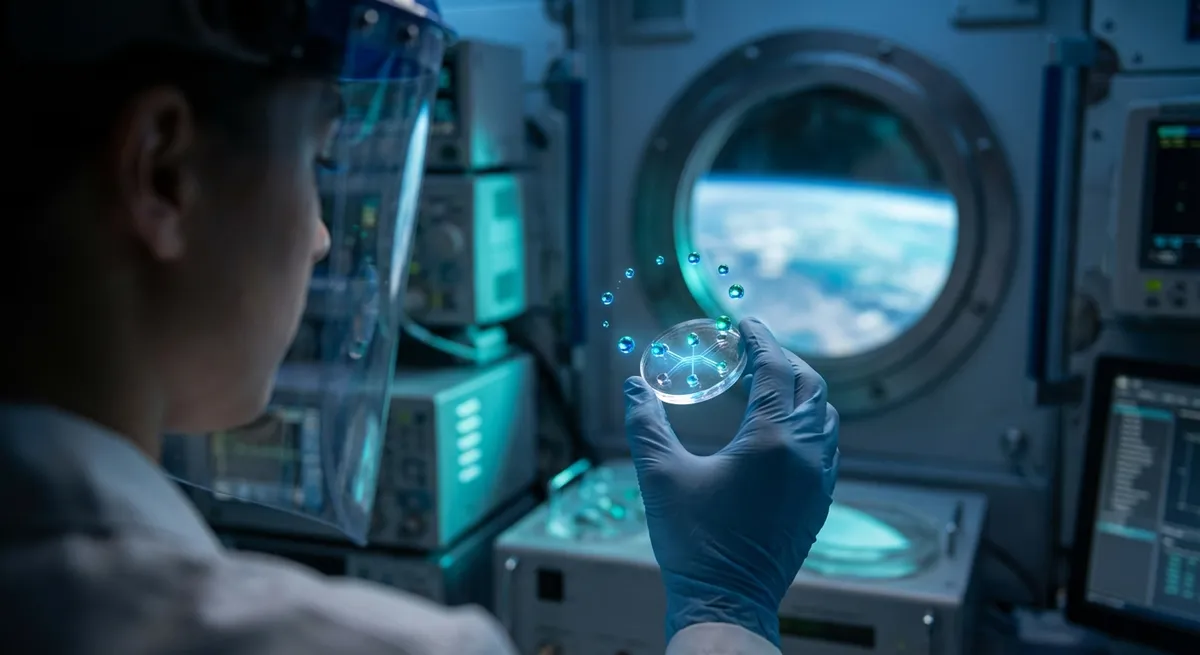
Today, “lab-on-a-chip” systems and ultra-compact instruments let scientists launch fully capable experiments in shoebox-sized satellites or as small payloads on larger missions. Many of these experiments focus on microgravity, which allows physics, biology, and chemistry to behave in ways they never can on Earth.
Examples include:
- Protein crystal growth that forms larger, purer crystals than on Earth, helping drug design
- Fluid behavior in microgravity that informs fuel management and life support systems
- Materials science experiments to test new alloys, 3D-printed structures, and coatings in the harsh space environment
These experiments don’t just teach us about space. They feedback directly into better medicine, stronger materials, and more efficient technologies on Earth.
Amazing Space Fact #3:
Human cells behave so differently in microgravity that some types of tissue age-like changes appear more rapidly in orbit. Experiments on the International Space Station (ISS) have shown accelerated bone and muscle loss, changes in immune response, and gene expression shifts. Far from being a problem only for astronauts, these fast-forward biological effects are being used as a model to study aging and disease progression much more quickly than on Earth.
Gravity Simulators and Atom Interferometers: Measuring the Invisible
Miniaturization isn’t just about packing more gadgets into smaller satellites. It’s also about new ways to sense and measure reality itself.
One of the most exotic frontiers of space tech is quantum sensing, particularly devices called atom interferometers. These instruments cool atoms to extremely low temperatures and use their wave-like behavior to measure infinitesimal changes in acceleration and gravity.
Why space? Because microgravity lets these atoms “fall” for a long time without hitting anything, increasing the sensitivity of the instrument. By putting such quantum sensors on satellites, scientists can:
- Map tiny variations in Earth’s gravitational field
- Monitor changes in ice sheets, oceans, and groundwater
- Test fundamental physics, like whether gravity behaves exactly as Einstein predicted
Even more futuristic are “gravity on a chip” concepts: lab platforms that can partially emulate different gravitational environments (like Mars or the Moon) using clever mechanical and electromagnetic tricks, allowing spacecraft components and biological samples to be tested before they ever leave Earth.
Amazing Space Fact #4:
The GRACE and GRACE-FO missions, using paired satellites that measure minute changes in their separation caused by Earth’s gravity, can detect changes in water mass equivalent to a layer of water just a few centimeters thick spread across entire continents. In other words, by timing spacecraft separations to fractions of a micron, we can “see” underground aquifers filling and draining from orbit.
Tiny Thrusters, Big Destinations: How Small Spacecraft Travel Far
Shrinking spacecraft raises a hard question: how do you move tiny satellites efficiently without massive rocket fuel tanks?
The answer lies in electric propulsion and other advanced thruster technologies designed for small platforms. Instead of burning large amounts of chemical propellant in quick blasts, electric thrusters like ion engines and Hall-effect thrusters use electric fields to accelerate ions to tremendous speeds, producing a very gentle but extremely efficient push.
This is ideal for small satellites that don’t need to leave Earth’s gravity well on their own—they just hitch a ride to orbit and then slowly maneuver into their desired positions. With enough time, even small craft can:
- Change orbits around Earth
- Fly in precise formations with other satellites
- Travel to the Moon or even deep space destinations on relatively tiny amounts of propellant
Paired with miniaturized navigation systems and autonomous guidance software, such thrusters let small spacecraft attempt missions that once required much larger platforms.
Amazing Space Fact #5:
NASA’s Deep Space 1 and Dawn missions proved that ion propulsion can change a spacecraft’s speed by over 10 km/s—far more than typical chemical stages at comparable mass. Dawn, powered by ion engines, became the first spacecraft to orbit two separate bodies (Vesta and Ceres) in the asteroid belt, something that would have been extremely difficult with traditional chemical propulsion alone.
Why Shrinking Space Tech Expands Our Cosmic Reach
Miniaturized space tech isn’t about making “lesser” spacecraft. It’s about flipping the script on how we explore.
When satellites are cheaper and smaller, you can:
- Take more risks and test bolder ideas
- Launch swarms of coordinated instruments instead of a single flagship
- Rapidly respond to new discoveries with follow-up missions
- Open the space environment to students, startups, and countries that never had access before
The result is a more agile, diverse, and creative era of space exploration—one where a CubeSat cluster might map an exoplanet transit, a briefcase-sized lab may test next-generation medicines in orbit, and a quantum sensor in microgravity could quietly rewrite pieces of physics.
Space is still vast and unforgiving. But the tools we’re sending out to meet it are becoming unexpectedly small, astonishingly capable, and scientifically transformative.
In the coming decades, some of the most important discoveries about the universe may not come from the biggest telescopes or heaviest spacecraft—but from the tiny, patient machines silently orbiting above us, turning precision, miniaturization, and ingenuity into new ways of knowing.
Sources
- NASA – CubeSats Overview – Explains what small satellites and CubeSats are, including examples of science and technology missions.
- ESA – Gravity field and steady-state Ocean Circulation Explorer (GOCE) – Details how satellites map Earth’s gravity field and the precision achievable from orbit.
- NASA – Human Research Program: Microgravity Effects – Summarizes how microgravity affects the human body and why it matters for space and Earth medicine.
- NASA – Dawn Mission Overview – Describes how ion propulsion enabled the Dawn spacecraft to orbit both Vesta and Ceres in the asteroid belt.
- National Academies – Quantum Sensing and Its Applications – Provides background on quantum sensing technologies, including atom interferometry and their potential space applications.
Key Takeaway
The most important thing to remember from this article is that this information can change how you think about Space Tech.