For most of human history, “space” meant empty nothingness—a cold, silent backdrop where nothing much happened except stars twinkling quietly. Today, that same “nothing” is being treated like a laboratory, a power source, and even a factory floor. Space technology is no longer just about rockets and astronauts; it’s about learning to use the vacuum itself as a tool.
From satellites that surf on invisible forces to telescopes that see the afterglow of the Big Bang, modern space tech is teaching us that the cosmos is anything but empty. Hidden in the darkness are particles, fields, and energies that can be measured, manipulated, and maybe one day harvested. Here are five astonishing ways that space technology is extracting insights—and sometimes power—from the deep cosmic void.
Fact 1: “Empty” Space Is So Clean We Can Build Better Materials There
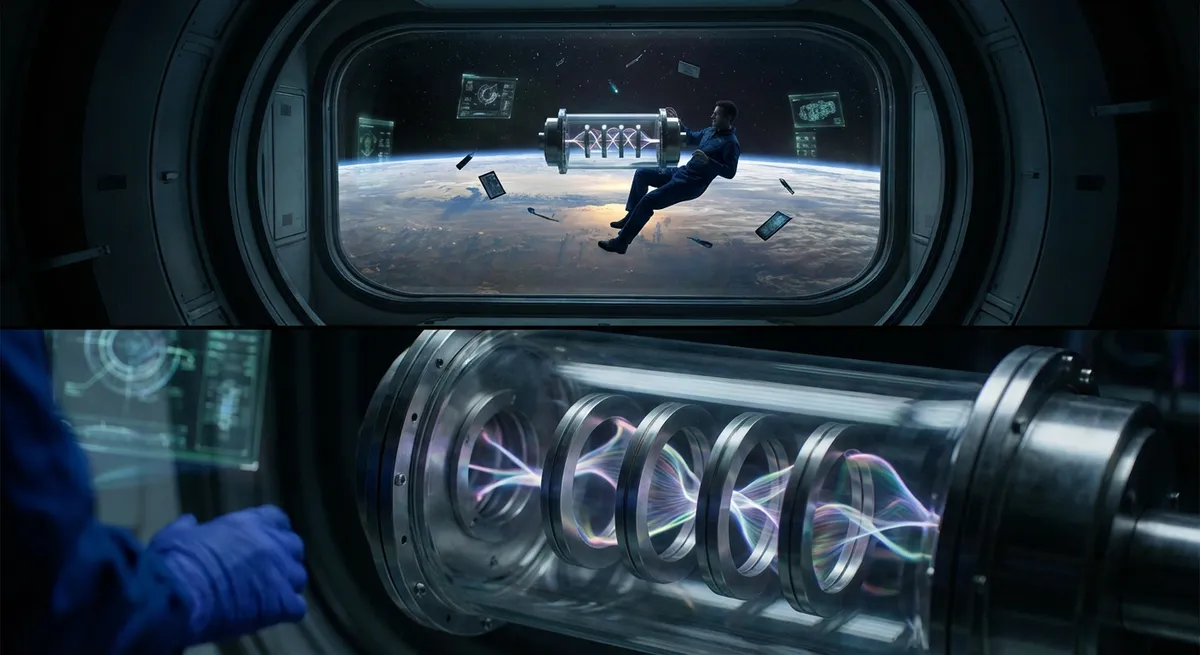
On Earth, even the cleanest laboratories are chaotic by cosmic standards: gravity pulls, air swirls, dust floats, and everything is constantly bumping into everything else. In orbit, microgravity and hard vacuum create a unique environment where materials form in ways they simply can’t on the ground. That’s why companies and space agencies are experimenting with “orbital factories” aboard the International Space Station (ISS) and on dedicated microgravity platforms.
In microgravity, molten metals and alloys can mix evenly without heavier elements sinking, producing ultra-uniform structures. Protein crystals, grown slowly in orbit, can become larger and more orderly than their Earth-grown cousins—ideal for drug discovery and precision medicine. Fiber optics made in space can have fewer defects and purer internal structures, potentially carrying far more data with less signal loss. The vacuum itself also helps: no atmospheric contamination, no moisture, fewer impurities. Space tech is transforming the ISS from a “science outpost” into a prototype for future off-world manufacturing, where the void becomes a key ingredient in next-generation materials.
Fact 2: Invisible Ripples in Spacetime Are Now Measured Like Weather
Einstein predicted that massive objects like black holes and neutron stars should create ripples in spacetime—gravitational waves—but he doubted we’d ever be able to detect them. A century later, space tech has turned that theoretical whisper into something we can actually measure. Ground-based observatories like LIGO started the revolution, but space-based detectors are on the way, designed to float in the vacuum and listen for subtler, slower waves.
Future missions like the Laser Interferometer Space Antenna (LISA) will position spacecraft millions of kilometers apart, linked by laser beams so stable they can detect changes in distance smaller than the width of an atom. When a gravitational wave passes, it stretches and compresses spacetime, ever so slightly altering the separation between the spacecraft. By reading these changes, scientists can “hear” collisions between supermassive black holes, mergers of exotic objects, and maybe even echoes from the earliest moments after the Big Bang. Space, once thought silent, turns out to be full of deep, bass notes in the fabric of reality itself—and we’re building the instruments to record the cosmic soundtrack.
Fact 3: Satellites Can Steer Using Nothing but Earth’s Magnetic Field
Traditional spacecraft control their orientation using spinning wheels, thrusters, or gyroscopes. But some satellites, especially small ones called CubeSats, can steer using an almost invisible resource: Earth’s magnetic field. By running electric current through coils of wire or magnetized rods, these spacecraft create their own mini-magnets, which then push or pull against the planet’s magnetic field lines—like a compass that can actively twist itself.
These “magnetorquers” have no fuel tanks, no moving propellant, and no nozzle exhaust. Instead, they rely on the physics of electromagnetism to turn and face different directions for imaging, communications, or experiments. This method is weaker near the magnetic equator and useless far from Earth, but it’s ideal for low-cost missions in low-Earth orbit. It’s a subtle form of space sailing: not on solar wind this time, but on the invisible structure of the planet’s magnetic bubble. Space tech is learning to tap into environmental forces that were once just background conditions, turning them into built-in steering wheels.
Fact 4: Cosmic Background Radiation Is a Fossil Image of the Infant Universe
Point a sensitive microwave telescope at any patch of the sky and you’ll find a faint, nearly uniform glow: the cosmic microwave background (CMB). It’s not starlight, not galaxy light, but something much older—the afterglow of the Big Bang itself, stretched into microwave wavelengths by 13.8 billion years of cosmic expansion. Space telescopes like COBE, WMAP, and Planck have mapped this glow across the entire sky with incredible precision.
What looks like static noise actually contains a detailed record of the early universe. Tiny temperature variations—differences of just millionths of a degree—reveal where matter was slightly denser or thinner shortly after the Big Bang. Those subtle ripples eventually grew into galaxies, clusters, and cosmic filaments. Space technology can now decode these patterns to measure the universe’s age, composition (dark matter, dark energy, normal matter), and geometry. The “empty background” of the sky turns out to be a fossil photograph of everything that would ever exist, captured when the universe was only a few hundred thousand years old. Space tech has turned the universe’s oldest light into a precision tool for cosmology.
Fact 5: Interstellar Space Is Filled with Atoms We Can Taste from Home
Between the stars, you might picture perfect emptiness, but interstellar space is sprinkled with gas, dust, and even complex organic molecules. The density is so low that you’d call it a better vacuum than most lab chambers—but over vast distances, that “almost nothing” adds up. Spacecraft and telescopes can measure this thin soup, turning interstellar space into a subject we can study in surprising detail.
Voyager 1 and 2, now in interstellar space, have directly sampled charged particles and magnetic fields beyond the Sun’s protective bubble. Closer to home, space telescopes observe how starlight is dimmed, reddened, or absorbed as it passes through clouds of interstellar gas. Specific fingerprints—spectral lines—reveal what elements and molecules are floating in that near-void: hydrogen, helium, water vapor, simple organics, and even complex carbon chains. Space tech has shown that the gaps between stars are not truly empty; they’re a vast, diffuse chemical workshop where raw ingredients for planets and life are assembled and recycled over billions of years.
Conclusion
Space used to be the stage; now it’s part of the experiment. Our newest technologies don’t just travel through the vacuum—they exploit it, measure it, and sometimes manufacture within it. Clean microgravity labs give us purer materials. Gravitational-wave detectors turn spacetime into a readable signal. Magnetic fields become steering tools. Faint radiation becomes a cosmic baby picture. And the thinnest gas between stars becomes a chemical archive we can study from light-years away.
The more our tools improve, the less “empty” the universe looks. Space tech is revealing a cosmos thick with structure, memory, and energy, hiding in what we once dismissed as nothing at all. As we learn to hack the vacuum itself, we’re not just exploring space—we’re discovering that the void is one of the most powerful resources in the universe.
Key Takeaway
The most important thing to remember from this article is that this information can change how you think about Space Tech.