Space looks empty. It isn’t.
Behind every star you see and every galaxy you don’t, there’s a web of invisible forces choreographing the universe like a cosmic puppet master. Gravity bends light, dark matter sculpts galaxies, and ancient radiation still whispers from the birth of time.
This is the story of the unseen universe—and five astonishing discoveries that reveal how much of reality is built from things we can’t directly see.
The Cosmic Web: Galaxies on Invisible Highways
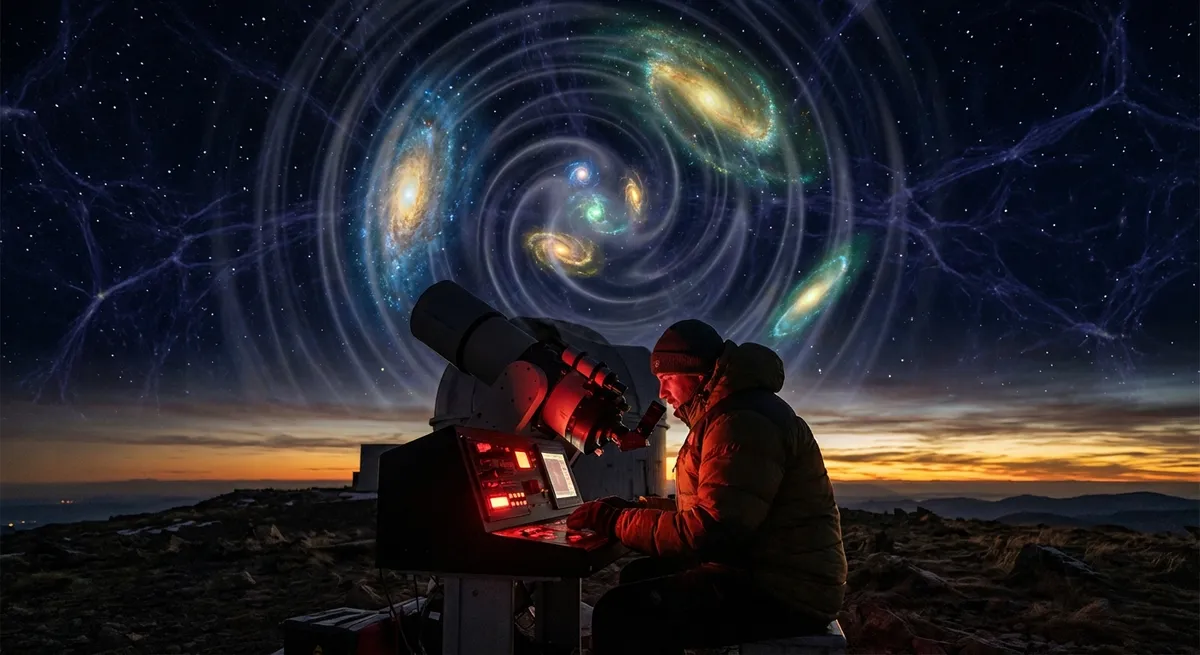
If you could step back far enough from the universe and look at it as a whole, you wouldn’t see a random scatter of galaxies. You’d see structure—an enormous 3D web.
Astronomers call it the cosmic web: vast filaments of galaxies and gas stretching hundreds of millions of light‑years, separated by huge voids. Galaxies are not sprinkled evenly through space; they gather along these filaments like cities along highways.
Here’s the twist: the cosmic web is traced by visible matter, but it was largely built by something we cannot see at all—dark matter. In the early universe, tiny clumps of dark matter pulled in gas with their gravity. Over billions of years, those clumps merged and stretched into filaments. Galaxies formed along these invisible “skeletons.”
Astronomers can’t see dark matter directly, but they can reconstruct its distribution by mapping millions of galaxies and watching how their motions deviate from what visible matter alone would predict. Surveys like the Sloan Digital Sky Survey and the Dark Energy Survey have shown that the large‑scale structure of the universe matches what dark‑matter‑driven simulations predict with uncanny precision.
Amazing Discovery #1: We’ve effectively mapped the invisible skeleton of the universe.
Using galaxy surveys, computer simulations, and gravitational lensing (light bending around mass), astronomers have built 3D maps of the cosmic web, showing that galaxies are tracing the shape of something far more massive and unseen.
Dark Matter: The Gravity We Can’t See (But Can Measure)
Dark matter is one of astronomy’s strangest success stories: it explains so much, yet has never been directly detected in a lab.
When astronomers measured how fast stars orbit in galaxies, they discovered something unsettling. The stars in the outer regions were moving too fast. If only visible matter existed, those stars should have flown off into space. Instead, they stayed bound—implying that galaxies sit inside enormous halos of unseen mass.
This invisible material interacts through gravity, but not with light. It doesn’t glow, doesn’t absorb, and doesn’t reflect. Galaxies, galaxy clusters, and the cosmic web all behave as if dark matter is there, outweighing normal matter by about 5 to 1.
One of the most striking pieces of evidence comes from collisions between galaxy clusters, such as the Bullet Cluster. When two clusters crash, the hot gas (visible in X‑rays) slams together and slows down. But most of the mass, traced by gravitational lensing, passes almost straight through, barely interacting. The mass and the glowing gas separate, revealing that most of the mass is something invisible and ghostlike: dark matter.
Amazing Discovery #2: Colliding galaxy clusters show dark matter separating from normal matter.
In events like the Bullet Cluster, the center of gravity is physically offset from the visible gas. Space itself acts like a detector, revealing that most of the matter is dark and barely interacts with anything except through gravity.
Gravitational Lensing: When Space Itself Becomes a Telescope
Einstein predicted it. Space confirmed it. And astronomy is now built on it.
According to general relativity, mass curves spacetime, and light follows those curves. When light from a distant galaxy or quasar passes near a massive object—like a galaxy cluster—the path of that light gets warped. To us, that background object can appear stretched, magnified, or multiplied. This phenomenon is called gravitational lensing.
Sometimes the effect is gentle: distant galaxies appear slightly squashed or sheared—this “weak lensing” is used to map the distribution of dark matter across the sky. Other times, the lensing is dramatic: arcs, rings (Einstein rings), and multiple images appear around a foreground mass.
Lensing acts as a natural telescope, boosting the brightness of background galaxies that would otherwise be invisible. Astronomers have used galaxy clusters as lenses to glimpse some of the faintest, earliest galaxies formed not long after the Big Bang.
Amazing Discovery #3: Nature built us cosmic magnifying glasses.
Using gravitational lensing, telescopes like Hubble and the James Webb Space Telescope have imaged galaxies from the early universe—objects so distant and faint that, without the magnification from intervening mass, they’d be beyond our reach.
The Cosmic Microwave Background: Fossil Light from the Universe’s First Moments
Long before there were stars, galaxies, or planets, the universe was a hot, dense plasma—a glowing fog of particles and light. About 380,000 years after the Big Bang, the universe cooled enough for electrons and protons to combine into neutral atoms. Light that had been constantly scattered was suddenly free to travel.
We still see that light today. It has been stretched by the expansion of the universe into microwaves, forming a nearly uniform glow across the sky called the Cosmic Microwave Background (CMB).
At first glance, the CMB looks almost perfectly smooth. But zoom in, and you find tiny temperature differences—fluctuations of just a few millionths of a degree. Those minuscule ripples mark places where matter was slightly denser or less dense in the early universe. Over billions of years, they grew into galaxies and clusters.
By precisely measuring the CMB, spacecraft like COBE, WMAP, and Planck have pinned down the age, composition, and geometry of the universe. They’ve shown that normal matter, dark matter, and dark energy together create a cosmos that is remarkably close to flat on large scales, and about 13.8 billion years old.
Amazing Discovery #4: We’ve taken a baby picture of the universe.
The CMB is literally the oldest light we can see—a relic from when the universe was less than 400,000 years old. Its subtle patterns tell us the universe’s age, contents, and early conditions with extraordinary precision.
Gravitational Waves: Listening to the Universe’s Silent Collisions
For over a century, astronomy was about light: visible, radio, infrared, X‑ray, gamma‑ray. Then, in 2015, humanity detected something new: ripples in spacetime itself.
When massive objects like black holes or neutron stars collide or spiral together, they send out waves in the fabric of spacetime—gravitational waves—predicted by Einstein but long thought to be nearly impossible to measure. These waves stretch and compress space as they pass.
Facilities like LIGO (Laser Interferometer Gravitational-Wave Observatory) and Virgo use laser beams across kilometers‑long arms to detect changes in distance smaller than a proton’s width. In September 2015, they recorded the unmistakable signal of two black holes merging over a billion light‑years away.
Since then, dozens of gravitational‑wave events have been detected, revealing a previously hidden population of merging black holes and neutron stars. Unlike light, which can be blocked or absorbed, gravitational waves travel almost unhindered, carrying information from the most violent and opaque regions in the universe.
Amazing Discovery #5: We opened a completely new sense—hearing the universe.
Gravitational‑wave astronomy lets us observe phenomena that emit little or no light, such as black hole mergers. It turns the cosmos into a multi‑messenger story, where light, particles, and spacetime itself all carry different pieces of the same event.
Conclusion
The universe you see is only a sliver of what exists.
Galaxies trace an invisible cosmic web. Dark matter silently anchors structures. Gravitational lensing turns spacetime into a telescope. The Cosmic Microwave Background preserves a fossil record of the universe’s youth. Gravitational waves let us feel distant cataclysms rippling through reality.
Astronomy is no longer just about staring at bright points in the dark. It’s about uncovering the hidden architecture that holds everything together—and realizing that the most powerful forces in the cosmos are often the ones we cannot see at all.
Sources
- [NASA: Dark Matter](https://science.nasa.gov/universe/dark-matter/) - Overview of dark matter, its evidence, and role in cosmic structure
- [ESA Planck Mission – Cosmic Microwave Background](https://www.esa.int/Science_Exploration/Space_Science/Planck) - Details on CMB measurements and what they reveal about the early universe
- [LIGO Scientific Collaboration](https://www.ligo.org/science/Publication-GW150914/index.php) - Description of the first gravitational-wave detection from merging black holes
- [HubbleSite: Gravitational Lensing](https://hubblesite.org/contents/articles/gravitational-lensing) - Explanation of strong and weak lensing and how they’re used in astronomy
- [Sloan Digital Sky Survey (SDSS)](https://www.sdss.org/science/cosmology-and-the-universe/) - How large galaxy surveys map the cosmic web and constrain cosmology
Key Takeaway
The most important thing to remember from this article is that this information can change how you think about Astronomy.