Astronomy is often about what dazzles our eyes—nebulae glowing, galaxies swirling, stars exploding. But some of the most mind‑bending discoveries in modern space science come not from what we see, but from what we can’t. Invisible matter shaping galaxies, ghostly particles flying through your body, and ripples in spacetime itself have all forced us to rewrite our picture of the universe.
This is the story of the hidden architects of the cosmos—and five remarkable discoveries that revealed them.
The Universe That Shouldn’t Exist (But Does)
If you took only the things we can see—stars, planets, gas, dust—and ran the math, our universe would fall apart. Galaxies spin too fast. Galaxy clusters should fly apart. Large‑scale structures shouldn’t look the way they do.
In the 1930s, astronomer Fritz Zwicky noticed that galaxies in the Coma Cluster were moving so quickly that there wasn’t enough visible matter to hold them together with gravity. Something unseen—he called it “dunkle Materie,” or dark matter—had to be adding mass. Decades later, Vera Rubin measured how fast stars orbit in spiral galaxies. The outer stars were moving just as fast as those closer in, which shouldn’t happen if only visible matter were involved.
Taken together, these lines of evidence led to a radical conclusion: most of the matter in the universe is invisible, interacting primarily through gravity. Today’s best measurements suggest that:
- About 5% of the universe is normal matter (everything we can see and touch).
- About 27% is dark matter.
- About 68% is something even stranger: dark energy.
The universe we see—stars in the night sky, galaxies in telescopes—is just the tip of a cosmic iceberg.
Dark Matter: The Invisible Skeleton of Galaxies
Think of dark matter as the cosmic scaffolding on which galaxies are built. We can’t see it directly, but we watch its fingerprints in motion and light.
Astronomers use gravitational lensing—how mass bends light—to map dark matter. When they observe massive galaxy clusters, the background galaxies appear stretched, smeared, and distorted into arcs. By measuring those distortions, scientists reconstruct where the invisible mass must be hiding. The result: clumpy halos of unseen matter surrounding galaxies, like vast protective cocoons.
One of the most striking pieces of evidence comes from the Bullet Cluster—two galaxy clusters that collided. X‑ray images show where the hot gas (normal matter) ended up, while gravitational lensing shows where most of the mass went. The two don’t line up. The mass mostly followed the galaxies, not the gas. That strongly suggests some kind of non‑luminous matter passed through the collision with little resistance—just what you’d expect from dark matter.
And yet we still don’t know what dark matter is. Is it a new kind of particle? Something else entirely? Massive underground detectors and space telescopes are on the hunt. Until we solve it, dark matter remains one of the most tantalizing mysteries in science.
Amazing Space Fact #1:
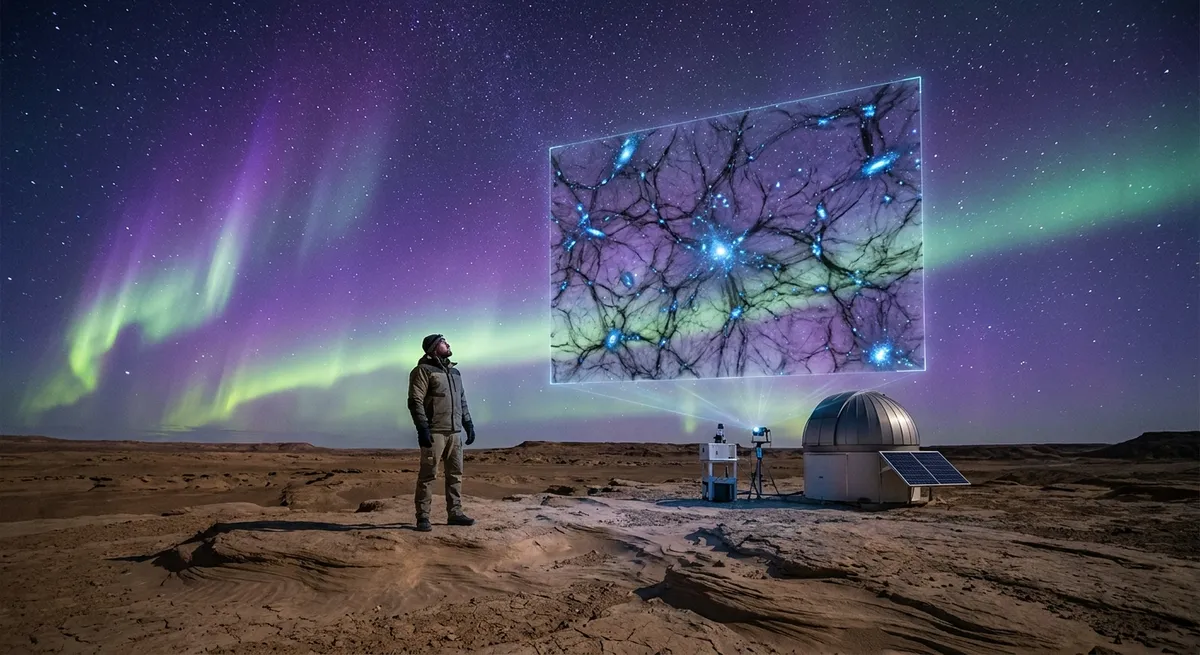
If you could instantly remove all dark matter from the universe, most galaxies (including the Milky Way) would eventually fly apart or never have formed in the first place. Dark matter is literally holding the cosmic web together.
Dark Energy: The Force Making Space Race Away
As if unseen matter weren’t strange enough, the late 1990s delivered an even bigger shock. Two independent teams of astronomers used Type Ia supernovae—exploding white dwarf stars that shine with fairly uniform brightness—as “standard candles” to measure cosmic distances. They expected to find that the universe’s expansion was slowing down due to gravity.
Instead, they found the opposite: distant supernovae were dimmer than expected, meaning they were farther away than they should be in a decelerating universe. The expansion of space is not slowing; it’s accelerating.
To explain this, cosmologists proposed dark energy: a mysterious form of energy woven into the fabric of spacetime itself, driving galaxies apart faster and faster. It doesn’t clump like matter; it acts more like a negative pressure, pushing the universe outward.
No one yet knows what dark energy is. It might be the energy of empty space (a “cosmological constant”), a dynamic field, or something even more exotic. But its effect is clear in the data:
- The cosmic microwave background (the afterglow of the Big Bang) shows a universe whose geometry and structure require dark energy.
- Large‑scale galaxy surveys trace how structure grew over time, consistent with an accelerating expansion.
- Independent measurements of cosmic expansion all point to the same conclusion.
Amazing Space Fact #2:
Dark energy currently dominates the universe’s total energy budget—around two‑thirds of everything—yet we have no confirmed explanation for its nature. It is the most influential “thing” in the cosmos, and we don’t know what it is.
Neutrinos: Ghost Particles Streaming Through You
Right now, trillions of particles are passing through your body every second, mostly without interacting at all. These are neutrinos: nearly massless, electrically neutral particles born in nuclear reactions in the Sun, exploding stars, radioactive decay, and even the Big Bang.
Neutrinos were first proposed in 1930 to solve a puzzle: some radioactive decays seemed to “lose” energy and momentum. To conserve these quantities, physicist Wolfgang Pauli suggested an unseen particle was sneaking off with the missing energy. Enrico Fermi later developed a full theory of this mysterious particle, naming it the neutrino—“little neutral one.”
For decades, we thought neutrinos were completely massless. But experiments detecting neutrinos from the Sun found fewer electron‑type neutrinos than expected. The solution: neutrinos can oscillate—change flavors (electron, muon, tau) as they travel. This can only happen if they have mass, however tiny. That discovery required updating the Standard Model of particle physics.
Neutrino detectors are some of the strangest observatories on Earth: tanks of ultra‑pure water deep underground, Antarctic ice laced with sensors, or massive volumes of liquid scintillator. They wait for the rare neutrino that happens to interact, creating a faint flash of light that reveals its presence and direction.
Neutrinos give us a new kind of “vision.” While light may be blocked or scattered, neutrinos pass through dense matter and emerge carrying information from otherwise hidden regions—like the cores of stars or the heart of a collapsing supernova.
Amazing Space Fact #3:
A supernova in a nearby galaxy can send a burst of neutrinos that reaches Earth before the explosion becomes visible in light, acting as an early cosmic alarm system for star death.
Gravitational Waves: Listening to the Universe’s Silent Collisions
In 1916, Albert Einstein predicted that massive, accelerating objects would send ripples through spacetime—gravitational waves. For a century, they remained a purely theoretical idea, too faint to detect.
That changed in September 2015, when the LIGO detectors in the United States caught a fleeting signal: a gently rising “chirp” in their data. It matched what you’d expect from two black holes—each about 30 times the mass of the Sun—spiraling together and merging more than a billion light‑years away. Space itself had stretched and squeezed by less than the width of a proton over a 4‑kilometer detector arm, and yet we detected it.
Since then, LIGO and its partners (like Virgo and KAGRA) have recorded dozens of mergers involving black holes and neutron stars. Gravitational waves have turned the universe into not just something we see, but something we can listen to.
In 2017, astronomers detected gravitational waves from two colliding neutron stars and saw the explosion in light across the electromagnetic spectrum. This multi‑messenger event revealed where many heavy elements—like gold and platinum—are forged: in the violent mergers of dead stars.
Amazing Space Fact #4:
The first detected black hole merger converted about three Suns’ worth of mass directly into gravitational wave energy in a fraction of a second—briefly outshining all the stars in the observable universe in gravitational radiation.
The Cosmic Microwave Background: Afterglow of the First Light
Long before stars or galaxies existed, the universe was hot, dense, and opaque—a glowing plasma of particles and light. About 380,000 years after the Big Bang, the cosmos cooled enough for electrons and protons to combine into neutral atoms. Suddenly, light could travel freely. That ancient light has been stretching with the expansion of the universe ever since, cooling into a faint microwave glow that fills all of space.
This is the cosmic microwave background (CMB)—the oldest light we can see, a baby picture of the universe. First detected accidentally in 1964 as a persistent “hiss” in a radio antenna, it has since been mapped in exquisite detail by missions like COBE, WMAP, and Planck.
The CMB is astonishingly uniform, but not perfectly so. Tiny temperature differences—only tens of microkelvin—encode information about:
- The composition of the universe (normal matter, dark matter, dark energy).
- The age and geometry of space.
- The seeds of galaxies and galaxy clusters.
- Conditions in the first fraction of a second after the Big Bang.
By analyzing the CMB, scientists have pinned down the age of the universe to about 13.8 billion years and confirmed that on large scales, space is very nearly flat. It’s one of the most powerful tools we have for testing cosmological models.
Amazing Space Fact #5:
If your TV or radio ever picked up “static” between channels, a tiny fraction of that noise—roughly 1%—was the cosmic microwave background, the fossil light from the infant universe washing through your living room.
Conclusion
Astronomy has evolved from charting visible stars to uncovering a hidden cosmic infrastructure: dark matter silently sculpting galaxies, dark energy accelerating space, neutrinos ghosting through us, gravitational waves shivering spacetime, and the CMB whispering from the dawn of time.
The more precisely we measure the universe, the stranger it becomes. What we can see is only a sliver of what exists, and each discovery of the unseen—whether it’s ghost particles or spacetime ripples—acts like a new sense, revealing a universe that is richer, darker, and more wondrous than our eyes alone could ever imagine.
We are, in a very real way, inhabitants of a hidden universe. And with every new detector, telescope, and theory, we’re learning to read the signature of the things that silently shape everything we see.
Sources
- NASA – Dark Matter and Dark Energy – Overview of dark matter and dark energy, including observational evidence and current theories
- ESA – Planck Mission: Cosmology Results – Details on how the Planck spacecraft mapped the cosmic microwave background and what it revealed about the universe
- LIGO – Gravitational Waves and Discoveries – Explanation of gravitational waves, the first detections, and their significance for astronomy
- IceCube Neutrino Observatory – What Are Neutrinos? – Introduction to neutrinos, how they are detected, and what they tell us about the universe
- NASA – Bullet Cluster Evidence for Dark Matter – Discussion of the Bullet Cluster observation and why it is strong evidence for dark matter
Key Takeaway
The most important thing to remember from this article is that this information can change how you think about Astronomy.