In the cold outskirts of our Solar System, far beyond the warm comfort zone of Earth, something astonishing is happening: worlds that look like frozen, dead snowballs may actually be hiding global oceans — and possibly life — beneath their ice. For decades, scientists assumed that “habitable” meant Earth-like planets bathed in starlight. Now, space missions, telescope data, and clever physics are revealing a different story: entire oceans can exist in the dark, powered not by sunlight, but by tidal forces and radioactive heat.
These discoveries are quietly rewriting what it means for a world to be “alive.” Here are five remarkable space facts and discoveries that show how icy moons and hidden oceans are transforming the search for life in the universe.
Icy Moons Are Now Top Candidates for Alien Life
For a long time, Mars and Earth-like exoplanets were the main targets in the search for life. But evidence is now stacking up that some of the most promising homes for biology may be small, frozen moons orbiting giant planets.
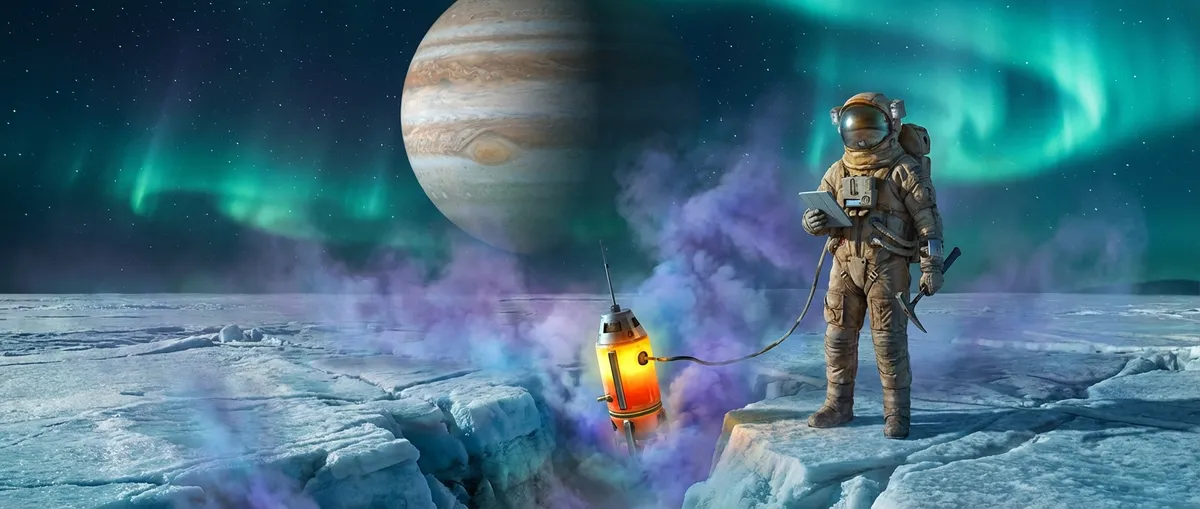
Jupiter’s moon Europa and Saturn’s moon Enceladus are the poster children of this new frontier. Beneath their bright, cracked ice shells lie deep, salty oceans kept liquid by tidal heating — the constant squeezing and stretching caused by the gravity of their giant parent planets. Europa’s ocean may contain more water than all of Earth’s oceans combined. Enceladus, meanwhile, vents its ocean into space through towering geysers that the Cassini spacecraft actually flew through, sampling their contents.
This shift in focus is profound: it suggests that life in the universe might not care whether a world gets much sunlight at all. If you have liquid water, a source of energy, and the right chemistry, even a seemingly frozen moon might be surprisingly alive on the inside.
Fact 1: Enceladus Is Spraying Its Ocean into Space — and It Contains Key Ingredients for Life
Saturn’s tiny moon Enceladus is only about 500 kilometers wide, but it behaves like a fully active world. Cassini’s close flybys revealed geysers erupting from cracks near its south pole—huge plumes of water vapor, ice grains, and organic molecules shooting hundreds of kilometers into space.
Cassini didn’t just image those plumes, it flew through them. Instruments on board detected water vapor, carbon dioxide, methane, ammonia, and a variety of organic compounds. Even more striking: later analysis of the data suggested the presence of molecular hydrogen (H₂) in the plumes, a clue that hydrothermal vents — hot, chemical-rich openings on the seabed — may exist on Enceladus’ ocean floor.
On Earth, hydrothermal vents at the bottom of our oceans host thriving ecosystems completely independent of sunlight, powered by chemistry instead of photosynthesis. The idea that something similar could be happening on Enceladus turns this icy moon into one of the most compelling targets for future “life detection” missions.
Fact 2: Europa’s Cracked Ice Shell May Be Floating on a Deep Global Ocean
Europa, one of Jupiter’s large Galilean moons, looks like a smooth, bright marble etched with dark, rust-colored fractures. Those mysterious lines are more than just scars; they’re clues that its icy shell is mobile and may be drifting over an underlying ocean.
The Galileo spacecraft, which orbited Jupiter in the late 1990s and early 2000s, detected strange patterns in Europa’s magnetic field. These were best explained by a conducting layer beneath the surface — likely a salty ocean. Models suggest this ocean may be 60–150 kilometers deep, wrapped entirely around the moon.
Even more intriguing, recent observations from the Hubble Space Telescope and re-analyses of Galileo data hint at sporadic water vapor plumes erupting from Europa’s surface, much like Enceladus, though the evidence is still debated. If confirmed, those plumes would give future spacecraft the chance to “taste” Europa’s ocean without having to drill through kilometers of ice.
NASA’s upcoming Europa Clipper mission, set to launch in the 2020s, is designed to fly repeatedly past Europa, mapping its ice shell, measuring its ocean, and searching for the chemistry that life would need to thrive.
Fact 3: Ocean Worlds May Be Common — Even Pluto Likely Had (or Has) One
The idea of hidden oceans is no longer limited to a few special moons. It’s becoming clear that “ocean worlds” — bodies with subsurface liquid water — might be common in our Solar System.
Beyond Europa and Enceladus, several other moons show signs of internal oceans:
- Ganymede (Jupiter): The largest moon in the Solar System appears to have a layered ocean beneath its icy crust, perhaps sandwiched between sheets of high-pressure ice.
- Callisto (Jupiter): Magnetic data hints at a salty, subsurface ocean as well.
- Titan (Saturn): Best known for its thick atmosphere and surface lakes of liquid methane and ethane, Titan likely hides a deep water-ammonia ocean below its icy crust.
- Pluto (dwarf planet): Data from NASA’s New Horizons mission suggest Pluto may once have had a subsurface ocean and may still retain one today, insulated by its thick ice shell.
This reshapes how scientists think about habitability. Instead of a narrow “Goldilocks zone” around a star, where temperatures allow liquid water on a planet’s surface, we now see that tidal heating, chemical energy, and radioactive decay can keep water liquid far from sunlight. That means the outer Solar System — once considered a frozen wasteland — might actually be teeming with habitable environments.
Fact 4: We’re Building Missions Specifically to Test These Oceans for Life
The era of simply suspecting subsurface oceans is ending. The next generation of missions is being built to probe them directly — and, in some cases, to look for clear signs of biology.
Key missions include:
- Europa Clipper (NASA): Will conduct dozens of close flybys of Europa, using radar to measure ice thickness, instruments to map chemistry, and sensors to detect potential plumes and their contents.
- JUICE (JUpiter ICy moons Explorer, ESA): Launched by the European Space Agency, JUICE will explore Jupiter’s icy moons, especially Ganymede, to study their oceans, surfaces, and potential habitability.
- Dragonfly (NASA): A rotorcraft mission to Titan, launching later in the 2020s, will hop across Titan’s surface, sampling organic-rich environments. While Titan’s subsurface ocean won’t be directly explored, Dragonfly will investigate complex chemistry that could be related to prebiotic processes.
Each mission is part laboratory, part detective. They’re designed to measure ingredients for life: liquid water, organic molecules, sources of energy, and environments that stay stable for long periods. The long-term goal is bold but clear: determine whether any of these hidden oceans show evidence that life ever gained a foothold there.
Fact 5: Ocean Worlds Are Redefining Where We Look for Life Beyond Our Solar System
These icy moons are not just local curiosities; they’re training us to recognize similar environments around other stars.
When astronomers detect exoplanets and exomoons, they often can’t see surfaces directly, but they can measure mass, size, and distance from the star. Worlds that are small, dense, and far from their stars might once have been dismissed as frozen and lifeless. Now, informed by Europa and Enceladus, scientists consider whether such planets and moons might hide oceans insulated by ice.
Some exoplanets known as “water worlds” could be covered in deep global oceans with high-pressure ice layers at the bottom. Others might be “super-Europas” — icy bodies with powerful tidal heating inside multi-planet systems. As detection methods improve, we may soon find worlds whose density and behavior can only be explained by massive amounts of internal water.
In other words, the lesson from our own backyard is expanding outward: the universe might be filled with oceans we can’t see — and some of them may be quietly hosting biology beneath the dark.
Conclusion
The most promising places to find alien life in our Solar System may not be sunlit surfaces, but hidden oceans in the dark — worlds wrapped in ice, warmed from within, and rich in chemistry. Enceladus spraying its ocean into space, Europa’s restless ice crust, Ganymede and Titan’s buried seas, and even Pluto’s possible ancient ocean together tell a single, extraordinary story: water and energy can create habitable niches in places we once wrote off as lifeless.
As missions like Europa Clipper, JUICE, and Dragonfly prepare to launch, we stand at the edge of a new era. The question is no longer just “Is there another Earth?” but also “How many oceans, hidden beneath ice and darkness, are waiting to be discovered?” The answer may transform our understanding of where life can exist — not just in our Solar System, but across the cosmos.
Sources
- NASA – Ocean Worlds: The Search for Life in the Solar System – Overview of known and suspected ocean worlds and why they matter for astrobiology
- NASA – Enceladus: Cassini’s Discoveries of a Potentially Habitable Ocean World – Details on Enceladus’ plumes, ocean, and evidence for hydrothermal activity
- NASA – Europa Clipper Mission – Official mission site describing how Europa Clipper will investigate Europa’s ocean and habitability
- ESA – JUICE (JUpiter ICy moons Explorer) – European Space Agency mission overview for exploring Jupiter’s icy moons
- Johns Hopkins APL – Dragonfly: Exploring Titan’s Organic Chemistry – Mission information on Dragonfly and its goals for studying Titan’s surface and complex chemistry
Key Takeaway
The most important thing to remember from this article is that this information can change how you think about Space News.