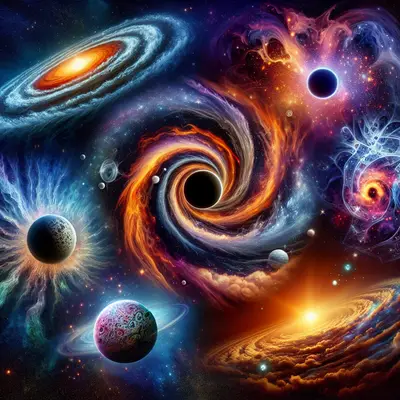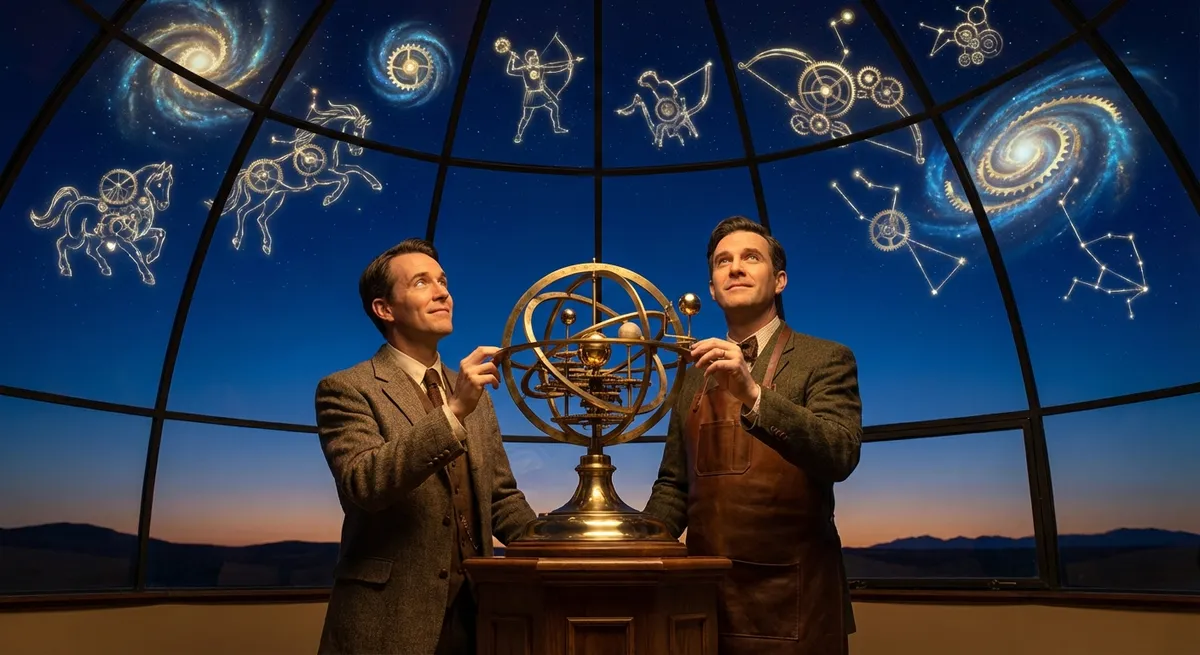
The universe is not a silent freeze-frame; it’s a grand, ticking mechanism with clocks made of stars, atoms, and even invisible waves in spacetime. Long before humans invented seconds and calendars, the cosmos was already keeping time—through pulsating stars, radioactive atoms, orbiting planets, and the fading glow of ancient explosions. Today, astronomers read these cosmic clocks to reconstruct the universe’s past and predict its future.
In this journey through space and time, we’ll explore how the universe measures itself, and along the way uncover five astonishing discoveries that reveal just how precisely the cosmos keeps the beat.
The Universe’s First Clocks: Pulsars and Stellar Heartbeats
When a massive star dies in a supernova, its core can collapse into a neutron star—an object so dense that a teaspoon of its material would outweigh a mountain. Some neutron stars spin and beam radiation from their magnetic poles like a cosmic lighthouse. As they rotate, their beams sweep across Earth with astonishing regularity. These objects are called pulsars, and they’re among the most precise natural clocks in existence.
Astronomers discovered the first pulsar in 1967, when Jocelyn Bell Burnell noticed an odd, repeating radio signal that clicked on and off with perfect rhythm. At first, it was so regular that researchers half-joked it might be a signal from extraterrestrials. It wasn’t aliens—but it was something equally revolutionary: a star turning itself into a perfect timekeeper, spinning dozens or even hundreds of times per second.
Some pulsars, known as millisecond pulsars, rotate over 700 times per second with mind-bending consistency. Their timing can rival the most advanced atomic clocks on Earth. Scientists now use networks of pulsars like a galactic-scale GPS, tracking tiny changes in their pulses to detect ripples in spacetime and even test Einstein’s theory of general relativity.
Amazing Fact #1: A neutron star can spin faster than a kitchen blender.
The fastest known pulsar, PSR J1748–2446ad, rotates about 716 times per second—its surface whirling at roughly a quarter of the speed of light.
Atomic Time vs. Cosmic Time: How We Sync Our Clocks to the Sky
On Earth, our most accurate clocks are atomic clocks, which measure time by tracking the vibrations of atoms—usually cesium or ytterbium. These clocks are so precise they would lose or gain about a second only over tens of billions of years. That level of stability helps run GPS, telecommunications, and global financial systems.
But even these hyper-precise clocks need a cosmic reference. Our concept of a “day” comes from Earth’s rotation, and a “year” from Earth’s orbit around the Sun. The problem: Earth is a slightly imperfect clock. Tides, shifting winds, melting ice, and even earthquakes can subtly alter the planet’s spin. Over centuries, days lengthen by milliseconds.
To keep civil time aligned with astronomical reality, global timekeepers occasionally add leap seconds to Coordinated Universal Time (UTC). These tiny adjustments are needed because Earth’s rotation is gradually slowing down, primarily thanks to tidal friction between Earth and the Moon. Without such corrections, our clocks would slowly drift away from the sky.
Amazing Fact #2: Days on Earth are getting longer.
Hundreds of millions of years ago, a day on Earth was closer to 21 hours long. Fossil coral growth rings and ancient tidal deposits show that the number of days per year has decreased as Earth’s spin has gradually slowed.
Radioactive Time Capsules: How Atoms Reveal the Age of Space
Some of the most powerful clocks in astronomy are invisible to the eye and don’t tick in the usual sense. They’re radioactive atoms, slowly decaying according to well-understood physical laws. This process—radioactive decay—allows scientists to measure time spans that stretch into billions of years.
By examining the ratios of radioactive elements and their decay products in meteorites, lunar rocks, and Earth’s crust, researchers can reconstruct when those rocks formed. That’s how we know the solar system is about 4.6 billion years old. It’s like opening a time capsule sealed with atomic glue.
Astronomers extend this method to distant stars as well. Some long-lived radioactive elements, like thorium and uranium, are created in rare, violent events such as neutron-star mergers. Traces of these elements in ancient stars act as cosmic stopwatches, helping scientists estimate how long ago those stars were born and how long the universe has been manufacturing heavy elements.
Amazing Fact #3: We age the universe using “stellar radioactive archaeology.”
By studying the decay of thorium and uranium in very old stars, astronomers have independently confirmed that the universe is about 13.8 billion years old—consistent with measurements from the cosmic microwave background.
Gravitational Waves: Time Ripples from Colliding Giants
In Einstein’s picture of the universe, gravity isn’t a force pulling objects together—it’s the curvature of spacetime itself. When extremely massive objects like black holes or neutron stars collide, they disturb spacetime so violently that ripples, called gravitational waves, travel outward at the speed of light.
For a century, these waves were purely theoretical. Then, in 2015, the LIGO observatories in the United States made the first direct detection: a tiny stretching and squeezing of space, less than the width of a proton, as two black holes billions of light-years away spiraled together and merged. The signal lasted just fractions of a second, but it carried a detailed record of the final moments of their orbit.
These ripples are a new way to keep time in the universe. By measuring the pattern and timing of gravitational waves from many events, astronomers can reconstruct how often black holes and neutron stars collide, how they form, and how the universe’s expansion affects the travel of these waves across cosmic distances.
Amazing Fact #4: Earth’s size changes as gravitational waves pass through us.
When a strong gravitational wave hits Earth, our planet is very slightly stretched and squeezed. We don’t feel it, but exquisitely sensitive instruments like LIGO can detect distortions smaller than one ten-thousandth the diameter of a proton over kilometers of distance.
Cosmic Expansion: The Universe’s Speeding Clock
One of the most dramatic “clocks” in astronomy isn’t tied to a single object, but to the universe as a whole. Space itself is expanding, a discovery first made in the 1920s when Edwin Hubble observed that distant galaxies are rushing away from us. The farther a galaxy is, the faster it recedes. This relationship, known as Hubble’s law, is a cosmic timestamp embedded in the light of galaxies.
By measuring how much the light from distant galaxies has been stretched—redshifted—as space expands, astronomers can infer how long their light has been traveling. This serves as a kind of cosmic odometer, revealing how the expansion rate has changed over time. The surprising result: about 5 billion years ago, the universe’s expansion began to accelerate, likely driven by a mysterious component called dark energy.
This expansion defines a cosmic time horizon. There are galaxies so far away that, due to the accelerating expansion, their light will never reach us. In a distant future, only the closest galaxies will remain visible; the rest of the universe’s history will be permanently out of reach, hidden beyond a horizon drawn by the flow of cosmic time.
Amazing Fact #5: Some galaxies are already receding faster than light.
Because space itself is expanding, very distant galaxies can move away from us at an effective speed greater than light—not by breaking the speed limit locally, but because the fabric of space between us and them is stretching. We can still see some of them now because their light left long ago, but in the far future their new light will never arrive.
Conclusion
From pulsars spinning like celestial metronomes to radioactive atoms counting down billions of years, from gravitational waves echoing through spacetime to the accelerating expansion of the universe itself, the cosmos is filled with clocks far stranger and more precise than anything humans first imagined when we watched the Sun cross the sky.
By decoding these hidden rhythms, astronomers are not just measuring time—they’re reconstructing a 13.8-billion-year story: when the first stars ignited, how galaxies assembled, when black holes collided, and how the expansion of the universe is rewriting its future. The next time you glance at a clock, remember: it’s just one tiny echo of a much grander mechanism, one in which the entire universe is keeping time.
Sources
- NASA – Pulsars: Neutron Stars with a Pulse – Overview of pulsars, their discovery, and how they are used as cosmic clocks
- National Institute of Standards and Technology (NIST) – Time and Frequency Division – Explains atomic clocks, precision timekeeping, and how civil time is maintained
- European Space Agency (ESA) – Gravitational Waves – Background on gravitational waves and their role in modern astronomy
- NASA – Hubble’s Law and the Expanding Universe – Describes evidence for cosmic expansion and how astronomers measure it
- Planck Mission (ESA) – Age of the Universe – Details on how observations of the cosmic microwave background reveal the universe’s age and history
Key Takeaway
The most important thing to remember from this article is that this information can change how you think about Astronomy.