Every time a rocket lifts off, it’s not just carrying satellites or space probes—it’s carrying pieces of our future civilization. Bit by bit, orbit is turning into a new layer of Earth itself: a digital shell where we store knowledge, watch our climate, move money, talk to each other, and test the machines that will one day leave the solar system. Space tech is no longer just about going “out there.” It’s about building a second, invisible version of Earth—one that hums above our heads, 24/7.
In that growing shell of metal, solar panels, code, and plasma, some of the most surprising discoveries aren’t happening in far‑off galaxies; they’re happening in the silence of low Earth orbit, in the data our satellites send back, and in the tiny experiments that ride on rockets as “secondary payloads.” Here’s how today’s space technology is quietly reshaping life on the ground—and five astonishing facts that reveal just how far we’ve already gone.
The New Skin of Earth: Satellites as Planet‑Scale Sensors
Our planet now wears a technological skin—tens of thousands of satellites and fragments of hardware, with hundreds of new spacecraft added each year. But within that floating swarm is an extraordinary nervous system: instruments that can measure the tiniest changes in ice, ocean height, air pollution, and even the shifting mass of underground water.
Modern Earth‑observing satellites don’t just take pictures; they sense. Radar satellites can see through clouds and at night, tracing the shape of waves, ground deformation after earthquakes, or the slow sag of a sinking city. Infrared instruments track the heat signatures of wildfires in near real time. Spectrometers dissect sunlight reflected from Earth, teasing out fingerprints of methane leaks from a single facility, or nitrogen dioxide over a single city block.
This planetary sensing network is turning climate science into something we can watch almost live. It’s also quietly changing geopolitics and disaster response: organizations now monitor floods, crop failures, and deforestation from orbit, and responders on the ground can receive satellite maps within hours of an earthquake or hurricane. In a very real sense, space tech has given Earth its first true full‑body mirror.
Amazing Discovery #1: Satellites Can Weigh Planet‑Sized Changes
The GRACE and GRACE‑FO missions use pairs of satellites chasing each other around Earth to measure tiny changes in the distance between them—microscopic stretches caused by variations in gravity. From those shifts, scientists can “weigh” moving water: how much ice Greenland has lost, how full underground aquifers are, and how sea level is rising across the globe. No human eye sees these changes directly; space tech does the sensing for us.
Rocket Science Meets Microchips: The Rise of Tiny, Smart Spacecraft
For most of spaceflight history, “satellite” meant something big, heavy, and expensive. Now, some of the most capable machines in orbit weigh less than a suitcase. CubeSats and smallsats—modular spacecraft as little as 10 cm across—have turned orbit into a laboratory for students, startups, and entire countries that never had a space program before.
These tiny satellites pack surprising power: high‑resolution cameras, AI chips to analyze data before it’s sent back, and even propulsion systems the size of a paperback book. Instead of waiting years for a single flagship satellite, companies can launch flocks of small craft that work in swarms, scanning the entire Earth every day.
Because the hardware is cheaper and launches more frequent, space tech can now iterate like software. Instruments are tested, improved, and replaced quickly. This has transformed what used to be “heroic missions” into something closer to a constant upgrade cycle for Earth’s orbital infrastructure.
Amazing Discovery #2: AI Is Already Running in Orbit
Some Earth‑imaging companies now fly satellites that use artificial intelligence directly on board. Rather than sending all raw images down, they scan for specific patterns in space—like ships where no ships should be, unexpected smoke plumes, or signs of illegal fishing—and only transmit the interesting pieces. In other words, our first widely deployed, off‑world AI systems aren’t humanoid robots on Mars; they’re quiet software minds filtering information 500–700 km above Earth.
Space as the Ultimate Materials Lab
Space is more than “empty” vacuum; it’s a strange laboratory with an unusual set of rules. Microgravity, intense radiation, and endless vacuum make orbit a testbed no Earth‑bound facility can fully replicate. Space tech has begun to exploit this, transforming the space station and private stations into orbital factories and research labs.
In microgravity, liquids behave like slow‑motion sculptures; crystals can grow larger and purer; alloys mix without gravity pulling heavy elements down. Experiments on the International Space Station (ISS) have explored new fiber‑optic materials, more precise protein crystals for drug development, and metal alloys with properties that could improve turbines and engines back on Earth.
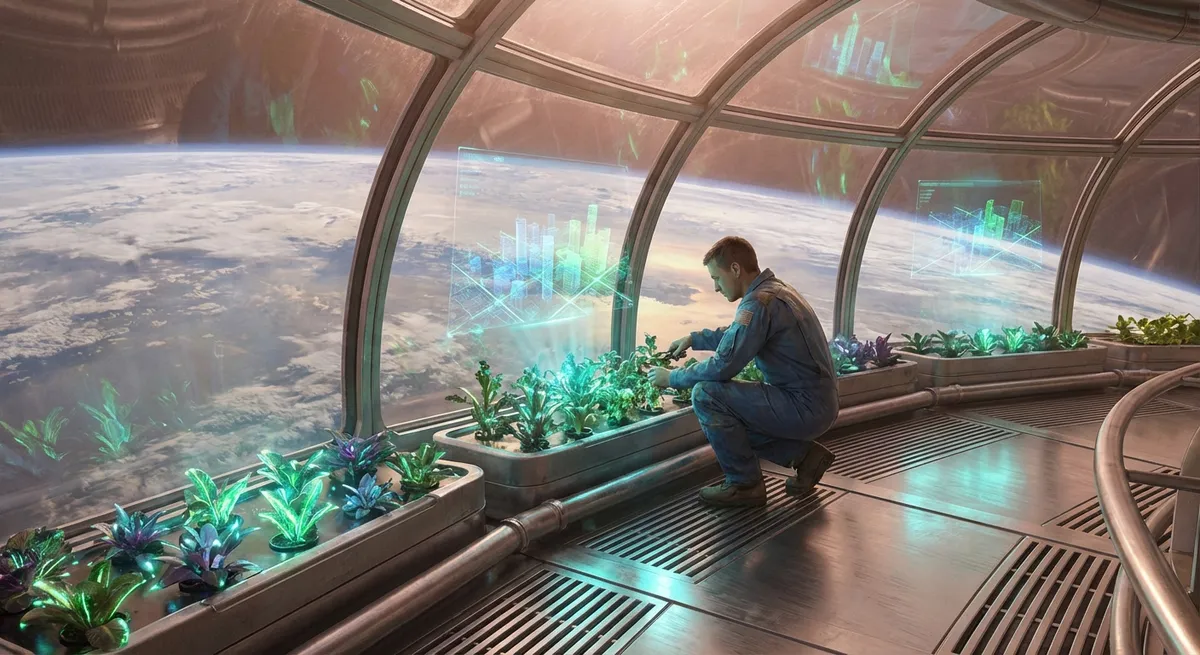
We’re also discovering how living systems respond to this unusual environment: how bones lose mass, how plants grow with light but almost no “up” or “down,” how microbes adapt under cosmic radiation. Every one of these studies is both a lesson in fundamental biology and a preview of the challenges we’ll face when humans live off‑world long‑term.
Amazing Discovery #3: Space‑Grown Protein Crystals Can Make Medicine Sharper
In microgravity, protein molecules can form exceptionally ordered crystals, with fewer defects than on Earth. Those perfect structures allow scientists to map proteins in higher resolution, which can directly improve the design of certain drugs. Orbit, in effect, becomes a precision tool—helping us understand the shape of life’s machinery more clearly than Earth’s gravity usually allows.
Navigation Without Roads: How Space Keeps Us Aligned
Behind every map on your phone and every time‑synced financial transaction lies a quiet constellation of clocks in orbit. GPS and other global navigation satellite systems (GNSS) are often described as “positioning” systems, but in practice they are time machines: ultra‑precise atomic clocks broadcasting timestamps. Your receiver calculates how long those signals took to arrive from multiple satellites and turns those delays into position.
Space tech had to solve an extraordinary problem here: how to keep clocks so accurate that even relativity matters. Time passes slightly differently for satellites high above Earth’s surface and moving at orbital speeds. Engineers must correct for both general relativity (gravity slowing time) and special relativity (motion affecting time) to make sure position fixes don’t drift by kilometers each day.
The same timing infrastructure underpins power grids, financial trades, and even cellular networks. If GNSS systems vanished, much of our modern digital life would unravel in hours. Our phones and planes don’t just talk to space; they rely on space to agree on what “now” means.
Amazing Discovery #4: Relativity Is Baked into Everyday Navigation
GPS satellites carry atomic clocks that would drift by about 38 microseconds per day relative to clocks on Earth if relativity weren’t accounted for—enough to introduce navigation errors of around 10 km daily. To prevent this, engineers deliberately offset the satellite clocks before launch and apply continuous relativistic corrections in orbit. Einstein’s theories are not abstract here; they’re quietly steering ships, planes, and rideshares.
Space Weather: The Invisible Storms We’ve Learned to Watch
Beyond the blue sky, the Sun is constantly throwing a storm at us: charged particles, twisting magnetic fields, and blasts of plasma that race outward at millions of kilometers per hour. Most of the time, Earth’s magnetic shield deflects this space weather harmlessly. But when solar eruptions line up just right, they can distort that shield, trigger auroras far from the poles, and buffet our orbital infrastructure.
Satellites now act as early‑warning buoys in this invisible ocean. Probes like the Solar and Heliospheric Observatory (SOHO), the Deep Space Climate Observatory (DSCOVR), and newer missions sit between Earth and the Sun, staring at our star and sampling the solar wind before it reaches us.
This gives power grid operators, spacecraft controllers, and aviation authorities crucial minutes to hours of warning before major geomagnetic storms arrive. As our reliance on space‑based systems grows, space weather forecasting becomes as essential as ground‑level meteorology.
Amazing Discovery #5: Coronal Mass Ejections Can Charge Our Planet Like a Battery
During intense solar storms, currents can be induced in Earth’s crust and long conductors, including power lines and pipelines. In 1989, a geomagnetic storm knocked out power to millions in Quebec. Today’s satellites and solar observatories, combined with ground‑based magnetometers, are part of a planetary‑scale shield—designed not to stop the storm, but to help us brace for its impact.
The Next Leap: From Orbital Shell to Interplanetary Backbone
The technologies we’re refining in orbit now—autonomous spacecraft, resilient communications, robot maintenance, in‑space manufacturing—are rehearsal for a much bigger stage. Lunar communication networks will likely be extensions of Earth‑orbit systems. Deep‑space navigation will build on the timing lessons of GPS, perhaps adding pulsar‑based “cosmic GPS” for interplanetary probes. Orbital fuel depots, 3D‑printed satellite parts, and robotic servicing missions are early drafts of the infrastructure we’ll need around other worlds.
What’s remarkable is how seamlessly this cosmic scaffolding is blending into daily life. Most people using satellite internet, checking maps on their phones, or watching a storm form on a weather radar never think about the vacuum and orbital mechanics behind it. Yet the line between “Earth tech” and “space tech” is dissolving. Our devices, cities, and even our understanding of ourselves are now entangled with machines that never touch the ground.
As we continue to extend this second skin of Earth—denser with sensors, smarter with onboard AI, more intertwined with our economy—space stops being a distant frontier and becomes something closer to infrastructure. Not a place we merely visit, but a layer of our civilization we’re steadily learning to inhabit.
Conclusion
Space technology began as a daring experiment: could we even reach orbit at all? Today, it quietly underpins weather forecasts, global communications, emergency response, precision farming, and navigation systems that knit the world together. It doubles as a lab for new materials, a test range for AI, and a vantage point from which we can see the health of our entire planet in a single frame.
The five discoveries above—gravity‑sensing satellites, AI in orbit, space‑grown crystals, relativistic navigation, and storm‑watching sun probes—are glimpses of a deeper shift. Humanity is learning to treat space not as a backdrop, but as an active environment we can engineer, explore, and depend on.
We are, piece by piece, building Earth 2.0 in the sky. And every quiet satellite pass overhead is another reminder that our future is already floating above us, waiting to be noticed.
Sources
- NASA GRACE-FO Mission Overview – Explains how GRACE-FO satellites measure changes in Earth's gravity to track ice, water, and mass movement
- European Space Agency: Earth Observation – Overview of Earth‑observing satellites and their role in climate, disaster monitoring, and environmental science
- NASA: GPS and Relativity – Describes how general and special relativity affect GPS satellite clocks and how engineers correct for them
- NASA: International Space Station Research Overview – Details microgravity research on materials, biology, and protein crystal growth aboard the ISS
- NOAA Space Weather Prediction Center – Provides information on space weather, solar storms, and their impacts on satellites, power grids, and communication systems
Key Takeaway
The most important thing to remember from this article is that this information can change how you think about Space Tech.