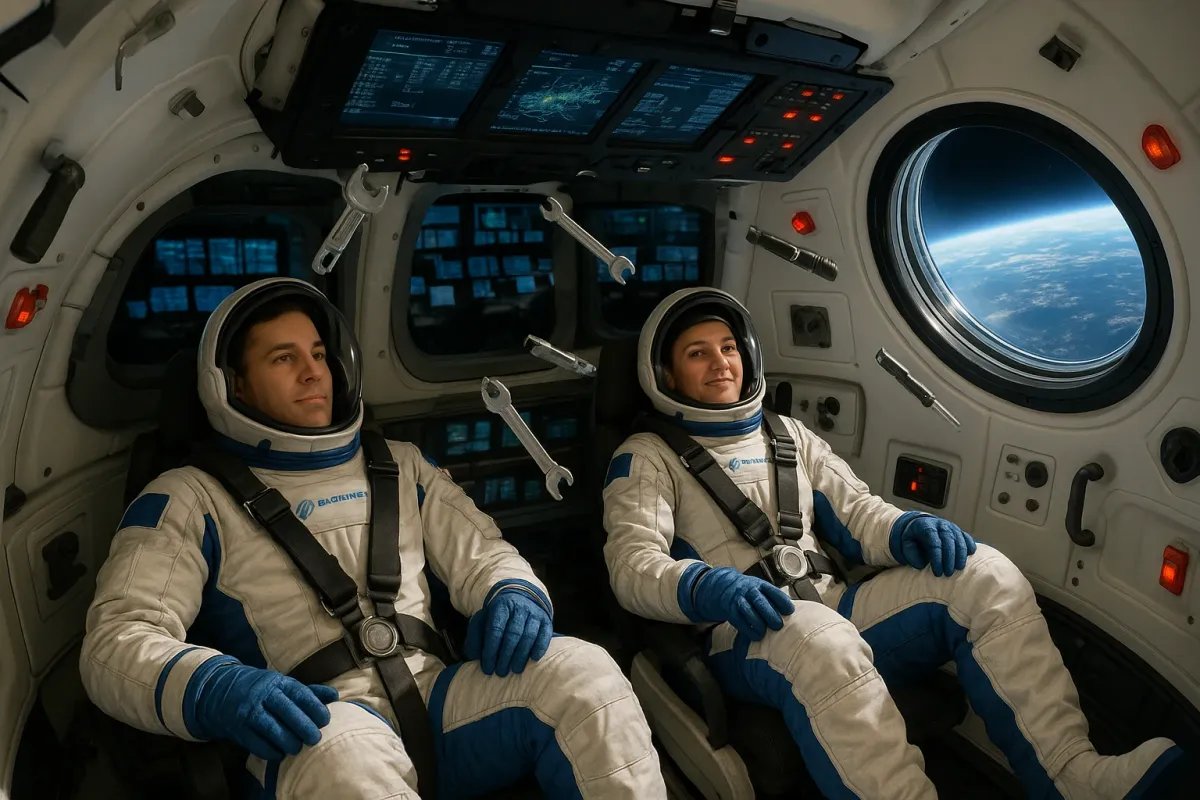
Boeing’s Starliner capsule has just turned into the most dramatic reality show in orbit—only this isn’t streaming on Netflix, it’s unfolding 400 kilometers above Earth with real astronauts on board. What was supposed to be a relatively routine crew test flight to the International Space Station (ISS) has become a stress test for the entire idea of commercial human spaceflight. Multiple helium leaks, stubborn thrusters, and a delayed ride home have pushed Starliner into global headlines—and forced everyone to ask: how ready are we, really, for a future where spaceflight is “normal”?
Yet hidden inside the tension of this mission is something far more interesting: a front-row view of how 21st‑century spacecraft are built, tested, and fixed in real time. Starliner’s problems are not just glitches; they’re lessons. And as NASA, Boeing, and their competitors like SpaceX watch this mission unfold, the future of human space travel is quietly being rewritten.
Below, we’ll break down what’s happening with Starliner right now—and along the way uncover five incredible, very real space-tech facts that show just how far we’ve come, and how far we still have to go.
Starliner’s High-Stakes Test: A Spacecraft Learning on the Job
Boeing’s CST‑100 Starliner finally launched its first crewed test flight to the ISS in June 2024, carrying NASA astronauts Butch Wilmore and Suni Williams. This mission has one job: prove Starliner is safe enough to ferry astronauts regularly, giving NASA a second commercial crew option alongside SpaceX’s Crew Dragon.
Instead, the flight has turned into an extended engineering exam. Before docking with the ISS, multiple reaction control thrusters misbehaved, and engineers detected several helium leaks in the propulsion system. Helium doesn’t power the engines—it’s used to pressurize the propellant—but losing it can eventually limit maneuvering capability. That’s why NASA is taking its time, running extra tests, and delaying the crew’s return while the spacecraft remains docked as a kind of orbital laboratory.
Here’s what’s wild: this is exactly what a test flight is supposed to do. The difference is that, unlike the Apollo era, we’re watching every setback unfold in public, in an age of instant social media commentary and corporate competition. Starliner’s current saga is less a failure and more a brutally honest snapshot of how hard human-rated spacecraft are to get right—even for a company that has been building airplanes and space hardware for decades.
Amazing Space Fact #1: Human-rated spacecraft are tested to survive about 10–12 G’s of launch and re-entry loads—even though astronauts typically experience only around 3–4 G’s on a normal ascent.
That enormous safety margin is part of why missions like Starliner’s take years to certify. Every valve, seal, and thruster has to survive the absolute worst day, not just the average day.
Why NASA Wants Two Space Taxis, Not One
You might wonder: if SpaceX’s Crew Dragon is already flying astronauts reliably, why bother with Starliner at all? The answer: redundancy. NASA has seen what happens when it relies on a single system. The loss of the Space Shuttle Columbia in 2003 shut down American crewed launch capability for nearly a decade, forcing NASA to buy seats on Russia’s Soyuz spacecraft.
The Commercial Crew Program was designed specifically to avoid that. NASA doesn’t want one “perfect” vehicle; it wants a market of vehicles. Boeing and SpaceX have very different engineering philosophies, supply chains, and avionics systems. That diversity acts like a biological ecosystem: more variety means more resilience. If one vehicle is grounded, the other can keep the ISS staffed and research ongoing.
Starliner’s difficulties actually underscore why this approach is wise. NASA can afford to be conservative with Starliner precisely because astronauts still have access to orbit on SpaceX flights. That breathing room allows engineers to pull data, tweak designs, and correct issues without the political panic that followed previous accidents.
Amazing Space Fact #2: Since the year 2000, the International Space Station has been continuously inhabited—over 24 straight years of humans living off Earth.
Commercial crew vehicles like Starliner and Crew Dragon are not just fancy taxis; they are lifelines that keep humanity’s longest-running off-world outpost alive.
The Hidden Hero of Modern Spaceflight: Software in the Loop
When people imagine spacecraft, they think of big engines and gleaming capsules. But modern spaceflight is driven at least as much by software as by hardware. Starliner is a perfect example. Its first uncrewed test flight in 2019 suffered from onboard software problems that caused timing errors and fuel overuse—enough to prevent it from reaching the ISS. Boeing and NASA spent years reviewing code line by line, adding simulations, and tightening verification processes.
On this current crewed test, the issues are more “plumbing than programming”: helium leaks and thrusters. Yet even these are deeply tied to software. How the vehicle detects a pressure drop, how it responds to a misfiring thruster, and how it reallocates control authority are all logic decisions running at machine speed. In 2024, a safe spacecraft isn’t just built—it’s debugged.
Crew Dragon, Orion (for Artemis Moon missions), and Starliner all use layers of fault-tolerant computers, redundant networks, and autonomous decision-making. Astronauts still pilot and command these vehicles, but increasingly they act more like test pilots of flying supercomputers than drivers of rockets.
Amazing Space Fact #3: A modern crew capsule can autonomously rendezvous and dock with the ISS to within centimeters—using lidar, radar, star trackers, and vision systems—while orbiting at 28,000 km/h (about 17,500 mph).
The “handshake” between spacecraft is now a robotic ballet: precisely choreographed by software, monitored by humans, and validated by thousands of hours of simulation.
Thrusters, Leaks, and Life Support: How Close Is “Too Close” to the Edge?
Hearing “helium leak” and “thruster problem” with astronauts on board sounds terrifying. But not every anomaly is an emergency. Spacecraft are designed with enormous margins and multiple “graceful degradation” modes: ways to remain safe even as certain capabilities are lost.
In Starliner’s case, the service module—where the thrusters and helium systems live—will be discarded before re-entry. That gives engineers an important freedom: they can use and test those systems aggressively while they’re still attached, logging as much real data as possible. The crew capsule itself, which returns to Earth, has its own independent life support, parachutes, and backup systems.
NASA’s current decision to keep Wilmore and Williams on the ISS a bit longer isn’t a sign of panic; it’s a sign of luxury. They do not have to rush. They can compare ground test results, monitor helium usage, verify re-entry margins, and only then approve the ride home. This is how modern risk management looks—not the total elimination of risk, but careful, transparent negotiation with it.
Amazing Space Fact #4: A returning capsule’s heat shield can face temperatures over 1,600°C (about 3,000°F), hot enough to melt steel—yet just a few centimeters away, astronauts sit in shirtsleeve conditions.
That thin layer of engineered carbon and ablative material separates “routine landing” from “instant plasma.” Every re-entry, including Starliner’s eventual return, is a controlled fall through hell.
From Starliner to Starship: The New Era of Spacecraft Competition
Starliner’s dramatic test isn’t happening in a vacuum—commercial and national players are racing on multiple fronts. SpaceX’s Starship is pushing toward fully reusable, super-heavy lift flights. China is developing its next-generation crewed spacecraft for lunar missions. Europe is scrambling to field new rockets like Ariane 6. India’s Gaganyaan program is preparing for its first crewed launch. Meanwhile, multiple startups are building private space stations to succeed the ISS.
In this crowded ecosystem, Boeing’s Starliner represents something very specific: the attempt by a traditional aerospace giant to prove it still belongs on the bleeding edge of human spaceflight. The delays, the criticism, and the cost overruns are real—but so is the engineering climb. If Starliner completes its crewed test safely, it will join a very exclusive club: spacecraft that have flown real humans and brought them home.
And that matters. Because the future of space is almost certainly multi-vehicle and multi-nation. We will not explore the Moon, Mars, and beyond with a single perfect ship, but with a messy fleet: capsules, spaceplanes, mega-rockets, cargo haulers, and stations, all talking, docking, and navigating together. Starliner’s story—warts and all—is part of that larger evolution.
Amazing Space Fact #5: As of 2024, only four nations (the U.S., Russia/USSR, China, and India) have demonstrated independent crew-capable spacecraft programs, and only three have flown humans into orbit.
Add in commercial providers like SpaceX—and potentially Boeing—and we’re witnessing a historic shift: human access to orbit is slowly moving from a state-run monopoly to a mixed public–private ecosystem.
Conclusion
Starliner’s bumpy journey is not just Boeing’s problem or NASA’s headache—it’s a live, unfolding chapter in how humanity learns to live beyond Earth. Every helium leak traced, every thruster anomaly dissected, and every line of software patched becomes part of an invisible library that future spacecraft designers will lean on when we’re building vehicles not just for low Earth orbit, but for lunar bases and Mars transits.
Right now, two astronauts are orbiting Earth in a spacecraft that engineers are still learning how to trust. That may sound unsettling, but it’s also how all real exploration works: we test, we adapt, we iterate in public view. Space is unforgiving, but it is also teachable. And Starliner, for all its struggles, is teaching the spaceflight world a vital lesson:
The road to routine space travel is not straight. It’s a looping orbit of bold attempts, visible failures, and hard-earned successes—each pass bringing us a little closer to a time when riding to space feels as normal as boarding a transoceanic flight… and just as carefully engineered.
Key Takeaway
The most important thing to remember from this article is that this information can change how you think about Space Tech.