From the outside, space exploration looks like magic: fire, light, and a tiny human-made object disappearing into the sky. But behind every shimmering launch is a hidden ecosystem of technologies quietly rewriting what humans can do in the universe.
Space tech is not just rockets and astronauts. It’s a mesh of sensors, code, materials, and machines built to survive a place that does not care if we exist. And the more we push outward, the stranger—and smarter—our tools have to become.
In this tour, we’ll peel back the sleek metal skin of space technology, explore how it survives the void, and uncover five astonishing facts and discoveries that show just how far we’ve already bent the impossible.
The Harsh Rules of Space: Why Tech Must Be Almost Superhuman
Space is not just “far away”; it’s fundamentally hostile to everything that makes life (and electronics) comfortable.
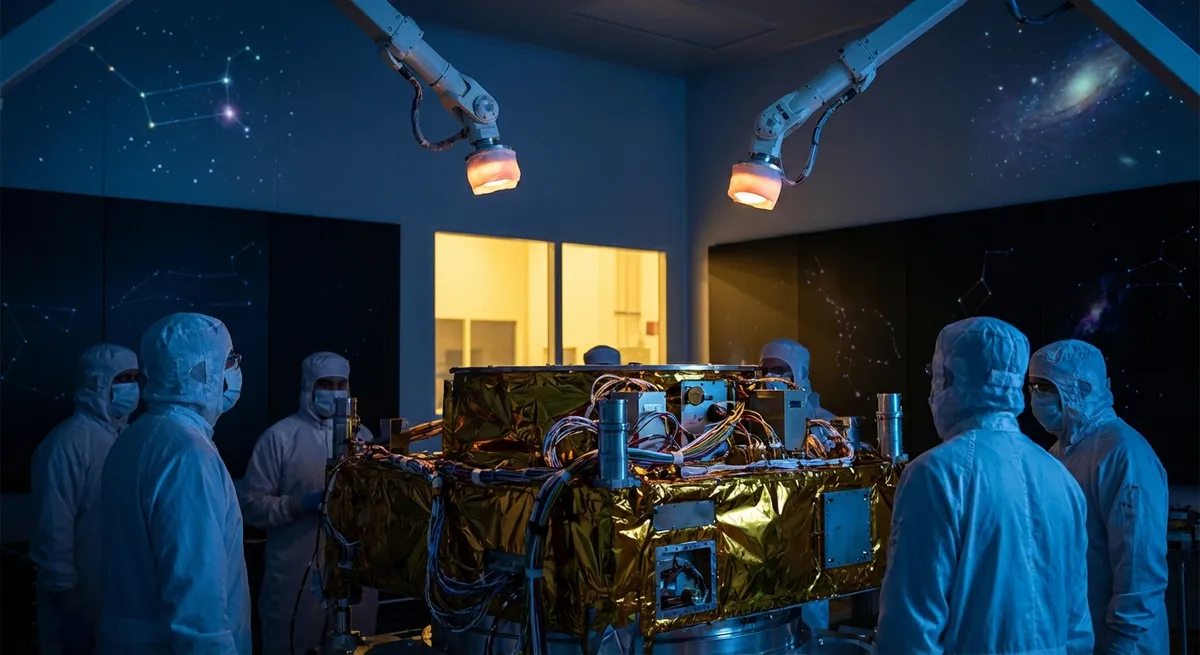
Vacuum means no air to cool circuits, no pressure to protect materials, and no atmosphere to cushion micro-meteoroid hits. Temperature can swing hundreds of degrees between sunlit and shadowed surfaces. Radiation from the Sun and deep space can flip bits in memory, degrade solar panels, and even erase data mid-flight.
To survive this:
- Electronics are radiation-hardened: Chips are designed so that stray high-energy particles are less likely to flip bits or fry circuits. Some use older, larger transistor designs because they’re more robust than cutting-edge, miniaturized consumer chips.
- Spacecraft carry layered shielding: Aluminum, special polymers, and sometimes water or fuel are arranged to soak up radiation and reduce impacts from tiny debris.
- Thermal control is surgical: Spacecraft don’t “feel” wind; they rely on radiators, heat pipes, and thermal coatings to shunt heat around. Some sections are painted white to reflect sunlight, others black to radiate heat.
- Redundancy is standard, not luxury: Many key systems—computers, power lines, sensors—have backups or even triple-redundant configurations that vote on correct answers if one system glitches.
Space tech is engineered around a brutal design brief: assume everything wants to fail, and then build something that still works anyway.
How We Actually Navigate the Void
Flying through space is less like steering a plane and more like playing slow-motion billiards with gravity.
Once a spacecraft leaves Earth, its path is mostly determined by its initial push and the gravity fields it drifts through. Mission planners use celestial mechanics and powerful simulations to design:
- Hohmann transfer orbits to move efficiently between circular orbits using just two main engine burns.
- Gravity assists where spacecraft steal a bit of momentum from planets—like Voyager 2 slingshotting around Jupiter and Saturn—to gain speed without extra fuel.
- Lagrange point parking, where a spacecraft sits in a gravitational “sweet spot” between larger bodies (like the Sun and Earth) and can maintain position with minimal fuel.
Onboard, navigation is handled by:
- Star trackers: Cameras that recognize patterns of stars to determine the spacecraft’s orientation in 3D.
- Gyroscopes and reaction wheels: Spinning wheels and sensors that help the craft twist and turn without firing thrusters constantly.
- Deep Space Network (DSN): Giant antennas on Earth ping the spacecraft, measure the time delays and Doppler shift, and triangulate its position across millions or billions of kilometers.
In deep space, “Where am I?” is answered with math, starlight, and time—no GPS, no landmarks, just physics.
Machines That Build Science: Rovers, Landers, and Orbiters
Planetary missions are like sending a laboratory across the solar system in a high-speed bullet, then asking it to land softly and do years of science in a place that has never seen human hands.
Consider the core roles:
- Orbiters circle planets or moons, mapping terrain, probing atmospheres, and scanning with radar, infrared, ultraviolet, and more. NASA’s Mars Reconnaissance Orbiter can spot objects as small as a desk on the Martian surface.
- Landers touch down and often stay fixed, drilling, scooping, or sniffing the air. InSight listened for marsquakes to map Mars’s interior. Huygens parachuted onto Saturn’s moon Titan, tasting an alien atmosphere and terrain for a few brief hours.
- Rovers are mobile laboratories. Curiosity and Perseverance carry instruments that zap rocks with lasers, analyze dust chemistry, and even store samples for a future return to Earth.
These machines use:
- Autonomous navigation: Especially on Mars, where signals take minutes to travel, rovers must route around rocks and craters with onboard AI.
- Miniaturized labs: Mass spectrometers, gas chromatographs, X-ray spectrometers, and laser-induced breakdown spectroscopy (LIBS) systems compressed into rugged, low-power modules.
- Energy budgets measured like survival rations: Solar panels or nuclear power sources (like radioisotope thermoelectric generators) are balanced against heaters, computers, and instruments to keep everything alive.
The result: human curiosity, turned into hardware that can crawl, listen, dig, and analyze a world no human has yet walked.
Space Tech and Life Support: Engineering an Artificial World
Putting machines in space is hard. Putting people there is exponentially harder. A crewed spacecraft or space station is essentially a miniature Earth ecosystem, squeezed into metal and plastic.
Life support systems must:
- Recycle air: Carbon dioxide is scrubbed from the cabin air using absorbent materials (like lithium hydroxide cartridges or regenerative systems), while oxygen is generated from water via electrolysis.
- Conserve water: On the International Space Station (ISS), water is so precious that it’s reclaimed from humidity, wash water, and even urine—then filtered and purified until it’s cleaner than most tap water on Earth.
- Manage pressure: Cabin pressure is maintained at near sea-level or slightly reduced, with stringent leak detection systems monitoring the hull.
- Handle waste: Human waste is stored, treated, or sometimes incinerated in special cargo craft that burn up reentering Earth’s atmosphere, turning trash into plasma streaks across the sky.
To keep astronauts healthy, there’s also:
- Radiation shielding: Sleeping quarters and key areas are often placed in better-shielded parts of the station, sometimes surrounded by water tanks or supplies to absorb energetic particles.
- Exercise machines: Advanced treadmills, resistance devices, and bikes help counteract bone and muscle loss in microgravity.
In space, survival isn’t passive—it’s an ongoing technological performance, with every breath and every sip of water mediated by machines.
Five Astonishing Space Tech Facts That Redefine What’s Possible
Space technology is packed with quiet miracles. Here are five that reframe just how extreme, and ingenious, our tools have become.
1. A Space Telescope Orbits a “Virtual” Point in Space
The James Webb Space Telescope doesn’t orbit Earth; it orbits the Sun, parked near a gravitational balance spot called Sun–Earth L2, about 1.5 million kilometers away.
At L2, the combined gravity of Earth and the Sun lets Webb move in tandem with our planet around the star. Webb actually loops around this point in a gentle orbit, using small thruster corrections to stay put.
Why this matters: L2 gives Webb a stable thermal environment, a constant view away from the Sun and Earth, and a dark, cold vantage point to stare deep into the cosmos. It’s space tech using gravity itself as a structural element.
2. A 1970s-Era Spacecraft Is Still Talking to Earth
NASA’s Voyager 1, launched in 1977, is now in interstellar space—beyond the influence of the solar wind—and still sending data back to Earth.
Its computers are far weaker than a basic calculator app on a smartphone. Yet its power system (a radioisotope thermoelectric generator) and robust design have allowed it to operate for nearly half a century, communicating over more than 20 billion kilometers.
Why this matters: Voyager proves that durability and simplicity can sometimes outperform raw power, especially when paired with long-lived power sources and careful mission planning.
3. The ISS Is the Most Expensive Structure Humans Have Ever Built
The International Space Station is a modular laboratory the size of a football field, assembled piece by piece in orbit since 1998. Its total cost—when including contributions from all international partners—is estimated in the tens of billions of dollars, often placed above $100 billion.
It orbits Earth about every 90 minutes, traveling at roughly 28,000 km/h (17,500 mph). The station has hosted hundreds of astronauts and thousands of experiments, from fluid physics to DNA research.
Why this matters: It’s not just a science lab; it’s a proof-of-concept for building and maintaining huge, complex structures in orbit—essential practice for future deep-space habitats and refueling depots.
4. Some Spacecraft Fly with Sails Made of Sunlight
Solar sails turn light itself into propulsion. Missions like Japan’s IKAROS and The Planetary Society’s LightSail 2 deploy ultra-thin, reflective sails that photons from the Sun bounce off, transferring tiny amounts of momentum.
The push is incredibly gentle, but constant. Over time, this allows the spacecraft to change orbits and speeds without traditional fuel.
Why this matters: Solar sailing hints at a future where some spacecraft could travel vast distances powered by starlight alone—no propellant tanks, just smart materials and patient navigation.
5. A Mars Rover Is Caching Rocks for a Future Interplanetary Relay
NASA’s Perseverance rover on Mars isn’t just studying rocks; it’s collecting and sealing samples for a proposed Mars Sample Return mission.
Perseverance drills core samples, places them into tube-sized containers, and stows them for future pickup. Later missions would land, retrieve the samples, launch them off Mars, and return them to Earth for detailed lab analysis.
Why this matters: It’s the first multi-mission, multi-step interplanetary supply chain—space tech behaving like a coordinated logistics system spanning two worlds.
How Space Tech Comes Back Home: Spinoffs That Shape Earth
Although designed for orbit, many space technologies eventually reappear around us on Earth in quieter forms.
Examples include:
- Improved camera sensors: Miniaturized, low-noise imaging technologies developed for space telescopes and planetary probes helped drive improvements in smartphone and medical imaging cameras.
- Satellite navigation and timing: GPS and other global navigation satellite systems rely on ultra-precise clocks and orbital dynamics, enabling everything from rideshare apps to banking and power grid synchronization.
- Earth observation tools: Sensors used to map other planets now track deforestation, crop health, ice loss, and pollution on Earth, informing climate science and disaster response.
- Advanced materials and insulation: Lightweight composites, radiation-resistant materials, and thermal blankets have influenced transportation, architecture, and even consumer products like high-performance clothing and insulation.
Space tech, paradoxically, may tell us as much about Earth—its health, its climate, its vulnerabilities—as it does about distant nebulae or alien terrains.
Conclusion
Space technology is not an abstract idea. It’s metal and code, solder joints and solar panels, spinning wheels and whisper-quiet radio waves crossing oceans of emptiness. Every mission is a negotiation with physics: heat, vacuum, gravity, and time.
Behind each gleaming photo from a distant world is a hidden story of engineering gambles and creative problem-solving—the decision to ride a gravity field, to trust a star tracker, to rely on 1970s hardware, or to send a lab on wheels to another planet.
As we design telescopes that orbit virtual points, rovers that stash Martian rocks for future pickup, and sails that surf sunlight, one pattern is clear: space tech is how we turn curiosity into contact. It’s the set of tools that lets a small species on a small world reach out and, very carefully, touch the universe.
Sources
- NASA – James Webb Space Telescope Overview – Details on JWST’s orbit at Sun–Earth L2, instruments, and mission design
- NASA – Voyager Mission Status – Up-to-date information on Voyager spacecraft, interstellar mission phase, and legacy hardware
- European Space Agency – International Space Station Facts and Figures – Data on ISS size, mass, partners, and operational details
- NASA – Perseverance Mars Rover Mission – Technical overview, sample caching plans, and scientific goals of the Perseverance rover
- The Planetary Society – LightSail® Program – Information on solar sail technology, mission results, and significance for future propulsion systems
Key Takeaway
The most important thing to remember from this article is that this information can change how you think about Space Tech.