The universe we see—the stars, planets, glowing gas clouds—might be the least interesting part of reality. Over the past few years, astronomers have been quietly assembling one of the strangest maps ever made: a map of things we can’t see. From dark matter that shapes galaxies to dark energy that pushes the cosmos apart, new discoveries are turning our picture of the universe inside out. The latest space news isn’t just about rockets and rovers; it’s about uncovering a hidden cosmic skeleton and a mysterious force stretching spacetime itself.
The Universe’s Secret Majority
Astronomers now estimate that everything we can directly observe—stars, planets, gas, dust, even black holes—makes up less than 5% of the universe. The rest is divided between dark matter (about 27%) and dark energy (about 68%). Neither has ever been seen directly, yet their fingerprints are visible everywhere.
Dark matter reveals itself through gravity. Galaxies spin too fast to stay together if they were made only of visible matter. Something invisible must be adding extra mass—like a transparent scaffolding holding everything in place. Dark energy, on the other hand, shows up not as extra pull but as extra push. Observations of distant exploding stars (supernovae) in the late 1990s revealed that the universe isn’t just expanding—it’s speeding up, as if an invisible pressure is stretching space like cosmic taffy.
Here’s the astonishing part: every new high-precision measurement keeps confirming this bizarre picture. Our best models of the universe are now built around something we can’t directly touch, see, or recreate on Earth—but can measure through its effects with remarkable accuracy.
Amazing Discovery #1:
Distant supernova observations showed the universe’s expansion is accelerating, providing the first strong evidence for dark energy and earning the 2011 Nobel Prize in Physics.
Gravitational Lensing: Nature’s Cosmic X‑Ray
If you want to find invisible matter, you need a trick—and gravity itself provides one. Massive objects like galaxies and clusters warp spacetime, bending the path of light passing nearby. This phenomenon, called gravitational lensing, allows astronomers to “see” dark matter by watching how it distorts the appearance of background galaxies.
Strong lensing can create dramatic effects: multiple images of the same galaxy, smeared arcs of light, or even “Einstein rings” that circle a central mass. Weak lensing is more subtle: it slightly stretches the shapes of millions of distant galaxies. By statistically analyzing these tiny distortions over huge areas of sky, scientists can build 3D maps of dark matter—almost like taking an X-ray of the cosmic web.
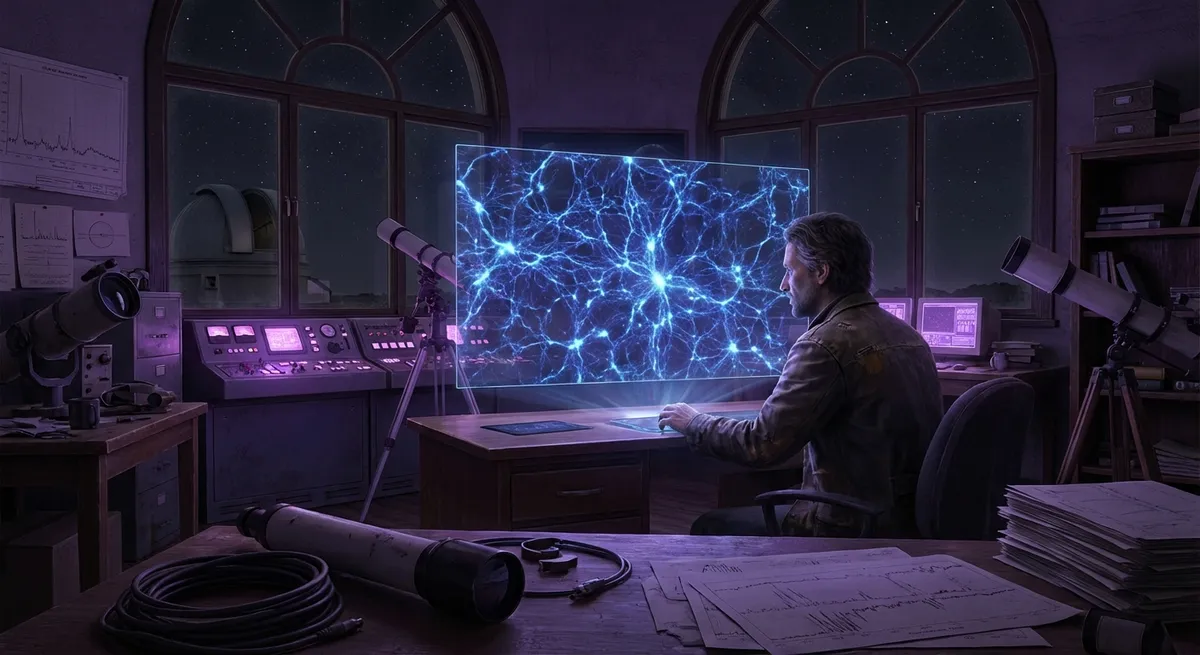
Recent sky surveys have revealed that dark matter isn’t randomly sprinkled around. It forms giant filaments stretching across hundreds of millions of light-years, connecting galaxy clusters in a vast, web-like structure. Galaxies light up these filaments like beads on invisible threads.
Amazing Discovery #2:
Space telescope surveys such as those using the Hubble Space Telescope have produced sprawling maps of dark matter across billions of light-years by measuring minute distortions in galaxy shapes caused by gravitational lensing.
A New Space Telescope Is Hunting Dark Energy
On December 2, 2023, a new European spacecraft launched with a single, ambitious mission: measure the universe with such precision that dark energy can’t hide in the details. The Euclid space telescope is designed to create the most detailed 3D map of the cosmos ever made, covering over a third of the sky and cataloging billions of galaxies.
Euclid’s strategy is clever. As light from distant galaxies travels through the universe, it passes through clumps of dark matter and expanding space. Euclid will measure:
- How galaxies cluster together at different cosmic ages
- How their shapes are distorted by gravitational lensing
- How far away they are and how fast space was expanding when their light began its journey
By combining these measurements, Euclid aims to test whether dark energy behaves like Einstein’s cosmological constant (a fixed energy density of empty space), or something more exotic—perhaps even new physics beyond our current understanding of gravity.
Amazing Discovery #3:
Once fully operational, Euclid is expected to map the shapes and distances of up to 1.5–2 billion galaxies, offering one of the sharpest tests yet of dark energy and the nature of cosmic acceleration.
The Hubble Tension: A Cosmic Measurement Standoff
Not all the data agrees, and that disagreement might be the most exciting news of all.
Astronomers have two main ways to measure the universe’s expansion rate, known as the Hubble constant:
- Nearby universe method: Measure distances to nearby galaxies using standard candles (like Cepheid variable stars and Type Ia supernovae), then see how fast they’re moving away.
- Early universe method: Use the cosmic microwave background—the afterglow of the Big Bang—as observed by satellites like Planck, then apply our best cosmological model to infer the current expansion rate.
Both methods are precise. Both are carefully checked. Yet they give different answers. The “nearby” measurements say the universe is expanding faster than the early-universe calculations predict. This persistent mismatch is called the Hubble tension, and it hasn’t gone away even as measurements have improved.
If this discrepancy isn’t due to overlooked systematic errors, it could mean that our model of the universe is missing a key ingredient—perhaps new types of particles, changing dark energy, or a subtle twist in how gravity works on cosmic scales.
Amazing Discovery #4:
Independent teams using different telescopes and methods keep finding a consistent gap between early- and late-universe measurements of the Hubble constant, suggesting we might be seeing the first cracks in our standard cosmological model.
Dark Matter Under the Microscope
While telescopes map dark matter on gigantic scales, particle physicists are trying to catch it in the act on Earth. If dark matter is made of particles, some of them may occasionally bump into ordinary atoms. Deep underground, shielded from cosmic rays and background noise, ultra-sensitive detectors wait for these rare encounters.
Experiments in places like the Laboratori Nazionali del Gran Sasso in Italy or the Sanford Underground Research Facility in the U.S. use tanks of liquid xenon, super-cooled crystals, or other exotic materials to look for tiny flashes of light or recoil signals caused by a dark matter particle strike. So far, no confirmed detection has emerged—but the non-detections themselves are informative, ruling out entire classes of hypothetical particles.
Meanwhile, astrophysical observations are tightening the noose from another direction. By studying the motions of stars in galaxies, the behavior of galaxy clusters, and the distribution of dark matter in the cosmic web, scientists can test whether dark matter behaves like a cold, collisionless sea of particles or something stranger—such as self-interacting dark matter or even ultra-light “fuzzy” dark matter.
Amazing Discovery #5:
Detailed observations of colliding galaxy clusters, like the famous Bullet Cluster, show dark matter and normal matter separating during the collision—powerful evidence that dark matter is a distinct, invisible component that barely interacts except through gravity.
Conclusion
The newest frontier of space exploration doesn’t always involve landing on distant worlds; sometimes it starts with admitting we don’t know what most of the universe is made of. Dark matter sculpts galaxies. Dark energy drives cosmic expansion. Subtle tensions in our measurements hint that our most trusted models might be incomplete.
What makes this era extraordinary is that these mysteries are finally becoming testable. With instruments like Euclid in space, powerful ground-based observatories scanning the sky, and underground detectors listening for whispers of new particles, we’re turning philosophical questions into scientific ones. The invisible universe is no longer a metaphor—it’s a measurable, mappable, and possibly revolutionary part of reality.
The next headline-making discovery might not be a new planet or a spectacular image, but a small numerical shift—a better map, a sharper measurement—that forces us to rewrite what we think the cosmos actually is.
Sources
- NASA – Dark Energy, Dark Matter – Overview of dark matter and dark energy and how we infer their existence
- ESA – Euclid Space Telescope – Mission details, scientific goals, and design of the Euclid dark universe mission
- Planck Mission – Cosmological Parameters – Results from the Planck satellite on the early universe and measurements of the Hubble constant
- HubbleSite – The Hubble Constant and Cosmic Expansion – Explanation of how astronomers measure the expansion rate of the universe and the Hubble tension
- NASA – Gravitational Lensing and Dark Matter (Bullet Cluster) – Chandra X-ray Observatory results on the Bullet Cluster as key evidence for dark matter
Key Takeaway
The most important thing to remember from this article is that this information can change how you think about Space News.