For almost all of human history, the night sky was a flat ceiling of twinkling lights. Now, for the first time, we’re turning that ceiling into a 3D map—and it’s changing almost everything we thought we knew about the universe. From dark matter “skeletons” to rogue worlds drifting between stars, new surveys and spacecraft are sketching the universe in astonishing detail. Here’s how astronomers are building the ultimate atlas of the cosmos—and five discoveries that feel almost too wild to be real.
The Universe, Upgraded: From Star Charts to Cosmic Cartography
Centuries ago, “mapping the sky” meant drawing where the brightest stars appeared on a flat canvas. Today, mapping the universe means measuring distances to millions—soon billions—of objects, reconstructing a vast, 3D cosmic web that stretches across space and time.
Modern sky surveys use robotic telescopes that scan huge areas of the sky night after night, capturing faint galaxies billions of light-years away. Instead of single snapshots, astronomers collect spectra—rainbow fingerprints of light—that reveal not just what something is made of, but how fast it’s moving and how far away it lies, thanks to the redshift caused by cosmic expansion.
The result isn’t just a prettier star chart. It’s a time machine. Light from distant galaxies left when the universe was much younger, so every data point on these maps is also a piece of cosmic history. By stitching together these snapshots, scientists can watch how structure emerged, how galaxies assembled, and how mysterious dark energy began to accelerate the universe’s expansion.
One of the most ambitious projects leading this transformation is the Dark Energy Spectroscopic Instrument (DESI), now building the most detailed 3D map of the universe ever attempted. And it’s already turning up surprises.
Fact #1: The Universe Is Laced with a Hidden Cosmic Web
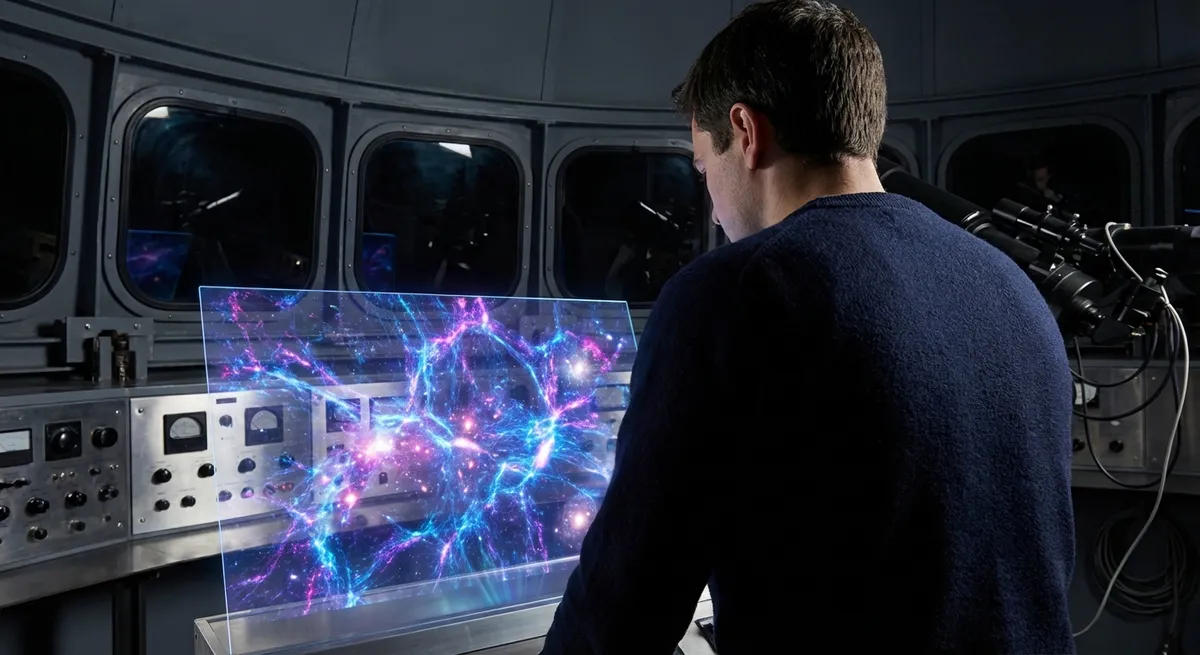
If you could step back far enough from the universe—far beyond individual galaxies—you wouldn’t see random dots of light. You’d see a vast network: enormous filaments, knots, and voids, like a ghostly, 3D spiderweb.
Astronomers call this structure the cosmic web. Galaxies are not sprinkled evenly through space; they cluster along invisible filaments of dark matter, gathering where these filaments intersect into colossal clusters. Between them lie enormous cosmic voids, regions so empty they can span hundreds of millions of light-years.
DESI and earlier surveys like the Sloan Digital Sky Survey (SDSS) have traced this web by mapping the positions and distances of millions of galaxies. Each galaxy on the map is like a pin stuck into a foam model; when you step back, a pattern emerges—evidence that gravity, acting on tiny clumps in the early universe, sculpted matter into this intricate skeleton.
This web doesn’t just look beautiful; it encodes vital physics. Its shape and growth rate tell us how fast the universe is expanding, how much dark matter it contains, and how dark energy has pushed on it over billions of years. In a sense, the cosmic web is both the universe’s scaffolding and its diary.
Fact #2: A New Sky Survey May Rewrite the Story of Dark Energy
Dark energy is the name we give to whatever is causing the universe’s expansion to speed up. We don’t know what it is, but we can measure what it does. That’s where DESI—and its vast map—comes in.
DESI works by measuring tiny ripples in the distribution of galaxies called baryon acoustic oscillations (BAO). These ripples are the fossilized imprint of sound waves that traveled through the hot plasma of the early universe. The waves set a preferred separation scale between galaxies, like a standard ruler imprinted across the cosmos.
By measuring how this BAO “ruler” appears at different distances (and thus different cosmic eras), astronomers can track how the expansion of the universe has changed over time. Any deviation from expectations can hint that our model of dark energy—or even gravity itself—needs serious revision.
Early DESI results already suggest tantalizing tensions with previous measurements, including the precise map of the cosmic microwave background made by the Planck satellite. While the discrepancies are still small and under active debate, they raise a profound possibility: either dark energy behaves differently than the simplest models predict, or our basic cosmological assumptions need an update. The universe may be subtly refusing to match the neatest equations.
Fact #3: Giant “Fossil Clusters” Reveal Ancient Cosmic Cities
Not all cosmic structures are new discoveries—some are ancient, but only now clearly seen. Deep surveys have uncovered fossil galaxy groups and clusters: enormous cosmic “cities” dominated by a single, bloated galaxy surrounded by faint, smaller companions.
These fossil systems are thought to be the end products of violent cosmic mergers over billions of years. Many smaller galaxies have already crashed together and blended into one dominant central galaxy, leaving behind a strikingly bright main occupant and a noticeable gap in brightness to the next brightest member.
By mapping the locations and masses of these fossil clusters across the universe, astronomers gain clues about how quickly structure formed and how long these systems have been gravitationally settled. Fossil clusters act like ancient archives for galaxy evolution, preserving the record of mergers, star formation bursts, and quenching—when galaxies abruptly stop forming new stars.
Future X-ray and optical surveys working together will sharpen this picture, as hot gas glowing in X-rays traces the depth of the gravitational wells while optical maps trace the galaxies themselves. Put together, they turn these clusters into laboratories for studying how gravity and environment sculpt entire families of galaxies.
Fact #4: Gravitational Waves Are Becoming a New Map Layer
Until recently, our maps of the universe relied almost entirely on light: visible, infrared, radio, X-ray. But now another messenger is joining our cosmic atlas—gravitational waves, ripples in spacetime caused by massive objects like colliding black holes and neutron stars.
Ground-based detectors such as LIGO and Virgo have already detected dozens of these events. Each detection is like hearing a “ping” somewhere in the universe—a short, sharp note from a catastrophic merger. While early instruments could only locate these pings to broad swaths of sky, upgrades and new detectors are steadily improving the precision.
In parallel, astronomers have begun to dream bigger: gravitational wave astronomy across the whole universe. Future observatories like the space-based LISA mission will detect lower-frequency waves from supermassive black hole mergers, while pulsar timing arrays—networks of precisely monitored pulsars—are revealing a background hum of waves likely produced by countless supermassive black hole pairs over cosmic history.
As these techniques mature, gravitational wave “maps” will overlay our optical maps, linking the positions of galaxies and clusters to the invisible dance of black holes within them. It’s as if the universe is gaining a soundtrack to accompany the starry visuals—a new dimension of information to decode how structures grew and merged across time.
Fact #5: Free-Floating “Rogue Planets” Haunt the Galactic Dark
Not everything that’s mapped in the cosmos is enormous. Some of the strangest things we’re finding are small, cold, and practically invisible: rogue planets.
Rogue planets are world-sized objects—similar in mass to Jupiter, or sometimes even Earth—that drift through space without a parent star. They’re detected not by their own light, but by the way their gravity temporarily magnifies the light of background stars, a phenomenon known as gravitational microlensing.
Surveys like OGLE (Optical Gravitational Lensing Experiment) and the MOA project have found growing evidence that these lonely worlds are surprisingly common. Some may have been flung out of their planetary systems during violent encounters; others might have formed on their own within gas clouds, like tiny failed stars.
While they don’t glow like suns, rogue planets are a crucial part of the galactic census. By refining our techniques and launching space telescopes specialized for microlensing (like NASA’s upcoming Nancy Grace Roman Space Telescope), astronomers hope to map the population of free-floating worlds, revealing how often planetary systems go unstable—and how often entire planets get kicked into the interstellar night.
How Our Next Maps Will Change the Questions We Ask
Each new wave of mapping technology—DESI for large-scale structure, LIGO/Virgo and future gravitational wave observatories, Roman and Euclid for dark matter and dark energy, and microlensing surveys for rogue planets—does more than add detail. It changes the kinds of questions we can ask.
Instead of asking, “What is out there?” we’re starting to ask, “How did all of this become what it is?” and “Which parts of our physics are wrong or incomplete?” The cosmic web shows us gravity’s handiwork on grand scales; fossil clusters reveal the slow burn of galaxy evolution; gravitational waves trace the invisible history of black hole mergers; rogue planets record the chaos of planetary systems.
The more complete our cosmic atlas becomes, the more it behaves like a laboratory notebook for the universe, capturing experiments that played out over billions of years. And we’re reading it faster than ever.
Somewhere in the data from these maps may lie the first robust hints of new physics beyond our current models—a subtle distortion in the cosmic web, an unexpected pattern in gravitational wave backgrounds, a surprising abundance of lonely planets in interstellar space.
We used to draw constellations to tell stories about ourselves. Now we map the universe to uncover the story of reality itself.
Conclusion
We are living through a quiet but radical shift in how humanity relates to the cosmos. The sky is no longer a distant backdrop; it’s a measurable, evolving structure that we can chart in 3D, across billions of years. From the hidden skeleton of the cosmic web to the lonely paths of rogue planets, each new survey adds a fresh layer of detail to our growing atlas of the universe.
These discoveries are not isolated curiosities. Together, they form a connected narrative: how matter clumped, how galaxies assembled, how black holes collided, how planets wandered free, and how an unknown force—dark energy—reshaped the universe’s fate. As new instruments come online, our maps will sharpen, our models will be challenged, and our place in this vast structure will become a little clearer.
The night sky hasn’t changed much to the naked eye in a human lifetime. But behind the scenes, the universe we’re mapping is becoming stranger, richer, and far more intricate than anyone staring up in wonder could have imagined.
Sources
- [DESI Releases First Data, Builds Largest 3D Map of the Universe](https://newscenter.lbl.gov/2024/04/04/desi-creates-largest-3d-map-of-universe) - Lawrence Berkeley National Laboratory article on DESI’s early results and its role in mapping large-scale cosmic structure
- [Sloan Digital Sky Survey (SDSS) – Mapping the Universe](https://www.sdss.org/science/) - Overview of SDSS science goals and discoveries related to the cosmic web and galaxy surveys
- [LIGO Scientific Collaboration – Gravitational Wave Discoveries](https://www.ligo.org/science/outreach.php) - Educational overview of gravitational waves and what they reveal about black holes and neutron stars
- [NASA – Rogue Planets: Worlds Without Suns](https://science.nasa.gov/exoplanets/rogue-planets/) - Explanation of free-floating planets, detection methods, and implications for planetary systems
- [ESA – Euclid Mission: Mapping the Dark Universe](https://www.esa.int/Science_Exploration/Space_Science/Euclid_overview) - European Space Agency mission page describing how Euclid will map dark matter and dark energy through large-scale structure
Key Takeaway
The most important thing to remember from this article is that this information can change how you think about Space News.