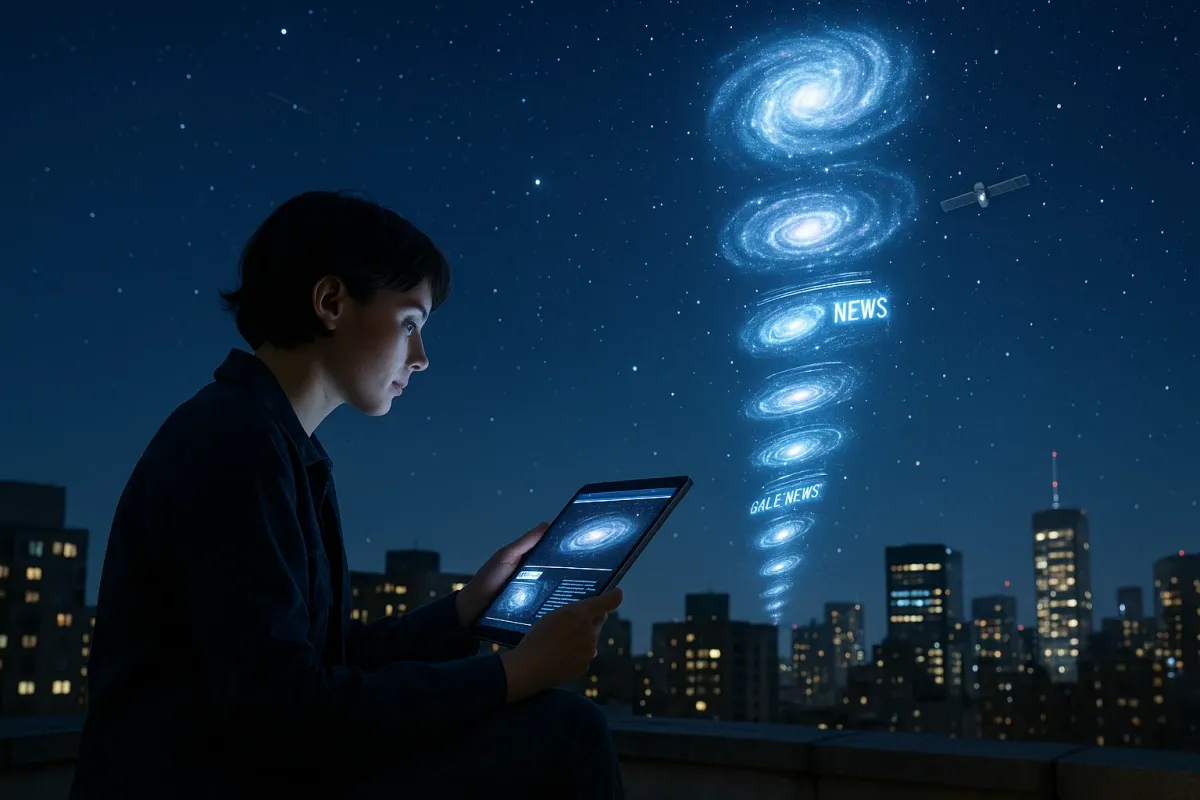
Every day, a handful of space headlines slip past in your news feed, competing with celebrity drama and viral memes. But behind those modest titles are missions and measurements that are quietly rewriting what we know about the universe—right now, this week, this year.
Today’s space story might look like a simple update on a telescope, a rocket launch, or a weird signal from deep space. In reality, it’s part of a much bigger pattern: we’re moving from looking at the cosmos to measuring, mapping, and engineering it with breathtaking precision. Below, we’ll ride that wave of breaking news and unpack five astonishing, very current space facts and discoveries shaping this moment in cosmic history.
James Webb Is Catching “Teenage Galaxies” Growing Up Too Fast
The James Webb Space Telescope (JWST) keeps popping up in headlines for a reason: it’s actively forcing astronomers to rethink how fast the universe built its first galaxies. Over the past year, Webb has found surprisingly massive, bright galaxies forming just a few hundred million years after the Big Bang—essentially, “teenage” galaxies in what should still be the universe’s cosmic kindergarten. Teams using instruments like NIRCam and NIRSpec have reported galaxies at redshifts greater than 10, which means the light left them over 13 billion years ago.
What makes today’s JWST-related news so electric is that these observations challenge long-standing galaxy formation models. We thought it should take more time, more mergers, and more gradual star formation to produce such heavyweights. Yet Webb keeps turning up overachievers: galaxies with vigorous starbirth, heavy elements, and complex structure shockingly early in cosmic history. Each new paper pushes theorists back to the drawing board, refining simulations run on supercomputers. When you see a headline about another “record-breaking distant galaxy,” it’s not just a flex of telescope power—it’s the universe telling us, repeatedly, that it evolved faster and more creatively than our textbooks assumed.
Starship’s Test Flights Are Turning Earth Orbit Into a Refueling Stop
When SpaceX’s Starship makes the news—whether for a fiery test, a splashdown, or an upcoming launch window—it’s not just about spectacle. It’s about a quiet but profound shift: rockets are beginning to be designed for reuse at scale and refueling in orbit. In recent test flights, Starship has demonstrated increasingly successful ascent, stage separation, and controlled descents, with each iteration feeding an aggressive test‑fly‑fix‑repeat cycle.
Why does this matter for space science, not just space tourism? Because a fully operational Starship, combined with on-orbit propellant transfer (a tech NASA is paying SpaceX to demonstrate for the Artemis lunar program), turns low Earth orbit into something like a cosmic gas station. Giant telescopes can be launched in single pieces instead of folded origami-style. Planetary science missions to the outer solar system could fly larger instruments and heavier shielding, riding on cheaper, more frequent launches. The latest Starship headlines are really about infrastructure: building the cargo ships and fuel depots that will underpin everything from Moon bases to Mars labs and even mega-observatories far beyond today’s Hubble and Webb.
Gravitational-Wave “Background Noise” Is Now a New Cosmic Radio Station
Recently, you may have seen headlines about astronomers detecting a faint “hum” of gravitational waves across the universe. This isn’t clickbait poetry—it’s one of the strangest and most significant new windows on the cosmos. Using pulsar timing arrays—networks of ultra-precise millisecond pulsars acting as natural galactic clocks—collaborations like NANOGrav, the European Pulsar Timing Array, and others have reported strong evidence for a gravitational-wave background.
Unlike the sharp bursts we’ve already observed with LIGO and Virgo from merging black holes, this background is more like a low, cosmic bass note stretching across the sky. The leading explanation: populations of supermassive black hole binaries—pairs of monsters millions to billions of times the mass of the Sun—spiraling together at the hearts of merging galaxies. As new datasets are released and combined across continents, this “noise” becomes a powerful tool: we can map how often galaxies merge, test general relativity on truly enormous scales, and maybe even hunt for exotic physics in the early universe. When today’s headlines mention updated gravitational-wave results, they’re really announcing that we’ve tuned in a new cosmic broadcast channel—one we didn’t even know how to listen to a decade ago.
Mars Is Becoming a Planet of Robots—and a Testbed for the Future
Whenever NASA posts a new image from Perseverance, or ESA and JAXA publish updates on the upcoming Mars Sample Return architecture, you’re seeing pieces of a coordinated campaign to turn Mars from a distant target into an active laboratory. Perseverance has already cached carefully selected rock cores in Jezero Crater that could, in the 2030s, be picked up and flown back to Earth by a sample return mission jointly developed by NASA and the European Space Agency.
At the same time, other missions—like China’s Tianwen‑1 orbiter and Zhurong rover (currently in hibernation), and ongoing studies for future landers—are building a layered view of Martian climate, geology, and potential habitability. Today’s news updates about engineering reviews, revised mission plans, or international collaborations around Mars aren’t just bureaucratic footnotes. They’re the scaffolding of the first true interplanetary science program, where missions talk to each other across decades. Mars is effectively becoming humanity’s testbed for everything: precision landing, in‑situ resource use (like NASA’s MOXIE oxygen-making experiment), autonomous navigation, and eventually human survival. Each modest headline hides a deeper story: we’re treating an entire planet like a long-term research project.
Commercial Space Stations Are Quietly Lining Up to Replace the ISS
Another kind of space headline has been showing up more frequently: NASA awarding contracts to companies like Axiom Space, Blue Origin’s Orbital Reef team, and Voyager Space and Airbus for commercial space station concepts. The International Space Station (ISS) is currently planned to operate through at least 2030, but orbital real estate doesn’t stay empty for long. The latest NASA agreements—under programs often called “commercial LEO destinations”—aim to transition low Earth orbit from a single government-run station to a marketplace of private platforms.
This isn’t just about renting orbital office space to wealthy tourists. It’s about ensuring there’s still a place in microgravity for cutting-edge research once the ISS retires. Pharmaceutical companies are already running protein crystallization and drug trials in space. Materials scientists are experimenting with fiber optics and alloys that form differently in weightlessness. Future observatories could be assembled or serviced from these stations, and Earth-observation startups could dock instruments for rapid upgrades. Each time you see a news update on a new station module design, funding round, or NASA milestone, it’s another sign that low Earth orbit is transitioning from “lab experiment” to “economic ecosystem,” with science and exploration at its core.
Conclusion
Today’s space headlines might look small—a telescope refinement here, a test flight there, a new signal analysis, a Mars rover update, a contract for a future station. But zoom out, and they form a striking pattern: humanity is learning to listen more carefully, reach more cheaply, and live more sustainably beyond Earth.
From Webb’s rebellious early galaxies to Starship’s super-heavy ambitions, from the gravitational-wave hum of unseen black holes to Mars’s robotic colony and the next generation of orbital labs, each story is a thread in a much larger tapestry. The cosmos isn’t just something we observe anymore; it’s becoming a place we measure, engineer, and steadily weave ourselves into.
Next time a space headline drifts through your feed, tap it. There’s a good chance it’s not just news—it’s a quiet announcement that our relationship with the universe has shifted yet again.
Key Takeaway
The most important thing to remember from this article is that following these steps can lead to great results.