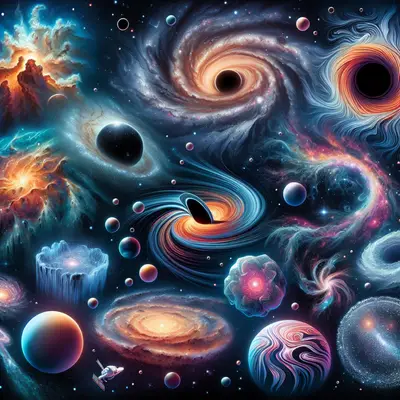
Space news often focuses on the dramatic—the star that explodes, the galaxy that collides, the black hole that devours. But some of the most astonishing discoveries are emerging from places that look, at first glance, calm and uneventful. Quiet regions, faint signals, subtle motions: these are the new frontiers reshaping how we understand the universe.
Below are five recent discoveries and facts that show how a “silent” cosmos is anything but empty—and why astronomers are listening more closely than ever.
1. The Giant “Invisible” Structures Bending Light Across the Universe
Galaxies don’t fly through space alone. They’re embedded in a vast, hidden framework of dark matter—an invisible web that doesn’t emit light but exerts gravity. Recently, astronomers have become better at mapping this ghostly scaffolding by watching how it bends light from distant galaxies, a phenomenon called gravitational lensing.
By combining data from observatories like the Subaru Telescope and space missions such as ESA’s Euclid, scientists are building three-dimensional maps of this dark matter backbone. Light from faraway galaxies arrives at Earth slightly distorted, as though passing through a cosmic funhouse mirror made of gravity. The degree and pattern of distortion reveal clumps, filaments, and knots of dark matter that we cannot see directly.
What’s astonishing is the sheer scale. These dark filaments can span hundreds of millions of light-years, subtly guiding where galaxies form and how they cluster. This quiet reshaping of the universe—no explosions, no bright flashes, just gravity at work—may hold the key to understanding why the cosmos looks the way it does and how it’s evolving.
2. Rogue Planets Drifting Through Interstellar Night
Not every planet orbits a star. Some worlds roam alone through the dark, far from the warmth and light of any sun. These rogue planets are incredibly hard to detect: they don’t shine, they don’t transit a host star, and they emit almost no visible light.
Yet surveys like NASA’s Nancy Grace Roman Space Telescope (scheduled for launch in the mid-2020s) and microlensing campaigns from ground-based telescopes are now sensitive enough to catch their fleeting gravitational fingerprints. When a rogue planet passes in front of a distant star, its gravity can briefly magnify the star’s light—a short, subtle brightening that gives the planet away.
Evidence suggests there could be billions of these orphan worlds in our galaxy alone, some possibly Earth-sized, others more like Jupiter. Their existence challenges our understanding of planetary systems: were they born alone, or ejected from their home systems in violent gravitational dances? Quiet, starless, and nearly invisible, these planets are among the most mysterious citizens of the Milky Way.
3. The Faint Radio Heartbeat of the Milky Way’s Black Hole
At the center of our galaxy lies Sagittarius A\ (Sgr A\), a supermassive black hole about four million times the mass of the Sun. Most of the time, it’s relatively subdued—a faint radio and X-ray source compared to the ferociously bright black holes in distant galaxies. But “quiet” doesn’t mean boring.
Using the Event Horizon Telescope (EHT) and other observatories, astronomers have detected subtle flickers and flares from the gas swirling just outside Sgr A\’s event horizon. These variations, sometimes happening on timescales of minutes, hint at hot clumps of plasma whipping around at a significant fraction of the speed of light.
In 2022, the EHT released the first image of Sgr A\, revealing a glowing ring of emission encircling a dark central shadow. Yet ongoing monitoring at radio and X-ray wavelengths shows that even when Sgr A\ appears calm, it’s full of activity on small scales—magnetic turbulence, sudden brightenings, and shifting hot spots. The galactic center, once thought of as a kind of cosmic still point, is more like a faintly pulsing heart.
4. Ultra-Quiet Pulsars Acting as Galaxy-Sized Gravitational Wave Detectors
Pulsars—rapidly spinning neutron stars—are often described as cosmic lighthouses, sweeping beams of radio waves past Earth with clock-like precision. Some of the most stable pulsars are so regular that their pulses rival atomic clocks. Astronomers have turned this quiet regularity into a tool for detecting one of the universe’s most elusive phenomena: nanohertz gravitational waves.
In 2023, international collaborations such as NANOGrav announced compelling evidence for a background hum of low-frequency gravitational waves permeating the cosmos. Instead of using lasers and mirrors like LIGO, they used timing data from dozens of pulsars sprinkled across the sky. If spacetime itself is gently stretching and squeezing due to the slow dance of supermassive black hole pairs in distant galaxies, those tiny distortions should alter the arrival times of pulsar signals in a coordinated way.
By tracking incredibly subtle deviations—fractions of a microsecond over many years—astronomers have started to “hear” this deep cosmic background hum. It’s not a loud burst like the gravitational waves from colliding stellar-mass black holes; it’s a slow, quiet chorus on scales of millions of years and millions of light-years.
5. Quiescent Galaxies That Stopped Forming Stars… but Not Stories
Not all galaxies are bright blue star factories. Many massive galaxies in the nearby universe appear quiescent—their gas is exhausted or heated, and star formation has slowed to a crawl. After years of focusing on bursting, star-forming galaxies, astronomers are now realizing that these quiet giants hold crucial clues to cosmic history.
Observations from telescopes like the James Webb Space Telescope (JWST) have revealed quiescent galaxies that already existed when the universe was less than a billion years old. These early “red and dead” galaxies formed stars rapidly and then shut down, far faster than many theories expected. Their mere presence forces a rethink of how quickly matter can assemble, cool, form stars, and then be quenched.
By studying the faint glow of their old stellar populations and the signatures of their chemical elements, researchers can reconstruct when their stars formed, how violently supernovae enriched their gas, and whether giant black holes in their centers helped shut off star formation. They may look dormant, but these galaxies are rich fossil records of the universe’s most intense early growth spurts.
Conclusion
The universe’s loudest events—supernovae, gamma-ray bursts, colliding black holes—will always capture attention. Yet some of the most profound insights are emerging from the quiet corners: dim galaxies that no longer form stars, nearly invisible planets wandering through interstellar night, tiny timing shifts in pulsar signals, and the faint whispers of gas circling a “sleepy” black hole.
The cosmos isn’t just a theater of spectacular explosions; it’s also a tapestry of subtle forces and hidden structures, shaping everything we see. As new telescopes and space missions come online, they’re teaching us that silence in space is rarely empty. It’s often where the deepest stories are waiting to be heard.
Sources
- ESA: Euclid Mission Overview - Background on Euclid’s role in mapping dark matter and dark energy through gravitational lensing
- NASA: Rogue Planets Could Outnumber the Stars - Explanation of free-floating planets and how astronomers detect them
- Event Horizon Telescope: Image of the Galactic Center Black Hole - Details on the first image of Sagittarius A\ and its properties
- NANOGrav Collaboration: Evidence for a Gravitational-Wave Background - Overview of how pulsar timing arrays detect low-frequency gravitational waves
- NASA: James Webb Space Telescope – Galaxies in the Early Universe - Discussion of early, quiescent and rapidly evolving galaxies seen by JWST
Key Takeaway
The most important thing to remember from this article is that this information can change how you think about Space News.