Space looks like a black, airless void—but the latest discoveries are quietly dismantling that idea. Astronomers are finding that the “empty” parts of the universe are humming with invisible structure, hidden radiation, and ghostly matter shaping everything we see. From planets floating alone in the dark to galaxies threaded along cosmic highways, the universe is revealing layers we never suspected a century ago.
These discoveries don’t just add trivia to our cosmic knowledge; they change our basic sense of where we live and what “space” actually is. Here are five breakthrough findings showing that the universe is far more crowded, connected, and alive with activity than it appears to the naked eye.
Rogue Worlds: Planets Lost Between the Stars
Astronomers are uncovering a population of “rogue” or free‑floating planets—worlds that drift through the galaxy without orbiting any star at all. These loner planets are detected using a technique called gravitational microlensing, where their gravity briefly warps and brightens the light of a distant background star as they pass in front of it. Recent surveys suggest there could be billions of such orphans in the Milky Way alone, possibly outnumbering the stars. Some might be frozen rock balls, others gas giants, and a few could even retain internal heat and thick atmospheres, creating eerie, starlight‑free environments that are still geologically active.
Their existence raises surprising questions. How many formed around stars and were later flung away in gravitational chaos, and how many formed directly in the galactic dark like failed stars? Could any host subsurface oceans warmed from within, hiding chemistry as rich as that on icy moons? In what we used to call “empty” interstellar space, these planets transform the void into a dim, planet‑strewn wilderness. For mission planners and future deep‑space travelers, rogue worlds are no longer science fiction backdrops—they’re real objects we may someday visit or use as stepping stones across the galaxy.
The Cosmic Web: Galaxies on Invisible Highways
Zoom out far enough from any galaxy, and a striking pattern emerges: matter in the universe is not sprinkled evenly but organized into a vast “cosmic web.” Recent sky surveys and simulations show that galaxies cluster along filamentary structures made of dark matter and gas, stretching hundreds of millions of light‑years. At the intersections of these filaments sit enormous galaxy clusters; between them lie immense voids, not completely empty but thinly populated.
New observations with X‑ray and radio telescopes are beginning to detect the hot, tenuous gas that traces these filaments, confirming that much of the universe’s “missing” normal matter resides in these vast strands. This web acts like a skeleton for the cosmos, guiding how galaxies form, merge, and evolve over billions of years. The shape and thickness of the filaments also encode clues about dark matter and dark energy—two invisible components that dominate the cosmic budget. What once seemed like static emptiness between galaxies is now recognized as a dynamic scaffold on which the entire visible universe is built.
Ghost Light: The Faint Glow Between Galaxies
Astronomers recently started measuring something called the “cosmic optical background”—a faint, diffuse glow of visible light that fills space, even far away from any obvious galaxy. Space telescopes like New Horizons, now far beyond Earth’s bright glow, are providing cleaner measurements of this ghost light because they’re not overwhelmed by the scattered sunlight and dust that interfere near our planet. Surprisingly, this background appears brighter than we can fully explain just by adding up known galaxies.
This excess glow hints that there may be countless ultra‑faint galaxies, star clusters, or even populations of stars stripped from galaxies and left drifting in intergalactic space. It suggests that our census of luminous matter is still incomplete and that star formation in the early universe may have been more widespread than we thought. Studying this background light helps astronomers probe eras too distant and dim for individual objects to be resolved, turning the entire universe into a kind of archaeological layer cake of fossil photons. The “black” between galaxies is, in reality, a softly lit archive of cosmic history.
Fast Radio Bursts: Millisecond Flashes from the Deep
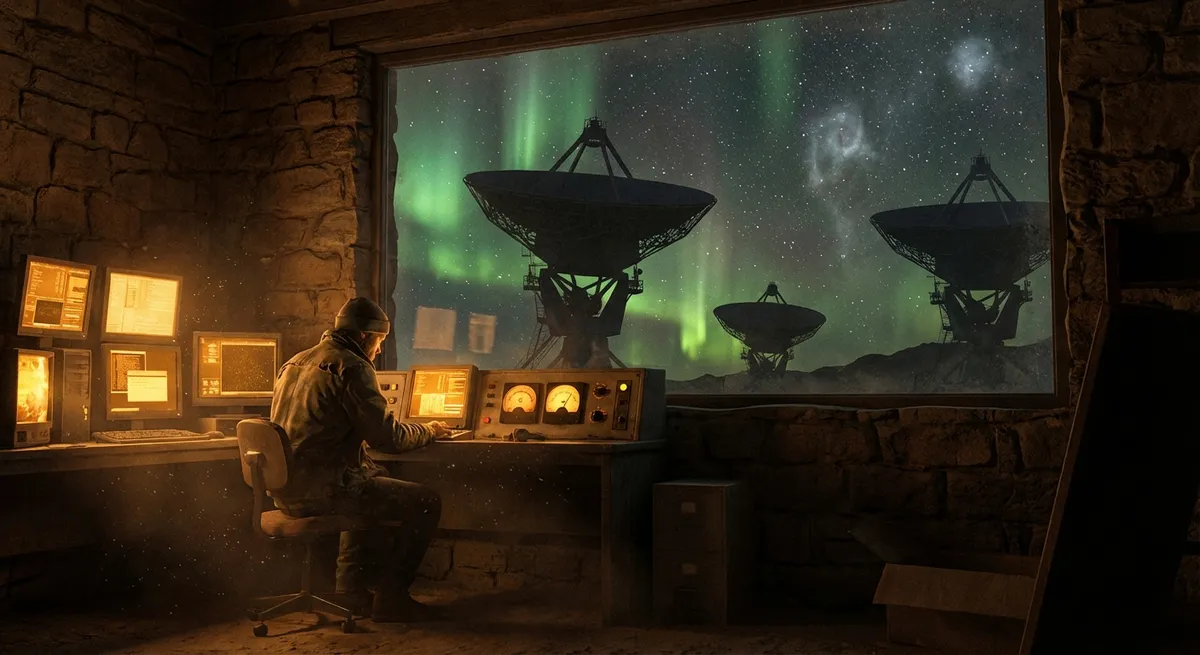
Fast radio bursts (FRBs) are among the strangest signals arriving at Earth from deep space: ultra‑brief, incredibly powerful flashes of radio waves that last just milliseconds but can release as much energy as the Sun emits in days. First detected in 2007, hundreds are now cataloged, with new radio arrays pinpointing their origins to distant galaxies. Some FRBs repeat, others fire only once, and their exact cause is still being debated, with leading explanations involving highly magnetized neutron stars called magnetars.
These bursts are more than a mystery to solve—they’re becoming tools. As FRB radio waves travel through intergalactic space, they’re delayed and dispersed by the thin plasma they pass through. By measuring this dispersion, astronomers can estimate how much ordinary matter lies between us and the source. This turns FRBs into backlights that reveal the otherwise invisible gas spread across cosmic distances. In effect, every new burst is both an astrophysical puzzle and a probe of the “in‑between” medium that fills the universe, helping close the gap on where all the missing baryonic matter is hiding.
Cosmic Rays: High‑Energy Messages from Violent Events
Space is constantly raining tiny, high‑energy particles called cosmic rays onto Earth—from all directions, all the time. These are mostly protons and atomic nuclei accelerated to near light speed by violent events like supernova explosions, shock waves in galaxy clusters, and possibly even jets from supermassive black holes. Detectors on the ground and in orbit keep logging these particles, including a handful of ultra‑high‑energy cosmic rays so powerful they challenge our understanding of how nature can accelerate anything to such extremes.
Cosmic rays don’t travel in straight lines because magnetic fields twist their paths, but patterns in their arrival directions and energies are slowly revealing their likely sources. They also interact with gas and dust as they fly, producing gamma rays and neutrinos that we can detect with specialized observatories. Together, these multi‑messenger signals turn the “silent” darkness into a bustling arena of shocks, collisions, and particle storms. Far from being a calm vacuum, interstellar and intergalactic space is an energetic laboratory where fundamental physics plays out on colossal scales.
Conclusion
As new instruments map the sky in radio waves, X‑rays, gamma rays, and beyond, our mental picture of space is evolving from lifeless emptiness to intricate ecosystem. Planets wander without suns, galaxies ride along invisible filaments, forgotten starlight softly glows between them, and high‑energy flashes and particles crisscross the void.
Every discovery like these reminds us that “nothing” in the universe is rarely truly nothing. The more closely we listen to the silence of space, the more it answers back—with signals that reshape how we see our cosmic home.
Key Takeaway
The most important thing to remember from this article is that this information can change how you think about Space News.