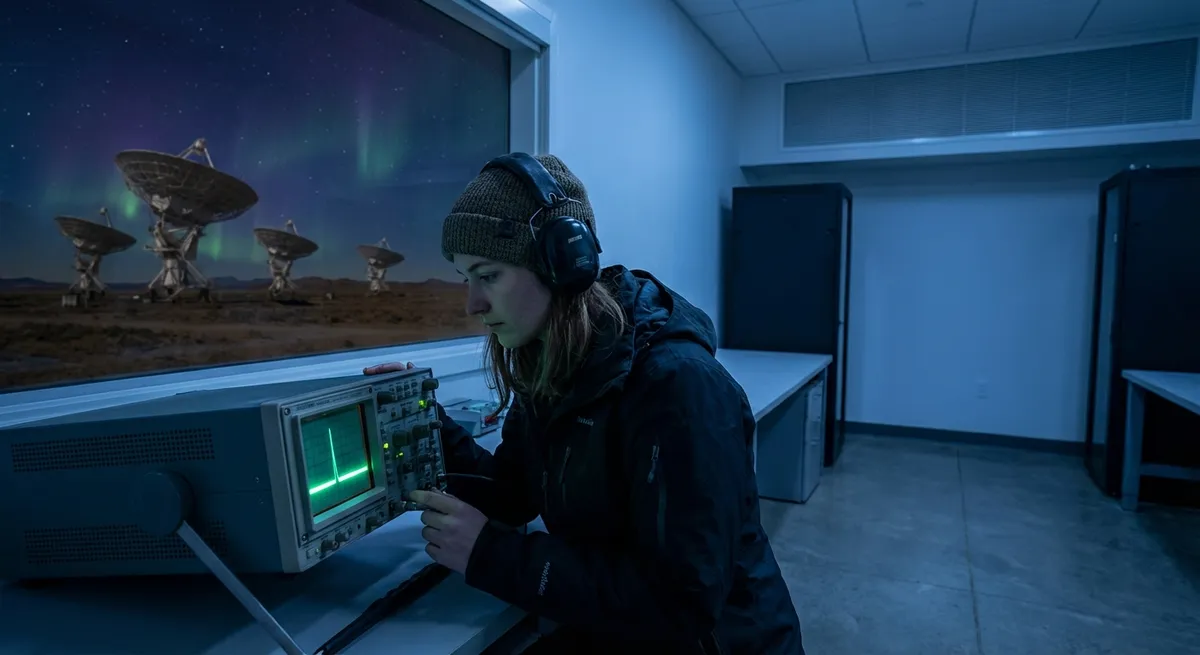
There’s a quiet revolution happening in the sky—and it isn’t about rockets, tourism, or billionaire space races. It’s about listening. All over Earth, radio dishes, laser experiments, and cosmic particle detectors are straining to catch the faintest hints that we are not alone, or that the universe itself is far stranger than we imagined. From mysterious radio bursts to planets with alien weather, recent discoveries are turning the night sky into a living laboratory of cosmic clues.
Below are five remarkable, current-space-science discoveries that are reshaping how we think about life, planets, and the invisible forces at work in the universe.
Whispers from Deep Space: Fast Radio Bursts Grow Stranger
Fast Radio Bursts (FRBs) used to be a cosmic mystery with a simple headline: powerful, millisecond-long radio blasts from deep space, origin unknown. Now, with a flood of new detections, the story is getting weirder—and more exciting.
In recent years, radio telescopes like CHIME in Canada and ASKAP in Australia have cataloged thousands of FRBs, some from galaxies billions of light-years away. Many appear only once. Others repeat, but not on any tidy schedule. One FRB, discovered in 2020, even showed a 16‑day cycle of activity before slipping back into silence.
The leading suspects behind FRBs are magnetars—neutron stars with magnetic fields a thousand trillion times stronger than Earth’s. In 2020, for the first time, astronomers caught a magnetar in our own Milky Way emitting an FRB-like blast, strongly tying at least some FRBs to these hyper-magnetic stellar corpses. But the sheer variety of bursts—different energies, durations, and repetition patterns—suggests that more than one type of cosmic engine might be involved.
FRBs matter because they’re not just fireworks. As their radio waves pass through the thin gas between galaxies, they get subtly distorted. By decoding that distortion, astronomers are turning FRBs into tools: probes that can map the otherwise invisible web of matter between galaxies and help solve long‑standing puzzles about how much “ordinary” matter the universe actually contains.
Hidden in those tiny blips of radio static may be a 3D map of the cosmos itself.
Planets with Metal Skies: Exotic Weather on Distant Worlds
Our solar system’s weather already ranges from Jupiter’s raging storms to Venus’s planet-wide oven. But exoplanet discoveries over the last decade have pushed “weird weather” into a new category entirely.
Take WASP‑76b, an ultra-hot Jupiter about 640 light-years away. One side of this world is permanently baked by its star at over 2,000°C—hot enough to vaporize metals. Observations suggest that iron actually evaporates on the star-facing side, drifts around the planet, then cools and condenses on the night side… where it likely falls as iron rain.
Other planets defy our intuition in different ways. On some “lava worlds,” like K2‑141b, the dayside may be covered with oceans of molten rock, with supersonic winds carrying vaporized stone into the night side, where it falls as rock rain. On smaller, potentially rocky exoplanets in their stars’ habitable zones, instruments like the James Webb Space Telescope (JWST) are just beginning to sniff out hints of atmospheres—gases that could protect surfaces, moderate temperatures, and maybe even allow oceans to exist.
Each strange atmosphere is more than a curiosity. By understanding how star type, planetary size, rotation, and composition shape alien weather, scientists are building a catalog of what “possible worlds” can be like. That, in turn, sharpens one of the big questions of our time: what kinds of planets are truly capable of hosting life?
The universe is telling us that “Earth-like” might be only one tiny island in a vast archipelago of planetary possibilities.
A Black Hole Caught in the Act of Star-Building
Black holes are famous for destroying things—shredding stars, swallowing gas, and bending light in ways that make even physics veterans double-check the math. Yet recent observations suggest they may also help create stars, not just erase them.
In 2023 and 2024, astronomers using NASA’s JWST and ESA’s XMM-Newton began to piece together a surprising picture in some distant galaxies. There, supermassive black holes at galactic centers were spewing out powerful jets and winds of energized particles. Instead of simply blowing material away, in some regions those outflows appear to be compressing gas clouds—pushing them over the edge into collapsing and forming new stars.
It’s a delicate balance: too much energy, and a galaxy’s gas gets heated and scattered, shutting down star formation entirely. Too little, and the galaxy stagnates. But in certain conditions, black holes may effectively “garden” their galaxies, pruning some gas while triggering star birth in other pockets.
This dual personality—both destroyer and creator—changes how we think about galaxy evolution. Black holes aren’t just passive endpoints; they’re active participants in sculpting the brightness, shape, and star content of galaxies over billions of years.
In a universe governed by gravity and light, black holes may be among the master architects.
Cosmic Rays: Invisible Messengers from Violent Events
Every second, high‑energy particles are slamming into your body, your home, and everything around you. They’re called cosmic rays, and most are harmless. But their origin story reads like an inventory of the universe’s most extreme environments.
For decades, scientists knew that some cosmic rays came from our own Sun, especially during solar storms. Others, far more energetic, were traced to supernova remnants—expanding shells of material from exploded stars—where powerful shock waves act like natural particle accelerators.
Recently, telescopes like IceCube (buried deep in Antarctic ice) and gamma-ray observatories such as HAWC and Fermi have added new pieces to the puzzle. They’ve linked some of the highest-energy particles—especially neutrinos and gamma rays—to active galactic nuclei and colliding galaxy clusters, where supermassive black holes and enormous shock fronts accelerate particles to energies far beyond what human-made accelerators can achieve.
These particles carry information that light alone can’t provide. Neutrinos, for instance, travel almost untouched through vast cosmic distances, passing straight through gas clouds and even entire planets. When detectors on Earth finally catch them, they offer direct evidence of the violent engines that created them.
Cosmic rays turn the universe into a giant physics experiment, continuously bombarding us with data about the energetic events scattered across space.
A Star’s Last Sigh: Watching a Supernova Before It Explodes
For most of history, supernovas were surprises—sudden new “stars” blooming in the sky, only understood long after the fact. Now, astronomers are starting to catch dying stars in the critical years, months, even days before they blow.
Wide-field sky surveys like the Zwicky Transient Facility (ZTF) have transformed supernova hunting from chance discovery to high‑speed monitoring. They scan huge swaths of the sky nightly, flagging any star that brightens, dims, or changes in unusual ways.
In several recent cases, astronomers identified stars that showed strange outbursts shortly before they exploded. Some were shedding huge shells of gas; others flickered or grew unstable. Then, weeks or months later, those same stars detonated as supernovas. By comparing “before” and “after” data, scientists can reconstruct how massive stars behave in their terminal phases.
One especially dramatic event, SN 2020tlf, was caught by ground-based telescopes and monitored with multiple instruments. Its progenitor star was seen violently ejecting gas in the final year before exploding—an early warning signal that such stars may often experience a chaotic “death rattle.”
Understanding these final acts goes far beyond curiosity. Supernovas are major factories of heavy elements—iron in your blood, calcium in your bones, and many of the ingredients for planets and life. By learning how and when massive stars die, astronomers refine our picture of how the universe seeded itself with the raw materials that eventually formed worlds like ours.
We are, in a sense, watching the chemical origin story of life being written in real time.
Conclusion
The universe is not a quiet, static backdrop. It’s alive with signals: radio bursts flashing from distant galaxies, planets whispering their chemical secrets through starlight, black holes shaping entire galaxies, invisible particles racing through space, and dying stars broadcasting their final warnings.
Each discovery adds a new thread to the tapestry of cosmic history—and to our own. We are decoding messages written in light, particles, and gravity, trying to understand what kind of universe we live in and whether anyone else is out here to witness it with us.
For now, the sky remains officially silent on the question of cosmic company. But the better we get at listening, the more the universe answers questions we never thought to ask.
Sources
- NASA – Fast Radio Bursts – Overview of FRBs, leading theories on their origins, and recent observational breakthroughs
- ESO – Iron Rain on the Exoplanet WASP-76b – European Southern Observatory press release describing evidence for iron rain and extreme exoplanet weather
- NASA – Webb Finds Evidence for Star Formation Triggered by Black Hole Outflows – Discussion of how black hole activity can encourage, not just suppress, star formation
- NASA – Cosmic Rays – Background on cosmic rays, their sources, and how they’re studied
- Keck Observatory – Astronomers Witness Massive Star’s Final Moments Before Supernova – Detailed look at SN 2020tlf and what it revealed about pre-supernova behavior
Key Takeaway
The most important thing to remember from this article is that this information can change how you think about Space News.