Space isn’t quiet, and it isn’t finished. Above our heads, the universe is still building, breaking, colliding, and flashing like a cosmic newsroom. Every week, telescopes on the ground and in orbit report fresh discoveries that rewrite what we thought we knew about reality.
Here are five recent and remarkable space discoveries and facts—each one a window into a universe that is stranger, more active, and more alive with physics than our everyday senses could ever reveal.
1. A Planet So Dark It’s Almost Pure Shadow
Astronomers have found a class of exoplanets so black they reflect less light than charcoal. One of the most extreme examples is WASP-12b, a “hot Jupiter” so close to its star that its atmosphere is being stripped away and baked to thousands of degrees.
What makes some of these worlds so dark is their brutally hot, stormy atmospheres. At temperatures over 2,000°C (3,600°F), molecules that would normally scatter light are ripped apart. Instead of bright clouds, their skies are filled with vaporized metals and light-absorbing atoms that act like a cosmic sponge, swallowing starlight instead of reflecting it.
From a distance, these worlds would look less like planets and more like moving holes in the light around them. For astronomers, they’re natural laboratories for testing extreme physics: how atmospheres behave when chemistry itself is being torn apart, and how planets evolve when they orbit so close to their stars that they’re effectively being slowly unmade.
2. The “Black Hole Symphony” We Can Hear with Detectors
We can’t see black holes directly—but we can listen to them.
In the last decade, observatories like LIGO and Virgo have picked up tiny ripples in spacetime called gravitational waves. These waves are triggered when massive objects such as black holes or neutron stars violently collide. On computer speakers, scientists convert those signals into audio—the result is a short, rising chirp, like a cosmic drop of water hitting an invisible drum.
Each of those chirps is the echo of a cataclysmic event billions of light-years away, where black holes spiral into each other and merge, releasing more energy in a fraction of a second than all the stars in the observable universe combined at that moment. Before 2015, these mergers were purely theoretical. Now, astronomers have a growing catalog of them, each one revealing something about the masses, spins, and even the population of black holes across the universe.
We used to map the cosmos only with light. Now, gravitational waves have opened a second sense—a way of “hearing” the universe’s most violent, invisible events.
3. A Star That Survived Being (Mostly) Eaten by a Black Hole
In 2019, astronomers watched something extraordinary: a star wandered too close to a supermassive black hole, got partly shredded, and then kept going.
These events are called tidal disruption events (TDEs). Normally, when a star strays too close, a black hole’s gravity pulls it apart, stretching it into a glowing stream of gas that spirals inward. But in at least one unusual case studied in recent years, the star wasn’t completely destroyed. Instead, it lost only part of its outer layers and continued on a heavily altered orbit—scarred, dimmer, but still a star.
This kind of survival story gives astrophysicists a rare chance to study both extremes at once: matter plunging into a black hole and a star that’s been gravitationally “wounded.” It also hints that black holes and stars may interact more often, and in more complex ways, than we previously realized.
Our galaxy’s central black hole may have once partially stripped nearby stars as well, leaving a fossil record of close calls written into their motions and compositions.
4. A Fast Radio Burst That Repeats with Almost Clockwork Precision
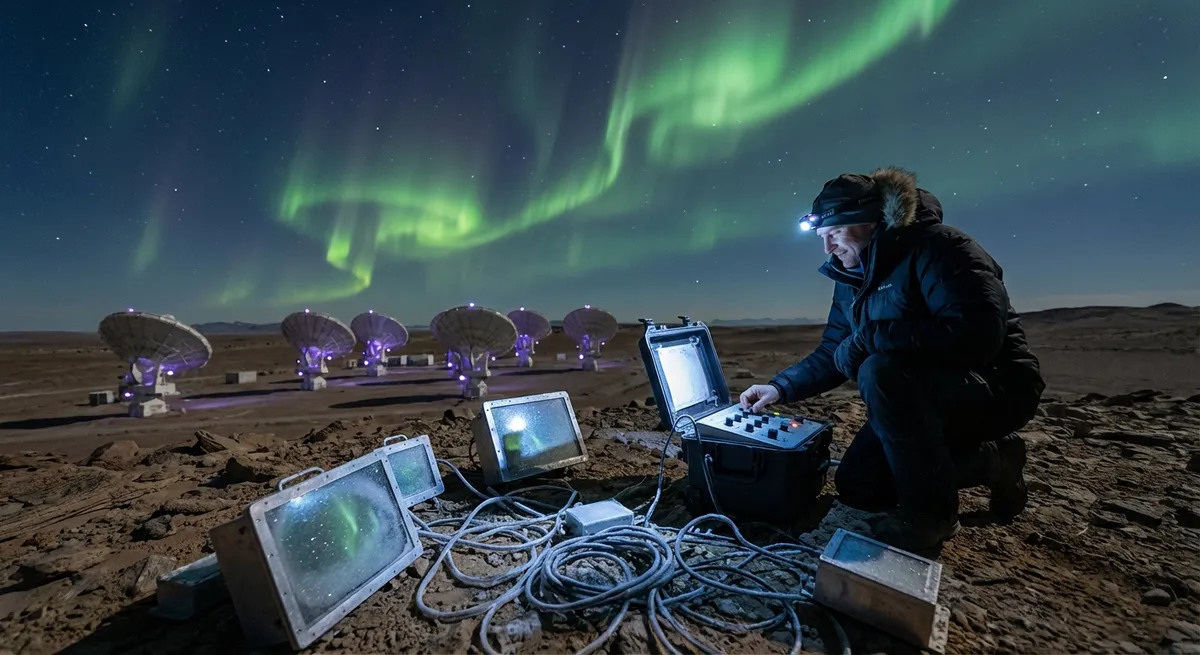
Fast radio bursts (FRBs) are one of astronomy’s strangest mysteries: ultra-brief, extremely bright flashes of radio waves coming from deep space. Most last only a few milliseconds and never repeat. But some do—and one of them, discovered in recent years, repeats on a remarkably regular schedule.
FRB 180916, for example, produces bursts that follow a roughly 16-day cycle: a few days of activity, then silence, again and again. This rhythmic behavior suggests that whatever is causing the burst—likely a highly magnetized neutron star called a magnetar—is in some sort of orbit or has a regular rotation or precession pattern that modulates its emission.
What’s astonishing is the power involved. In just a blink, a single FRB can release as much energy as our Sun emits in days or weeks. And yet, they come from objects only about 20 kilometers (12 miles) across.
By tracking repeating FRBs and pinpointing their host galaxies, astronomers hope to use them as tools—to map matter between galaxies, probe magnetic fields across cosmic distances, and perhaps one day turn them into precise yardsticks for measuring the expansion of the universe.
5. A Galaxy with Almost No Dark Matter (and Why That’s a Big Deal)
For decades, dark matter has been the invisible scaffolding of cosmology. Galaxies rotate too fast to be held together by visible matter alone, so astronomers infer that most of the mass in the universe is in some unseen form: dark matter.
Then came a shock: observations of a galaxy called NGC 1052-DF2 (and later a similar one, DF4) suggested that it contained very little dark matter—or possibly almost none at all.
If these measurements hold up, they’re enormously important. They imply that dark matter can be separated from normal matter under the right conditions, which helps scientists test and refine their theories of how galaxies form and how dark matter behaves. It’s like finding a house standing without the usual scaffolding: clearly, you’ve missed something crucial about the construction process.
Rather than weakening the dark matter idea, these outlier galaxies may actually strengthen it—because they show that dark matter isn’t just a mathematical trick; it’s a real component that can be absent, moved, or rearranged, leaving behind galaxies that look physically wrong by normal standards.
Conclusion
From planets as dark as spilled ink to galaxies that seem to have misplaced their dark matter, the latest space discoveries reveal a universe that is wildly varied and constantly surprising.
Each new observation—an odd FRB rhythm, a black hole “chirp,” a wounded star that lived through its brush with oblivion—isn’t just a headline. It’s a data point in a growing, interconnected story about how matter, energy, space, and time behave under the most extreme conditions nature can offer.
We aren’t just watching the universe from the outside. With every new discovery, we’re decoding the rules it runs on—and finding out that those rules are more flexible, more exotic, and more beautiful than we ever imagined.
Sources
- NASA Exoplanet Exploration – WASP-12b – Overview of the ultra-hot Jupiter WASP-12b, its extreme temperature, and light-absorbing atmosphere
- LIGO Scientific Collaboration – Gravitational Wave Discoveries – Catalog of confirmed gravitational wave events from black hole and neutron star mergers
- NASA Feature – Tidal Disruption Events – Discussion of black hole feeding events and stellar disruptions
- CHIME/FRB Collaboration – Periodic Activity from a Fast Radio Burst – Research article describing the 16-day periodicity of FRB 180916
- Nature – A galaxy lacking dark matter – Original study reporting the discovery of galaxy NGC 1052-DF2 with very little apparent dark matter
Key Takeaway
The most important thing to remember from this article is that this information can change how you think about Space News.