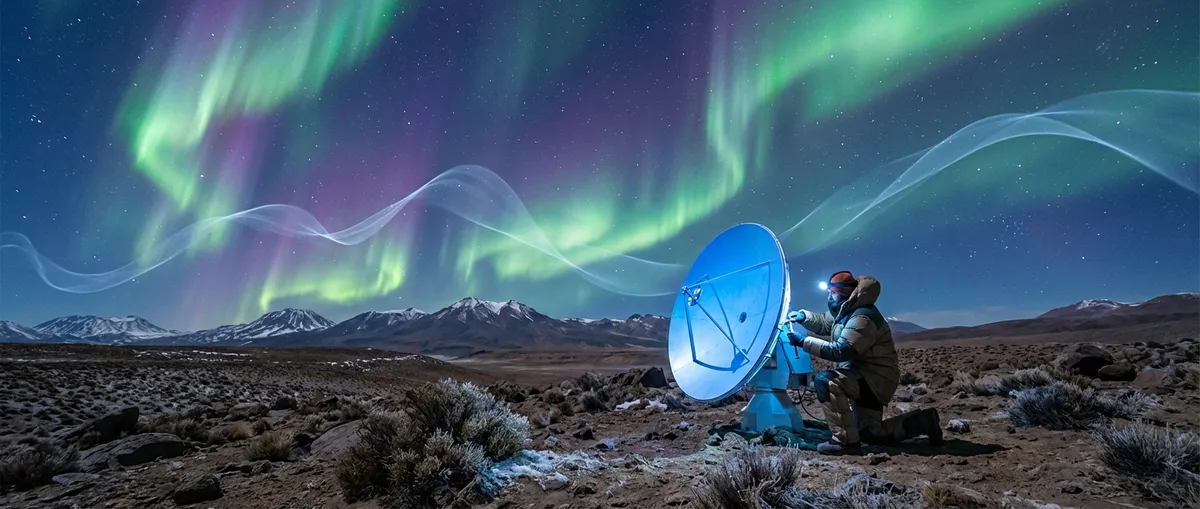
When we think about space technology, we often picture roaring rockets and gleaming spacecraft. But some of the most revolutionary space tech is quiet—built not to shout into the void, but to listen. Around Earth, on the Moon, and drifting far beyond the planets, a growing fleet of instruments is turning the universe into a whisper network of data. They listen for ripples in spacetime, faint radio pulses from dead stars, ghostly neutrinos, and even the “breathing” of our own planet.
Welcome to the age of silent signals, where space tech is less about going somewhere—and more about understanding everything.
The Universe Has a Background Hum: Gravitational Wave Observatories
For most of human history, astronomy was about light. Then space tech helped us build instruments that listen for something stranger: waves in spacetime itself.
Gravitational wave detectors like LIGO and Virgo don’t “see” in the traditional sense. Instead, they use lasers and vacuum tubes several kilometers long to sense minute distortions in spacetime—smaller than the width of a proton—produced when massive objects like black holes collide. While these detectors are on Earth, they depend heavily on space tech for timing, data calibration, and future planned upgrades that will operate in space, such as the Laser Interferometer Space Antenna (LISA).
Here’s one amazing discovery from this quiet technology: in 2015, LIGO detected the signal from two black holes merging over a billion light-years away. The event briefly released more energy in gravitational waves than all the stars in the observable universe emit in light at that instant. Those waves slightly stretched and squashed the distance between mirrors on Earth, and our tech was precise enough to notice.
What makes this even more astonishing is that we’re now picking up a background hum of gravitational waves from supermassive black hole mergers across the cosmos. Think of it as the universe’s deep bass track—a slow, rolling chorus of ancient collisions that our detectors are just beginning to tune into.
Amazing Fact #1: The gravitational wave signal LIGO detected changed the length of its 4 km arms by about one-thousandth the size of a proton—and that was enough for us to confirm the existence of black hole mergers.
Dead Stars as Cosmic Lighthouses: Pulsar Timing and Galactic Clocks
Long after some stars die, they keep sending out a message—in the form of perfectly timed radio pulses. These “pulsars” are fast-spinning neutron stars, the ultra-dense cores left behind after a supernova. Space-based and ground-based radio telescopes, working together, can time these pulses with extraordinary precision.
Orbiting telescopes, high-stability clocks, and deep-space communications tech allow astronomers to monitor pulsars across the sky and search for subtle irregularities. If a gravitational wave passes between us and a pulsar, it ever-so-slightly alters the time those pulses arrive. By comparing the timing of many pulsars, we can effectively turn the galaxy into a colossal detector.
This method—called a pulsar timing array—recently found evidence of a low-frequency gravitational wave background. Instead of catching brief, sharp events like black hole mergers, these arrays are sensitive to slow, massive disturbances, such as the gradual dance of supermassive black holes spiraling together in distant galaxies.
Amazing Fact #2: Some millisecond pulsars keep time more stably than the best atomic clocks on Earth, drifting by less than a microsecond over many years, making them natural galactic timekeepers.
Ice as a Telescope: Neutrino Hunters and Cosmic Ghosts
Imagine particles that pass right through planets, stars, and even you—billions every second—almost never interacting with anything. These are neutrinos, sometimes called “ghost particles.” On their way to detectors on Earth, many are born in violent cosmic events: exploding stars, black holes, and energetic jets from active galaxies.
To detect them, scientists have turned an entire chunk of Antarctic ice into a kind of space-connected observatory. The IceCube Neutrino Observatory drills thousands of light sensors deep into the ice, watching for tiny flashes of light created when a rare neutrino does interact. While IceCube is on Earth, much of the interpretation of its data depends on space tech: multi-wavelength observations from space telescopes help identify the astrophysical sources aligned with those neutrinos.
In 2017, a high-energy neutrino was traced back to a blazar—a galaxy with a supermassive black hole launching a jet almost directly at us. Space telescopes like NASA’s Fermi Gamma-ray Space Telescope and ESA’s INTEGRAL helped confirm that the galaxy was flaring at the same time. This was one of the first times humans linked a specific neutrino to a known astrophysical object, opening a new way of doing “multi-messenger astronomy,” where we blend light, particles, and gravitational waves to tell a fuller cosmic story.
Amazing Fact #3: Trillions of neutrinos stream through your body every second, mostly from the Sun—yet almost none of them ever interact with a single atom in you.
Planetary Heartbeats: Satellites That Hear Earth’s Invisible Fields
Space tech isn’t just eavesdropping on distant galaxies—it’s also listening to our own planet in ways our senses never could.
Magnetic field satellites like ESA’s Swarm constellation and NASA’s earlier missions map Earth’s magnetic field with extreme precision. They reveal how it shifts, flickers, and pulses due to molten iron flows in the outer core, solar storms, and even ocean currents and lightning strikes. To these satellites, Earth is humming with electromagnetic rhythms.
This listening has practical power. By monitoring how the magnetic field responds to energetic events from the Sun, we can better predict space weather that might disrupt power grids, GPS, or communications. It also teaches us about the hidden interior of our planet. Small changes in the field help scientists infer how material moves thousands of kilometers below our feet—something we can never visit directly.
Amazing Fact #4: Earth’s magnetic field is constantly changing; satellites have shown that its strength has dropped by about 9% over the last 170 years, and a strange “weak spot”—the South Atlantic Anomaly—keeps evolving over time.
Cosmic Archaeology: Ancient Light, Relic Radiation, and the Oldest Map We Have
Long before stars formed, before galaxies assembled, the universe was a hot, dense plasma. When it finally cooled enough for atoms to form, light was able to travel freely for the first time. That ancient light is still around us today, stretched by the expansion of the universe into microwave wavelengths. It’s called the cosmic microwave background (CMB), and space tech has turned it into a detailed map of the early cosmos.
Missions like NASA’s Wilkinson Microwave Anisotropy Probe (WMAP) and ESA’s Planck satellite mapped the CMB from space with extraordinary precision. They detected temperature variations across the sky of only a few millionths of a degree. Those tiny fluctuations represent the seeds of future galaxies and clusters—the earliest fingerprints of structure in the universe.
From this silent glow, scientists have extracted remarkable facts: the age of the universe (about 13.8 billion years), its overall composition (including dark matter and dark energy), and clues to what might have happened in the first fractions of a second after the Big Bang. All from an almost featureless wash of microwaves that’s invisible to human eyes.
Amazing Fact #5: The cosmic microwave background is so cold—about 2.7 degrees above absolute zero—that a standard home microwave oven is “brighter” in microwave radiation than the entire night sky.
Conclusion
Space technology is often introduced as a story of propulsion, engineering, and human daring—and it is. But its quieter side may be even more profound. By building instruments that listen as carefully as they look, we’ve learned that:
- Black holes can send ripples through spacetime itself.
- Dead stars can serve as galactic clocks.
- Ghostly neutrinos can point the way to extreme cosmic engines.
- Earth hums with invisible magnetic rhythms.
- Ancient light still carries the memory of the universe’s first moments.
In the coming decades, planned missions like the space-based gravitational wave observatory LISA, next-generation neutrino detectors, and even more sensitive cosmic background probes will deepen this listening. Orbit by orbit, signal by signal, we’re turning the silent universe into a readable story—and we’ve barely finished the first chapter.
Sources
- [LIGO Scientific Collaboration – Gravitational Waves](https://www.ligo.org/science/Publication-GW150914/index.php) – Overview of the first direct detection of gravitational waves from merging black holes
- [European Space Agency (ESA) – LISA Mission](https://www.esa.int/Science_Exploration/Space_Science/LISA_overview) – Details on the planned space-based gravitational wave observatory
- [IceCube Neutrino Observatory – Multimessenger Astronomy](https://icecube.wisc.edu/science/multimessenger/) – Explanation of how neutrino detections are combined with space-based observations
- [ESA Swarm Mission – Earth’s Magnetic Field](https://www.esa.int/Applications/Observing_the_Earth/Swarm/ESA_s_Swarm_probes_weakening_of_Earth_s_magnetic_field) – Findings on changes in Earth’s magnetic field from satellite measurements
- [ESA Planck Mission – Cosmic Microwave Background](https://www.esa.int/Science_Exploration/Space_Science/Planck) – Results and background on mapping the relic radiation from the early universe
Key Takeaway
The most important thing to remember from this article is that this information can change how you think about Space Tech.