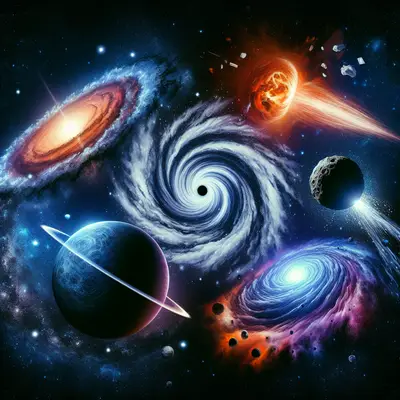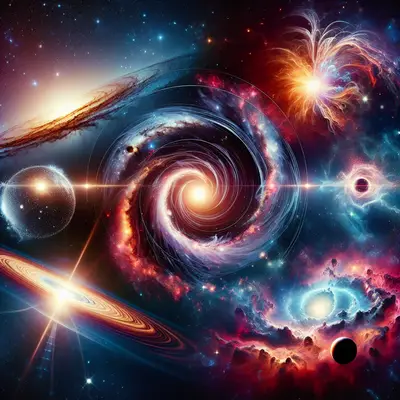
Most of the universe moves on time scales so long they make human history look like a camera flash. Stars take millions of years to form, galaxies slowly collide over eons, and black holes quietly feed for ages. Yet every so often, the cosmos hits the fast‑forward button—unleashing events so dramatic we can watch them unfold in a single lifetime, sometimes even in a single night.
These rare, high‑energy, blink‑and‑you‑miss‑them moments are the fireworks of the universe. From stars tearing themselves apart to invisible waves rippling through spacetime, they reveal secrets about how everything—from atoms to galaxies—actually works.
Let’s step into the universe’s highlight reel and explore some of the most astonishing cosmic events we can witness from Earth today, plus five mind‑bending facts that show just how wild our universe really is.
When a Star Explodes: Supernovae You Can Watch from Home
A supernova is what happens when a massive star reaches the end of its nuclear “fuel” and can no longer hold itself up against gravity, or when a white dwarf suddenly ignites runaway fusion. In a fraction of a second, its core collapses, its outer layers are blasted into space, and the star briefly outshines an entire galaxy.
On cosmic time scales, that’s a jump cut. One moment: normal star. The next: a flash visible across millions of light‑years.
Today, powerful telescopes like the Vera C. Rubin Observatory (soon), Pan‑STARRS, and the Zwicky Transient Facility scan the sky night after night looking for “new stars” that appear where there were none the night before. They’re not catching stars being born—they’re catching stars dying in real time.
A single bright supernova can:
- Outshine billions of other stars in its host galaxy
- Forge heavy elements like gold, iodine, and uranium in its blast
- Send shock waves that compress nearby gas and trigger new star formation
- Leave behind a neutron star or a black hole
Amazing Space Fact #1:
Some supernovae are so powerful we can detect individual neutrinos—ghost‑like particles—from them on Earth. In 1987, Supernova 1987A in the Large Magellanic Cloud sent a burst of neutrinos that arrived hours before the light did, letting physicists “feel” the explosion before they saw it.
The Universe Has Earthquakes in Spacetime: Gravitational Waves
In Einstein’s relativity, space and time are not a static stage; they’re a flexible fabric. When something truly colossal happens—like two black holes spiraling together and colliding—it doesn’t just release light. It sends out ripples in spacetime itself, called gravitational waves.
For a century, these were purely theoretical. Then, in 2015, the Laser Interferometer Gravitational-Wave Observatory (LIGO) recorded a signal from two black holes merging over a billion light‑years away. The distortion they caused when they passed through Earth changed the length of LIGO’s 4‑kilometer arms by less than the width of a proton—but it was enough.
Gravitational waves:
- Carry information about events that emit no light at all
- Let us “hear” the universe through spacetime vibrations
- Reveal the masses and spins of colliding black holes and neutron stars
- Open a whole new way of doing astronomy beyond light alone
Amazing Space Fact #2:
The first neutron‑star collision detected in 2017 (GW170817) was seen in gravitational waves and light—gamma rays, X‑rays, visible light, radio waves. This one event confirmed that such collisions are factories for heavy elements like gold and platinum. Some of the gold in your jewelry likely began in a smash‑up like this.
Stars That Pulse Like Cosmic Beacons: Neutron Stars and Pulsars
When some massive stars explode as supernovae, their cores don’t vanish. They collapse into neutron stars—city‑sized objects with more mass than our Sun compacted into a sphere about 20 kilometers across. A spoonful of neutron star material would outweigh Mount Everest.
Some neutron stars spin incredibly fast and shoot beams of radio waves (and sometimes X‑rays and gamma rays) from their poles. If those beams sweep past Earth, we detect regular pulses: these are pulsars, like cosmic lighthouses.
From our perspective they:
- Tick with extreme precision—better than atomic clocks in some cases
- Let astronomers test gravity under crushing densities
- Reveal the aftermath of supernova explosions
- Act as galactic “GPS beacons” for mapping our region of the Milky Way
Amazing Space Fact #3:
The fastest known pulsars spin over 700 times per second. That means a star with the mass of the Sun, squeezed into a 20‑kilometer ball, is rotating faster than the blade of a kitchen blender.
Even more mind‑bending: astronomers are now building a “pulsar timing array”—a network of precisely monitored pulsars—to detect ultra‑slow gravitational waves produced by supermassive black holes orbiting each other in distant galaxies.
Space Weather: Solar Flares and Auroras That Dance Over Earth
Not all dramatic cosmic events are light‑years away. Our own star, the Sun, erupts with violent outbursts called solar flares and coronal mass ejections (CMEs). These blasts hurl charged particles and magnetic fields across the solar system. When some of that material hits Earth’s magnetic field, the impact is called space weather.
The effects:
- Stunning auroras, not only near the poles but occasionally at much lower latitudes
- Disturbances in radio communications and GPS signals
- Potential damage to satellites and power grids during extreme events
- A stream of data that helps us understand how stars behave
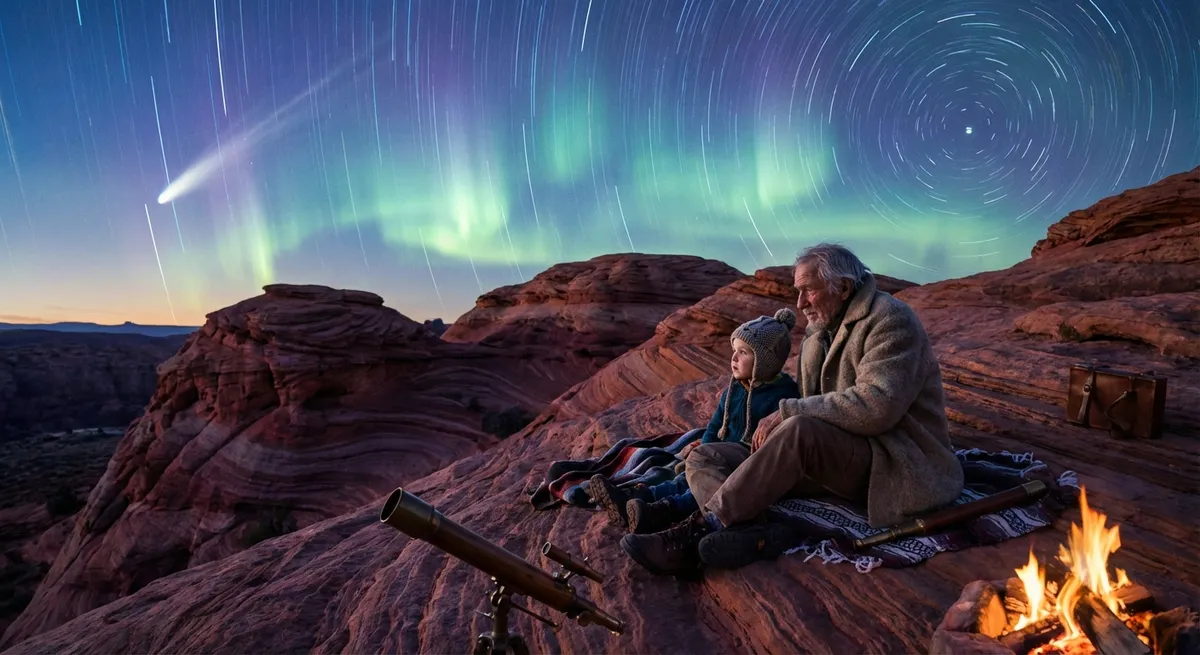
Auroras are the visible “footprints” of this interaction. Energetic particles guided along Earth’s magnetic field collide with atoms in our atmosphere. Those atoms get excited, then release light in characteristic colors—green and red for oxygen, purples and blues for nitrogen.
Amazing Space Fact #4:
A particularly intense solar storm in 1859, known as the Carrington Event, caused auroras so bright that people in the Caribbean could see them, and miners in the Rocky Mountains reportedly woke up in the middle of the night thinking it was dawn. Telegraph systems sparked, caught fire, and transmitted messages even when disconnected from their power supplies.
Modern infrastructure is far more vulnerable. This is why scientists continuously monitor the Sun with missions like NASA’s Solar Dynamics Observatory and the Parker Solar Probe—to predict and prepare for major storms.
Fast Radio Bursts: Millisecond Mysteries from Deep Space
Imagine a radio telescope calmly watching a patch of sky when, without warning, it’s hit by a burst of radio energy that lasts only a thousandth of a second—yet carries more energy than the Sun emits in days. Then it vanishes.
These are fast radio bursts (FRBs), one of the most baffling cosmic events discovered in the past two decades.
Key features:
- They appear randomly across the sky
- Some repeat from the same source; others are one‑offs
- They come from galaxies billions of light‑years away
- Their signals are “stretched” as they travel, revealing how much matter they’ve passed through
We still don’t know what causes all FRBs, but leading candidates include highly magnetized neutron stars called magnetars. By carefully measuring how FRBs’ signals are smeared out, astronomers are turning them into probes of the thin gas—called the intergalactic medium—between galaxies.
Amazing Space Fact #5:
A single repeating FRB has been traced to a star‑forming region in a relatively nearby galaxy about 500 million light‑years away. The repeating pattern is so stable that some researchers have jokingly compared it to a “cosmic lighthouse,” blinking from the edge of the observable universe—though all credible evidence points to extreme astrophysics, not aliens.
What These Events Reveal About Our Place in the Universe
Cosmic events that unfold in human time are more than just sky‑show spectacles. They’re experiments we could never run on Earth:
- Supernovae show how elements are forged and scattered, seeding future stars and planets.
- Gravitational waves let us test Einstein’s theories where gravity is strongest.
- Pulsars and neutron stars push physics into regimes of density and magnetism we can’t reproduce in any lab.
- Solar storms and auroras tie our fragile technological world directly to the behavior of our star.
- Fast radio bursts turn the universe into a natural laboratory for exploring the matter between galaxies.
When you look at an image of a supernova remnant, a snapshot of colliding neutron stars, or a shimmering aurora over a dark horizon, you’re seeing the universe in motion—caught mid‑act. These aren’t static pictures frozen in time; they’re frames from an ongoing cosmic story we’ve only just begun to understand.
And the most astonishing part? All of this is happening constantly, above your head, right now. The sky is not a museum of distant, unchanging lights—it’s an active, restless arena where stars explode, black holes collide, and invisible waves slide silently through your body as you read this sentence.
Our role is simple: build better eyes and ears, keep watching, and keep asking what the universe is trying to tell us with each new, fleeting cosmic event.
Conclusion
From the crack of a supernova to the whisper of a gravitational wave, cosmic events compress unimaginable energies into moments short enough for human minds to grasp. They turn abstract physics into visible and measurable phenomena—light curves, pulses, ripples, and shimmering skies.
As our telescopes, detectors, and space missions grow more sensitive, the universe’s “live broadcast” becomes clearer. Each new detection—an unexpected radio burst, a fresh gravitational‑wave chirp, an unusually bright supernova—adds another clue about how the cosmos evolves, recycles matter, and shapes the conditions for life.
The night sky might look calm, but on the scales of human time, it’s anything but. It’s a living, changing, explosive canvas—and we’re finally learning how to read its fastest strokes.
Sources
- NASA – Supernova Explosions – Overview of how supernovae occur and why they matter for cosmic evolution
- LIGO – Gravitational Wave Discoveries – Official catalog and explanations of gravitational‑wave events detected so far
- NASA – Neutron Stars and Pulsars – Educational resource on the nature and behavior of neutron stars and pulsars
- NOAA Space Weather Prediction Center – Real‑time monitoring and explanations of solar activity, geomagnetic storms, and auroras
- CHIME/FRB Project, via the Canadian Hydrogen Intensity Mapping Experiment – Information on fast radio burst discoveries and current research into their origins
Key Takeaway
The most important thing to remember from this article is that this information can change how you think about Cosmic Events.