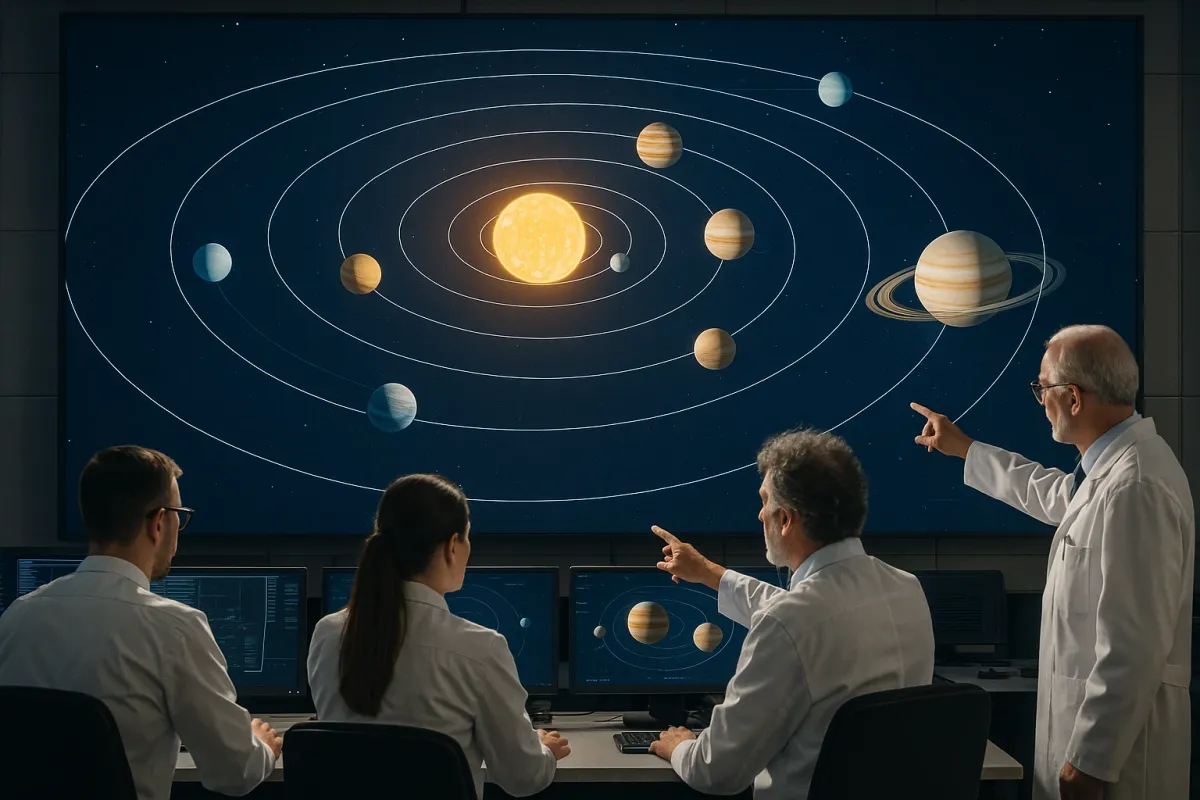
Our solar system used to look simple in textbooks: eight planets, some moons, a belt of rocks, and a chilly edge where everything faded into darkness. But if you’ve glanced at space news lately, you know that picture is collapsing in real time. Every new mission, from NASA’s asteroid rendezvous to ESA’s icy-moon hunters, is sketching in details we didn’t even know we were missing.
Right now, space agencies and private companies are flooding the solar system with probes, landers, telescopes, and sample-return missions. The result? A constant stream of “Wait, WHAT?” moments. Below are five current fronts in solar system exploration that are transforming our cosmic neighborhood from a simple diagram into a living, evolving ecosystem.
Asteroid Treasure Hunts: From Planet Killers to Resource Banks
For years, asteroids were framed mostly as extinction-level threats. Today, they’re turning into some of the most interesting — and valuable — real estate in the solar system. NASA’s OSIRIS-REx mission, which dropped its sample capsule from asteroid Bennu back to Earth in late 2023, is still revealing fresh results as scientists process the material. Early analyses suggest Bennu is loaded with carbon-rich compounds and water-bearing minerals, exactly the ingredients that may have helped seed Earth with the building blocks of life billions of years ago.
Japan’s space agency JAXA pioneered this game with Hayabusa and Hayabusa2, which brought back samples from the asteroids Itokawa and Ryugu. Those results showed that these rubble piles are more like loosely bound bags of ancient, primitive material than solid rocks. Now NASA has pivoted OSIRIS-REx to a brand-new target: the near-Earth asteroid Apophis, which will make a historically close flyby of Earth in 2029. While the world watches for orbital changes and impact risk, planetary scientists are more excited about something else: how tidal forces from Earth will literally shake and remodel Apophis’s surface in real time.
Layer onto this the testing of asteroid-deflection technology, like NASA’s DART mission in 2022 that slammed into the moonlet Dimorphos and measurably changed its orbit. Put together, we’re moving into an era where asteroids are simultaneously:
- Time capsules of the early solar system
- Life-ingredient couriers
- Mining targets for future space industry
- Practice targets for planetary defense
The next decade will likely see follow-on missions from NASA, ESA, and possibly private ventures that treat asteroids not as background debris, but as a central part of our long-term survival strategy — and maybe our off-world economy.
Ocean Worlds Awaken: Why Moons Are Now Hottest in the Life Hunt
If you’re looking for alien life, astronomers are increasingly telling you to skip the “Earth-like planet” hype and point your curiosity at icy moons. One of the biggest drivers of this shift is NASA’s upcoming Europa Clipper mission, which is in its final integration and test phase ahead of launch. Set to arrive at Jupiter’s moon Europa in the early 2030s, Clipper will repeatedly swoop past the moon searching for signs of a subsurface ocean and measuring its chemistry, thickness, and potential habitability.
Europa has long been a star in science fiction — a frozen shell with an ocean deep enough to swallow Earth’s tallest mountains. But it’s now part of a broader family of “ocean worlds” that also includes Saturn’s Enceladus and Titan. The Cassini mission’s iconic fly-throughs of Enceladus’s geysers showed water vapor, organic molecules, and salts being sprayed into space — basically an ocean sample delivered for free. That discovery is still reshaping mission concepts today, with proposed landers and orbiters designed to sniff, sample, and even scoop possible biosignatures.
Meanwhile, ESA’s JUICE mission (JUpiter ICy moons Explorer), launched in 2023 and currently cruising through the inner solar system, is on its way to study Ganymede, Callisto, and Europa. Its goal: understand how these massive moons work as complete systems — magnetic fields, ice shells, potential oceans, and all. The growing realization is profound: habitable zones may not just be about distance from the star, but about energy sources inside moons — tidal heating, chemistry at the seafloor, and interactions between rock, water, and ice. Oceans, it turns out, can hide beneath worlds that at first glance look utterly dead.
Mars in Transition: From “Is There Life?” to “Can We Live There?”
Mars has occupied the center of our collective sci‑fi imagination for generations, but current missions are turning it into a data-rich, testable engineering problem. NASA’s Perseverance rover, roaming Jezero Crater since 2021, is actively collecting rock cores intended to be returned to Earth in the ambitious Mars Sample Return campaign. As of now, dozens of sample tubes have been cached with sediments that appear to have formed in an ancient river delta — exactly the kind of environment on Earth that teems with microbial life.
The big pivot on Mars is this: scientists are no longer just asking “Was Mars ever habitable?” That question is already leaning heavily toward “yes” in its early history, based on what we’re learning from Curiosity, Perseverance, and orbiters like MAVEN. The frontier now is: “Can we ever build a sustained human presence there?” China’s Tianwen‑1 orbiter and the Zhurong rover have added crucial data about Martian soil, subsurface ice, and climate, as international interest ramps up. NASA, ESA, and private players like SpaceX are all developing technologies for entry, descent, landing, power generation, and in-situ resource utilization.
Rovers and landers are quietly doing the unglamorous but necessary homework: testing oxygen extraction from CO₂ (like NASA’s MOXIE experiment on Perseverance), mapping water ice deposits, and tracking dust storms that can black out solar panels for weeks. When you see headlines about another drilling attempt or atmospheric measurement, it might sound routine — but those numbers will define whether future Mars residents drink Martian water, breathe recycled local oxygen, and fuel rockets with Martian propellant or depend on endless supply chains from Earth.
The Edge of the Solar System Is Not Where We Thought It Was
For decades, the solar system “ended” — at least in school diagrams — around Neptune or Pluto, with maybe a faint ring of comets beyond. In reality, our star’s influence extends into a vast, dynamic bubble called the heliosphere, and current missions are giving us our first true taste of its outer skin. NASA’s Voyager 1 and Voyager 2 spacecraft famously crossed into interstellar space in 2012 and 2018, respectively, but they’re still sending back precious data as they move farther into the interstellar medium, measuring cosmic rays, magnetic fields, and the density of matter between the stars.
Closer in, NASA’s Interstellar Mapping and Acceleration Probe (IMAP), set for launch in the near term, is being designed to map the boundary of this heliospheric bubble from the inside-out. It will watch how solar wind particles interact with incoming interstellar material, effectively sketching the shape of our Sun’s protective shield. Meanwhile, the New Horizons mission — which dazzled the world with detailed images of Pluto in 2015 — is now in the Kuiper Belt, studying distant icy bodies and the dust distribution in this remote region.
The emerging picture is that the outer solar system is not a quiet, static frontier, but a turbulent boundary zone where the Sun negotiates with the galaxy. This matters for more than just curiosity: the heliosphere helps shield planets (including Earth) from high-energy galactic cosmic rays. Its shape and strength may influence climate, atmospheric chemistry, and even long-term radiation exposure for future deep-space travelers. As we refine our maps of this invisible bubble, we’re learning that the solar system is less like a set of orbits in empty space and more like an island surrounded by a cosmic sea.
The New Observers: How Next-Gen Telescopes Reframe “Our” Backyard
While spacecraft roam the planets and moons, a new generation of telescopes is reimagining how we observe the solar system from a distance. The James Webb Space Telescope (JWST), although famous for deep-universe imagery, is also quietly revolutionizing solar system science. Webb has already observed Jupiter’s auroras, Saturn’s rings, and distant objects like Uranus and Neptune with unprecedented infrared sensitivity, revealing temperature structures, atmospheric chemistry, and ring dynamics in exquisite detail.
These observations are doing double duty: they help us understand our own giants while providing templates for studying exoplanets. When JWST detects carbon dioxide, water vapor, methane, or hazes in exoplanet atmospheres, it’s leveraging the same physics and modeling developed from decades of Jupiter and Saturn data, now pushed to new extremes by Webb’s resolution. At the same time, ground-based observatories using adaptive optics — like the Very Large Telescope (VLT) in Chile — are catching asteroids in close flybys, refining orbits, and even resolving binary systems in the Kuiper Belt.
All of this folds into a critical shift: the solar system is no longer studied in isolation. We now treat it as a benchmark. Everything we’re learning about our own planets, moons, and small bodies feeds directly into how we interpret exoplanet light curves, transmission spectra, and population statistics. In other words, the more precisely we understand the swirl of dust in Saturn’s rings or the haze in Titan’s sky, the better we can decode alien worlds orbiting stars we’ll never visit.
Conclusion
The most radical thing about current solar system exploration is not any single discovery. It’s the way all of them are stitching together into a new picture: asteroids as both threats and economic assets, icy moons as hidden ocean refuges, Mars as a potential second home, the heliosphere as our cosmic forcefield, and telescopes that turn our local system into a Rosetta Stone for planetary science across the galaxy.
If you learned a neat, orderly version of the solar system in school, consider it an early draft. Probes streaking past asteroids, rovers crawling in Martian craters, and telescopes catching faint glimmers of distant ice are all telling us the same thing: our neighborhood is stranger, richer, and more alive with possibility than we ever imagined. And the map? We’re still drawing it — one mission at a time.
Key Takeaway
The most important thing to remember from this article is that following these steps can lead to great results.