Space probes once followed rigid scripts, obeying every line of code beamed from Earth. Now, a new generation of spacecraft is beginning to think for itself—spotting alien worlds, dodging hazards, and rewriting its own priorities millions of kilometers away.
Behind this shift is a powerful blend of autonomy, artificial intelligence, and miniaturized sensors that is quietly transforming how we explore the cosmos. From rovers that choose their own rocks on Mars to telescopes that learn which stars are most likely to host habitable worlds, space tech is evolving into something far more dynamic than just hardware in orbit.
Along the way, it’s also producing some astonishing facts and discoveries that hint at how radically different the next era of exploration will be.
From Remote-Controlled to Self-Directed
For most of spaceflight history, spacecraft have been more like obedient robots than independent explorers. Engineers on Earth wrote commands, uploaded them, and hoped the hardware would behave. Light-speed delays—up to 22 minutes one-way to Mars—meant there was no real-time joystick control, just carefully planned sequences.
Autonomy began modestly. Spacecraft learned to keep themselves safe: turning to the Sun if they lost orientation, switching to backup systems when something glitched, or entering “safe mode” until humans could intervene. These were rule-based reflexes, not intelligence.
Today’s missions go further. NASA’s Mars rovers use on-board navigation to route around rocks and craters without waiting for instructions. Earth-observing satellites automatically adjust which regions to image based on cloud cover or disaster alerts. Deep-space probes can re-prioritize targets if they detect something unexpected, like a sudden dust plume on a comet.
This shift isn’t just convenience. It’s a necessity for the outer solar system and beyond, where communication delays are hours long and transmission windows are narrow. To explore in real time in such distant domains, you need spacecraft that aren’t just tools—they’re partners.
The Rise of AI in Orbit
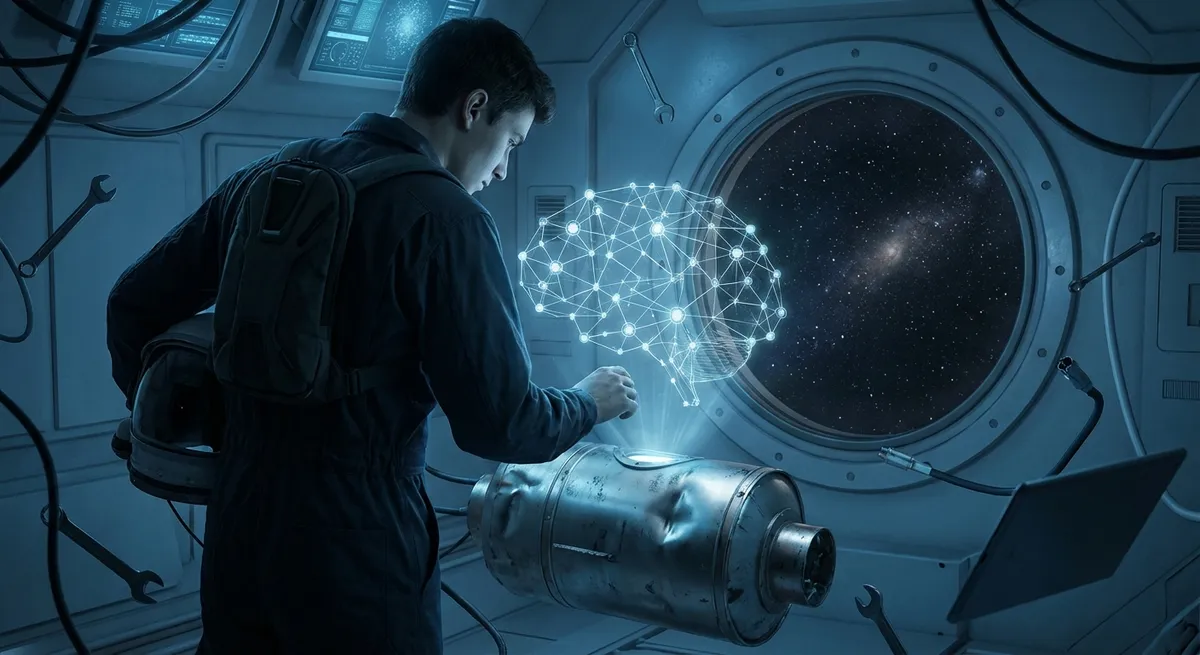
Artificial intelligence and machine learning are turning spacecraft from passive collectors into active decision-makers. Instead of sending home everything they see, they’re starting to understand what they see.
On Mars, the Curiosity rover used an AI system called AEGIS (Autonomous Exploration for Gathering Increased Science) to pick out scientifically interesting rocks and soils for its instruments—no human selection needed. It scanned the scene, ranked potential targets, and fired its laser at the most promising ones.
In Earth orbit, AI systems sift through vast streams of imagery to detect ship traffic, track wildfires, and even anticipate where climate-related changes are happening fastest. Some satellites now carry edge-computing hardware—basically, tiny data centers in space—so they can run AI models on-board rather than sending raw data back.
For future telescopes, AI will likely be central. Imagine a space observatory that scans thousands of stars for tiny brightness dips from transiting exoplanets, then learns which light curves look most promising for follow-up. Or a network of small telescopes that share findings and divide up the sky, letting machine-learning models coordinate what to observe next.
This is where the line between “instrument” and “agent” starts to blur. The spacecraft isn’t just gathering data—it’s helping decide which questions to ask.
Five Amazing Space Tech Facts That Redefine What’s Possible
Modern space technology is full of details that sound like science fiction but are already operating above us—or on other worlds. Here are five of the most stunning examples, each quietly reshaping how we explore the universe.
1. A Single Spacecraft Has “Seen” More Than 5,000 Alien Worlds
NASA’s Kepler space telescope, now retired, transformed our view of the galaxy. By staring at one small patch of sky and measuring the dimming of starlight as planets passed in front, it helped reveal thousands of exoplanets—more than 2,600 confirmed, with thousands more candidates.
What’s extraordinary isn’t just the number, but the variety. Kepler uncovered ultra-hot Jupiters skimming their stars, compact systems with planets in tight, clockwork orbits, and rocky worlds in the habitable zones of red dwarf stars. It showed that planets are not rare exceptions; they’re the rule.
The technology behind it—ultra-stable photometry and precise onboard processing—laid the groundwork for today’s exoplanet satellites and the AI tools that now comb through light-curve data for subtle signals.
2. Spacecraft Can Use Gravity as a Cosmic Slingshot
To go fast without carrying absurd amounts of fuel, deep-space probes use gravity assist maneuvers—stealing a bit of momentum from planets as they fly by. It’s orbital mechanics turned into a cosmic billiard game.
The Voyager 2 spacecraft famously used a rare lineup of the outer planets to swing from Jupiter to Saturn to Uranus to Neptune, each time gaining speed. This gravity “pinball” allowed it to tour four giant planets in one mission, and it’s now one of the farthest human-made objects in space.
These maneuvers are calculated with exquisite precision. A tiny change in trajectory at one flyby can determine whether the spacecraft reaches its target decades later. It’s like aiming an arrow at a moving target on the other side of the solar system, using planets themselves as shifting launch platforms.
3. We’ve “Touched” the Sun with a Probe Flying Through Its Atmosphere
NASA’s Parker Solar Probe is flying so close to the Sun that parts of its orbit dip directly into the Sun’s outer atmosphere, the corona. In 2021, Parker became the first spacecraft to cross the “Alfvén critical surface,” the boundary where the solar material begins to break free as the solar wind.
Protected by a carbon-composite heat shield that can withstand temperatures of about 1,400°C (2,500°F), Parker samples the charged particles and magnetic fields near the Sun in situ. Its instruments are exposed to an environment more extreme than almost any other spacecraft has faced.
Among its discoveries: the solar wind is far more structured and “switchback”-filled than expected, with rapid kinks in the magnetic field that may help explain how the corona is mysteriously hotter than the Sun’s visible surface.
4. A Space Telescope Unfolded Itself Like a Giant Mechanical Origami
The James Webb Space Telescope (JWST) is so large it couldn’t fit inside a rocket fully assembled. Engineers had to design it to fold up like a high-tech piece of origami: a segmented mirror, a multi-layered sunshield the size of a tennis court, and an array of delicate instruments.
Once in space, JWST performed a complex deployment sequence with hundreds of single points of failure. It had to work—there was no way to repair it in person at its distant orbit around the Sun–Earth L2 point.
The payoff is astonishing. With its infrared vision, JWST peers through cosmic dust clouds to see star nurseries, studies exoplanet atmospheres for signatures like water vapor and methane, and looks back over 13 billion years to some of the earliest galaxies. It’s not just a telescope; it’s a time machine powered by one of the most intricate pieces of space engineering ever launched.
5. Tiny “CubeSats” Have Ridden Alongside Giant Missions—and Gone Interplanetary
CubeSats, once dismissed as student toys, are now serious tools of space exploration. These modular satellites—often built from 10 cm cubes—are relatively cheap, fast to develop, and small enough to hitch rides on larger missions.
In 2018, two CubeSats named MarCO-A and MarCO-B traveled to Mars alongside NASA’s InSight lander. During InSight’s dramatic descent through the Martian atmosphere, the MarCO satellites relayed telemetry back to Earth in near real-time, proving that tiny spacecraft could perform deep-space communication roles once reserved for large, expensive probes.
Today, CubeSats are being designed for lunar exploration, asteroid reconnaissance, and even interplanetary missions with miniature propulsion and navigation systems. The idea of swarms of small, semi-autonomous explorers roaming the solar system is no longer fantasy; it’s an emerging strategy.
Living Laboratories in Orbit: Testing the Future of Space Tech
Beyond individual missions, Earth orbit is becoming a vast laboratory where tomorrow’s space technologies are tested under real cosmic conditions. The International Space Station (ISS) is a prime example: it’s not just a habitat; it’s a tech incubator circling the planet at 28,000 km/h.
On the ISS, astronauts test new life-support systems, 3D-print tools in microgravity, and study how materials behave in the absence of weight. These experiments help refine designs for spacecraft that will travel to the Moon, Mars, and beyond—where resupply is impossible and reliability is everything.
Satellites are also trial grounds for propulsion innovations like solar electric thrusters and experimental sails that use sunlight itself for momentum. Some missions test autonomous docking systems, giving spacecraft the ability to rendezvous and connect with each other without direct human control—critical for assembling large structures in space or refueling satellites.
Every successful test in orbit becomes a blueprint. The more we push this “in-space R&D,” the more comfortable we become treating the space environment itself as part of the manufacturing and development pipeline, not just a destination.
Conclusion
Space technology is rapidly evolving from scripted machines to adaptable, semi-intelligent explorers. Spacecraft that can choose their own targets, fly gravity-assisted trajectories across the solar system, sample the Sun’s atmosphere, unfold into gigantic telescopes, or pack interplanetary capability into briefcase-sized frames are redefining the limits of what we can do beyond Earth.
Each breakthrough—whether it’s AI on a rover, origami telescopes, or swarms of tiny probes—is more than a clever engineering trick. Together, they’re building a future where our presence in space is not just broader, but smarter and more responsive. As the “brains” of our spacecraft grow more capable, our window into the universe widens—and with it, the possibility that the most astonishing discoveries are still waiting just beyond the next autonomous decision.
Sources
- [NASA – Kepler and K2 Missions Overview](https://www.nasa.gov/mission_pages/kepler/overview/index.html) – Background on the Kepler space telescope and its exoplanet discoveries.
- [NASA – Parker Solar Probe: Mission to Touch the Sun](https://www.nasa.gov/content/goddard/parker-solar-probe) – Details on Parker’s mission design, objectives, and findings about the solar corona and solar wind.
- [ESA – James Webb Space Telescope](https://www.esa.int/Science_Exploration/Space_Science/Webb) – Technical overview of JWST’s deployment, instruments, and early science results.
- [NASA – MarCO: CubeSats to Mars](https://www.jpl.nasa.gov/missions/mars-cube-one-marco) – Description of the MarCO CubeSats and their role in relaying InSight’s landing data.
- [NASA – Autonomous Exploration for Gathering Increased Science (AEGIS)](https://www.jpl.nasa.gov/news/aegis-autonomy-on-mars) – Explanation of the AI system used by Mars rovers to autonomously select science targets.
Key Takeaway
The most important thing to remember from this article is that this information can change how you think about Space Tech.