Space technology used to be something humanity finished on Earth, launched once, and hoped would survive the void. That era is already fading. A new generation of spacecraft, satellites, and orbital robots isn’t just being used in space—it’s starting to learn, adapt, and in some ways, evolve there.
This isn’t science fiction. From self‑healing solar arrays to swarms of satellites that coordinate like flocks of birds, the hardware above us is getting smarter, more flexible, and more autonomous every year. And along the way, it’s uncovering some astonishing facts about our universe.
Below, we’ll explore how space tech is beginning to behave less like “equipment” and more like an ecosystem—plus five remarkable discoveries it’s revealing about the cosmos.
From “Fire and Forget” to “Fly, Learn, and Upgrade”
For most of the Space Age, spacecraft followed a simple rule: what you launch is what you get.
Every gram of metal, every line of code, had to be perfected on the ground because you couldn’t fix much once it was in orbit. That made missions slow, cautious, and expensive. It also meant that if we learned something new mid‑mission, the spacecraft couldn’t adapt.
Now that paradigm is fracturing.
New spacecraft are being designed to:
- Update their “brains” in orbit. Satellites increasingly run software that can be patched, upgraded, or replaced after launch—much like your phone, but from hundreds of kilometers up.
- Reconfigure their “eyes” and “ears.” Modern communications and Earth-observation satellites can reshape their beams, alter their imaging modes, and shift their priorities on the fly.
- Negotiate with each other. Constellations like Starlink and OneWeb rely on satellites coordinating who talks to whom, when, and how—without a human directing every move.
This shift took hold for a simple reason: space got crowded.
Tens of thousands of satellites, mountains of orbital debris, and a rapidly changing Earth demanded machines that could respond in real time. That pressure pushed engineers to give space tech more autonomy—not only to function but to thrive in an environment too complex for constant human micromanagement.
Spacecraft That Think: AI in Orbit and Beyond
Artificial intelligence and machine learning are quietly transforming what spacecraft can do once they leave the launch pad.
On‑Board AI: Decisions at the Edge of Space
Historically, raw data from satellites was sent back to Earth where human teams and ground computers processed and decided what mattered. That’s slow and bandwidth-hungry.
Now, increasingly, the satellite decides what’s worth sending.
- Earth observation missions are deploying AI on board to detect wildfires, floods, or volcanic eruptions and then prioritize those images for immediate downlink.
- Mars rovers like Perseverance use autonomous navigation, choosing safe paths without waiting for instructions from Earth—a necessity when one radio message can take over 10 minutes to arrive.
This is “edge computing,” but the edge here isn’t a cell tower—it’s the edge of a crater on Mars or a polar orbit around Earth.
Learning from the Void
Space is a brutal environment, and that makes it a powerful teacher.
AI systems on spacecraft can:
- Notice subtle degradation in hardware (like slight changes in motor behavior or sensor noise).
- Predict failures before they happen.
- Adjust how they operate to stretch their lives—choosing gentler maneuvers, conserving fuel, or rerouting tasks.
In effect, spacecraft are starting to learn how to age in space more gracefully. That means longer missions, more data, and fewer costly failures.
Swarms, Not Lone Rangers: The Rise of Orbital Collectives
Space used to be about singular heroes: the lone probe, the flagship observatory, the solitary astronaut. Now it’s increasingly about swarms.
Why Swarms Matter
A single satellite is limited: one orbit, one perspective, one set of instruments. Swarms can:
- Watch the same region from multiple angles at once.
- Trade tasks and data among themselves.
- Keep functioning even if several units fail—robustness through redundancy.
We’re seeing this already:
- CubeSat formations studying Earth’s magnetic field or tracking atmospheric changes.
- Megaconstellations providing near-global internet coverage by handing off connections from satellite to satellite as they race around the planet.
A New Kind of Coordination
What’s new isn’t just the number of satellites—it’s how they coordinate:
- Some constellations use algorithms that let satellites choose the best neighbors to link with based on signal quality and geometry.
- Future swarms could behave like “digital ant colonies,” distributing tasks—mapping, relaying communications, observing storms—based on current conditions rather than preplanned schedules.
As this evolves, orbit may start to resemble a constantly shifting, self-organizing infrastructure—a living nervous system wrapped around Earth.
Machines That Build Themselves: In-Space Construction and Repair
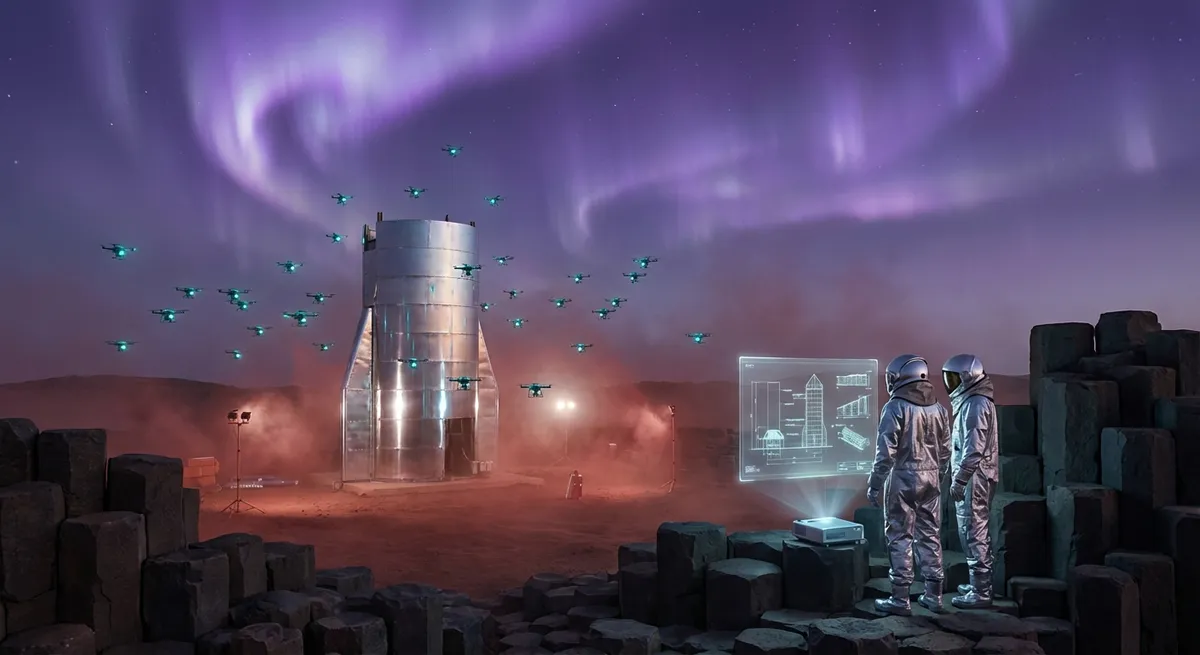
Sending finished hardware from Earth is expensive. Every bolt, panel, and tank has to survive launch loads and fit inside a rocket fairing. But what if we could launch kits and raw materials, and let space tech assemble itself in orbit?
Assembling in Microgravity
In-space manufacturing and assembly aim to:
- Build larger telescopes than we could ever fit inside a rocket.
- Construct massive solar power structures in orbit or beyond.
- Repair, refuel, or upgrade satellites long after they were “supposed” to die.
Early demonstrations are already happening:
- Robotic arms and servicing vehicles have docked with satellites, refueled them, or adjusted their orbits.
- Experiments have shown that 3D printing can work in microgravity, hinting at a future where trusses, brackets, or even pressure vessels are printed in orbit instead of launched fully formed.
In the long run, this points to a world where space hardware isn’t a finished product but a scaffold—ready to be extended, modified, and rebuilt, piece by piece, above our atmosphere.
Five Astonishing Discoveries Powered by Modern Space Tech
As space technology grows smarter and more adaptable, it’s also revealing deeper truths about the universe. Here are five remarkable findings that owe their existence to sophisticated space instruments and missions.
1. The Universe Is Littered with Rogue Planets
Using sensitive space telescopes and clever observation techniques, astronomers have identified planets that don’t orbit any star—they drift alone through the darkness of interstellar space.
These “rogue planets” were likely ejected from young planetary systems by gravitational chaos. Some might still carry thick atmospheres or even internal heat sources.
Their existence tells us:
- Planetary systems are more violent and dynamic than we imagined.
- There may be more planets between stars than orbiting them.
Space-based observatories, especially those able to detect subtle gravitational microlensing events, are crucial in spotting these free-floating worlds that would be nearly invisible from the ground alone.
2. Black Holes Can Launch Cosmic “Particle Cannons”
Space telescopes like NASA’s Chandra X-ray Observatory and ESA’s XMM-Newton have revealed colossal jets of material and energy blasting out from the regions around supermassive black holes.
These jets:
- Can stretch for hundreds of thousands of light-years.
- Pump enormous energy into surrounding galaxies and galaxy clusters.
- Help regulate star formation by heating and stirring interstellar gas.
What’s astonishing is that these jets arise from material just before it crosses the event horizon, converted into particles accelerated to near light-speed and focused into narrow beams. Without sensitive X-ray and radio instruments in space, these structures would be almost impossible to map in detail.
3. Exoplanet Skies Are Stranger Than Fiction
Space-based instruments studying exoplanet atmospheres—by watching starlight filter through them—have found worlds with:
- Glass rain driven sideways by supersonic winds.
- Clouds of vaporized metal and rock in ultra-hot atmospheres.
- Possible hints of water vapor on smaller, cooler planets in habitable zones.
Even more intriguing, telescopes like the James Webb Space Telescope (JWST) are beginning to identify complex molecules, temperature structures, and weather patterns on distant worlds.
The fact that we can infer the chemistry of an atmosphere light-years away, using tiny dips in light, is itself one of the great triumphs of modern space tech.
4. The Universe’s “Dark Web” Shapes Everything We See
Space missions mapping the cosmic microwave background (CMB) and large-scale structure—like NASA’s WMAP and ESA’s Planck—have given us detailed snapshots of the infant universe and how matter later clumped together.
These data revealed:
- Only about 5% of the universe is normal matter (the stuff that makes stars, planets, and people).
- Around 27% is dark matter, invisible but detectable through its gravity.
- A staggering 68% appears to be dark energy, driving the accelerated expansion of the cosmos.
By comparing maps of galaxy distributions, gravitational lensing, and the CMB, scientists can trace an invisible “cosmic web” of dark matter that acts as scaffolding for galaxy formation.
Without space-based, ultra-precise surveys, this underlying architecture would remain hidden.
5. Our Own Sun Is Far More Temperamental Than It Looks
Spacecraft dedicated to solar observation—like NASA’s Solar Dynamics Observatory (SDO) and ESA/NASA’s Solar and Heliospheric Observatory (SOHO)—have transformed our view of the Sun from a static glowing disk into a boiling, magnetic storm engine.
These missions have uncovered:
- Massive coronal mass ejections (CMEs) that can fling billions of tons of solar material into space.
- A mysteriously super‑hot corona, with temperatures in the millions of degrees, far hotter than the solar surface below.
- Complex magnetic loops that twist, snap, and reconnect, releasing bursts of energy that can affect satellites, power grids, and radios on Earth.
Advanced imaging, continuous monitoring, and multi-wavelength space observations let us see the Sun as a dynamic star, not a featureless circle—and help us protect our increasingly space-dependent civilization from space weather.
The Future: An Evolving Technosphere in Orbit
As we push further out—to the Moon, Mars, asteroids, and beyond—our space technology will need to become even more adaptive.
We’re heading toward a future where:
- Robots pre‑build infrastructure on the Moon before humans arrive.
- Satellites dynamically reorganize to prioritize disaster relief, climate monitoring, or scientific campaigns as events unfold on Earth.
- In-space factories turn asteroid material or lunar regolith into spare parts, radiation shields, and structural elements.
- Exploration fleets—swarms of small probes—fan out into the outer solar system, collaborating and redirecting themselves based on discoveries.
In that world, space tech won’t just be tools we throw into the sky. It will be an expanding, semi‑autonomous technosphere—an adaptive layer of intelligence and machinery interwoven with the natural environments of orbit, interplanetary space, and perhaps one day, interstellar space.
We’re watching the earliest stages of that evolution now, every time a satellite patches its own software, a rover chooses its own path, or a telescope in deep space beams back a result that forces humanity to rewrite its cosmic story.
Conclusion
The story of space technology is shifting from static machines to living systems—systems that learn, coordinate, self‑assemble, and reveal a universe far stranger than our earliest rocket pioneers ever imagined.
Rogue planets wandering the dark, black holes launching galaxy‑spanning jets, alien skies filled with glass rain, an invisible dark web of matter holding everything together, and a temperamental Sun shaping our planetary future—these are not just poetic images. They are scientific realities, discovered and decoded by an evolving ecosystem of space tech.
As orbit becomes a place where hardware can adapt, upgrade, and even build itself, our ability to explore won’t grow in a straight line—it will compound. The smarter our machines become out there, the more they’ll teach us about where we came from, where we’re going, and how vast the unknown still is.
Sources
- [NASA – James Webb Space Telescope Discoveries](https://www.nasa.gov/webb) – Official mission site with updates on exoplanet atmospheres, early galaxies, and other JWST findings
- [ESA – Planck Mission Overview](https://www.esa.int/Science_Exploration/Space_Science/Planck) – Details on how Planck mapped the cosmic microwave background and helped refine our understanding of dark matter and dark energy
- [NASA – Solar Dynamics Observatory (SDO)](https://sdo.gsfc.nasa.gov) – Comprehensive resource on high-resolution solar observations and insights into solar flares, CMEs, and space weather
- [NASA – Exoplanet Exploration Program](https://exoplanets.nasa.gov) – Data and explanations on exoplanet discoveries, rogue planets, and atmospheric characterization techniques
- [European Space Agency – Space Safety & Space Debris](https://www.esa.int/Safety_Security/Space_Debris) – Background on crowded orbits, satellite constellations, and the growing need for autonomous coordination and servicing in space
Key Takeaway
The most important thing to remember from this article is that this information can change how you think about Space Tech.