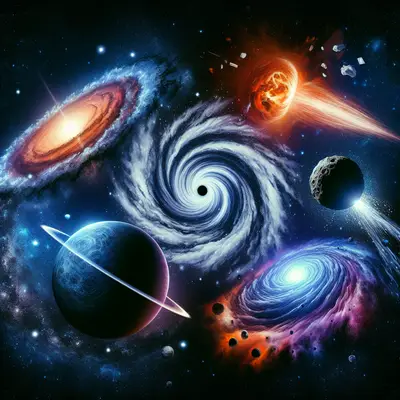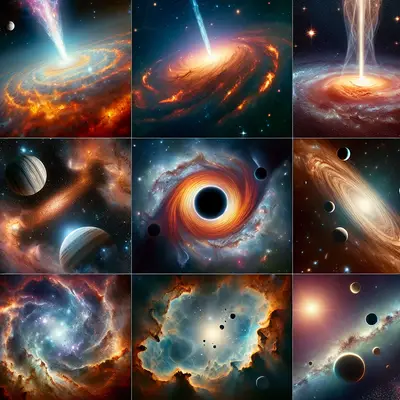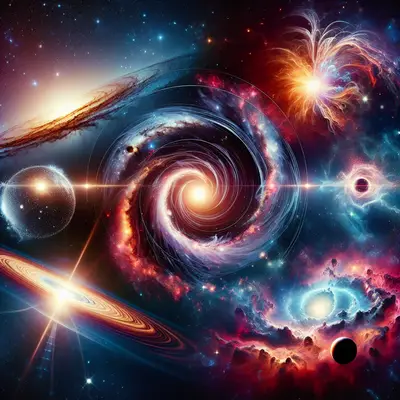
The universe looks calm from a distance—stars drifting, galaxies swirling, blackness stretching forever. But behind that quiet backdrop, space is full of invisible “switches”: sudden transitions when the cosmos flips from one state to another. Entire stars collapse in seconds, quiet galaxies flare into brilliance, and empty regions of space ignite with new suns.
These cosmic events don’t just make for stunning images; they reveal how dynamic, fragile, and surprisingly active the universe really is. Let’s dive into some of the most dramatic transitions happening above our heads right now—and uncover five awe-inspiring facts along the way.
When Stars Flip from Life to Death in a Single Instant
To human eyes, stars look eternal. They rise, they set, they twinkle. But at the end of a massive star’s life, everything changes in an instant. For millions of years, a star quietly fuses hydrogen into helium, balancing its own gravity with the pressure of hot gas. Then, in mere seconds, that equilibrium fails.
When fusion can no longer support a massive star, gravity wins. The core collapses at a staggering speed—up to a quarter of the speed of light. Outer layers slam inward, then rebound outward in a titanic explosion: a supernova. For a few days or weeks, that single star can outshine an entire galaxy of billions of stars.
Amazing Fact #1:
Some supernovae are so bright they release more energy in a few weeks than our Sun will emit in its entire 10-billion-year lifetime. For distant galaxies, a single exploding star can briefly become the most visible object we see.
These cataclysms are not just endings; they are beginnings. Supernovae forge and scatter heavy elements—like iron, nickel, and even some of the ingredients of gold and uranium—into surrounding space. Your blood’s iron atoms were likely born in a star’s explosive death.
In the aftermath, a new kind of object appears almost instantly: a neutron star, a black hole, or in rare cases, nothing stable at all—just an expanding shell of glowing debris and a transformed region of space.
Invisible Storms: When Galaxies Ignite Their Cores
Galaxies appear as serene spirals or smooth ellipses, but many hide a dramatic switch deep in their centers. At the core of most large galaxies is a supermassive black hole, millions to billions of times the mass of the Sun. Most of the time, these black holes are quiet—dark, invisible, just sitting in the middle of their galaxies.
But when enough gas and dust spiral into the black hole’s gravitational grip, the galaxy’s core undergoes a sudden identity shift. The region becomes an active galactic nucleus (AGN)—a furious engine blasting out radiation across the electromagnetic spectrum. Jets of charged particles can shoot out from the poles at nearly the speed of light, stretching farther than the diameter of the galaxy itself.
Amazing Fact #2:
The brightest known quasars—extremely powerful AGN—can shine with the luminosity of over a trillion Suns, yet the light comes from a region no larger than our solar system.
This “on-off” behavior isn’t random. It depends on how much matter the black hole is fed. Colliding galaxies, spiraling gas streams, or disrupted stars can dump material into the core and trigger a transformation. A once-ordinary galaxy becomes a lighthouse visible across billions of light-years.
For astronomers, these flips in activity are not just fireworks; they are clues to how black holes and galaxies grow together, shaping each other over cosmic time.
Silent Collisions: When Space-Time Itself Rings Like a Bell
Einstein predicted it, but the universe kept it quiet for a century: space-time can ripple.
When two massive objects like black holes or neutron stars orbit each other and finally collide, they don’t just crash—they send waves through the fabric of space and time itself. These gravitational waves move outward at the speed of light, stretching and squeezing distances as they pass.
For us on Earth, the effect is tiny—thousands of times smaller than the width of a proton. It took colossal, ultra-precise observatories like LIGO and Virgo to detect them. In 2015, humanity finally “heard” a pair of black holes merging more than a billion light-years away.
Amazing Fact #3:
In the fraction of a second when two black holes collide, they can briefly radiate more power in gravitational waves than all the stars in the observable universe emit in light—combined.
These events flip invisible systems into briefly detectable beacons. Once dark and undetectable, distant black hole pairs suddenly become observable not through light, but through space-time itself ringing like a distant chime.
Every new detection allows scientists to test general relativity, measure black hole populations, and even probe what the universe was like when those waves first began their journey toward us.
Births in the Dark: When Invisible Clouds Ignite New Suns
Not all dramatic transitions are explosive. Some are slow, quiet shifts that eventually light up the sky.
Deep in cold, dense molecular clouds—vast regions of gas and dust—gravity gradually pulls matter together. Over hundreds of thousands of years, these patches grow denser until something critical happens: in the center, pressure and temperature climb high enough for nuclear fusion to begin. A star turns on.
From the outside, it looks like a quiet patch of dark sky gaining new points of light. For the star itself, it is a complete change of state: from a cold, collapsing clump of gas to a blazing nuclear engine.
Amazing Fact #4:
The Orion Nebula, visible even in small telescopes, is a stellar nursery where thousands of young stars are forming—some less than a million years old, toddlers on cosmic timescales.
These birthplaces of stars are where planetary systems like ours begin. Disks of dust and gas around young stars collide, stick, and gradually build planets, moons, asteroids, and comets. Entire solar systems are the long-term products of these slow, but profound, cosmic transitions.
When you look at a region like Orion, you’re seeing a moment in a much larger cycle: clouds forming stars, stars living and dying, supernovae enriching space, and new clouds seeded with more complex elements than before.
Cosmic Flashes: When the Sky Changes in a Heartbeat
Some of the most dramatic changes in space are so brief that, without constant monitoring, we would never know they happened. The sky is full of transient events—short-lived bursts of light, energy, or particles that appear suddenly and vanish just as quickly.
These include gamma-ray bursts, fast radio bursts, and mysterious optical flares that last minutes or even milliseconds. Many are linked to extreme endpoints of stellar evolution: collapsing massive stars, merging neutron stars, or magnetars (neutron stars with magnetic fields a trillion times stronger than Earth’s).
Amazing Fact #5:
The most powerful gamma-ray bursts can release in a few seconds as much energy as the Sun will emit over its entire lifetime, focused in narrow beams sweeping across the universe.
Modern observatories scan the sky continuously, triggering alerts when something new appears—a flash that wasn’t there hours or even seconds before. Telescopes around the world then scramble to capture the fading afterglow.
These brief events are cosmic “alarms,” telling us when and where the universe has flipped a switch: a star has died, a compact object has merged, or a magnetic field has catastrophically rearranged itself.
Conclusion
The universe is not a static backdrop of distant lights. It is a restless, changing stage where matter, energy, and even space-time itself are constantly crossing thresholds: calm stars becoming supernovae; quiet galaxies lighting up their cores; dark regions igniting with newborn stars; invisible collisions making the cosmos vibrate.
Every sudden transition—whether a star’s last breath or a black hole’s merging moment—adds another piece to our understanding of how the universe works, evolves, and recycles itself.
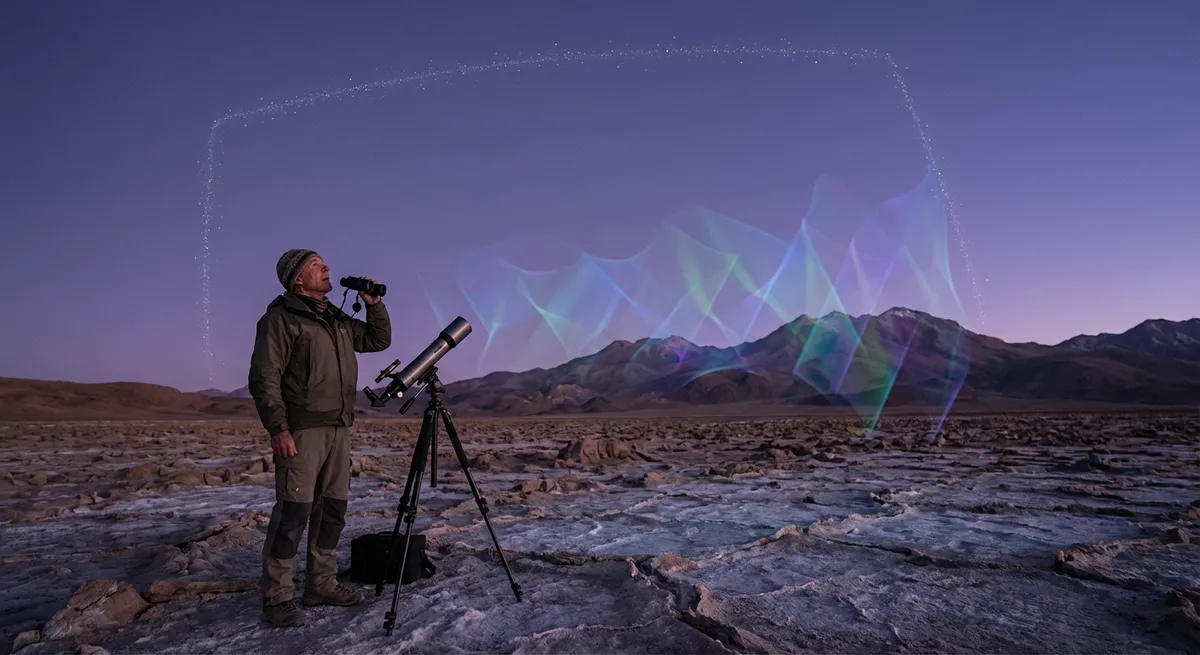
Next time you look up at the night sky, remember: what looks steady and timeless is actually a universe filled with hidden switches mid-flip. Somewhere, right now, a star is turning on for the first time, another is ending in a blaze, two black holes are colliding, and a silent ripple in space-time is already on its way to us.
Sources
- NASA – Supernovae: Exploding Stars – Overview of how supernovae occur and their role in distributing heavy elements
- ESA – Active Galactic Nuclei – Explains what AGN and quasars are and how they affect their host galaxies
- LIGO – What Are Gravitational Waves? – Description of gravitational waves and how black hole and neutron star mergers are detected
- NASA – Orion Nebula: A Star Nursery – Details and imagery of the Orion Nebula and its young stars
- NASA – Gamma-Ray Bursts: The Most Powerful Explosions in the Universe – Overview of gamma-ray bursts and their extreme energy output
Key Takeaway
The most important thing to remember from this article is that this information can change how you think about Cosmic Events.