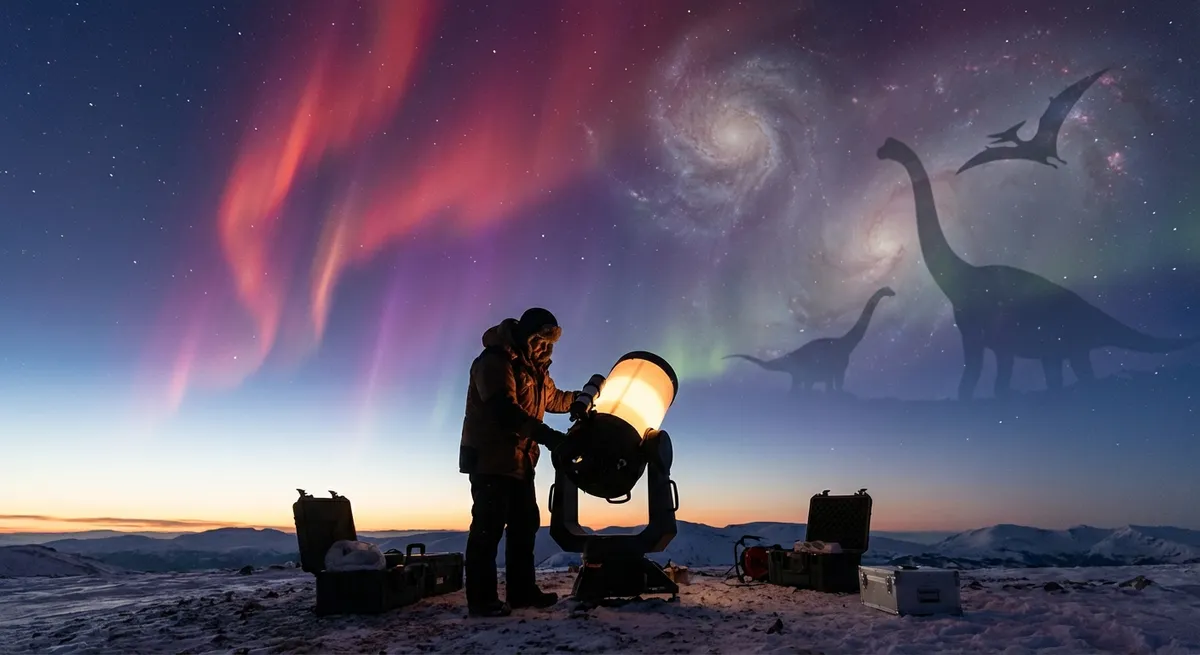
Every time you glance at the night sky, you’re not just looking up—you’re looking back. The light from stars, galaxies, and nebulae is a stream of ancient messages, traveling for years, centuries, even billions of years before finally reaching your eyes. Astronomy is, in a very real sense, time travel powered by physics instead of science fiction.
In this journey through the cosmos, we’ll explore how looking into space means looking into history—and we’ll uncover five astonishing discoveries that reveal just how strange and beautiful a time-warped universe can be.
Light as a Time Machine
Light moves fast—about 299,792 kilometers per second—but the universe is so vast that even this cosmic speed limit isn’t enough to make everything appear “live.” Instead, distance becomes time.
The Moon is about 1.3 light-seconds away, so when you see moonlight, you see the Moon as it was just over a second ago. The Sun? Roughly 8 minutes in the past. A bright star like Sirius is about 8.6 light-years away, meaning your view is nearly a decade old. What we call a “light-year” is simply the distance light travels in one year, turning kilometers into something more intuitive: years of history stored in every photon.
Astronomers weaponize this natural time delay. Farther objects show us deeper eras of cosmic history. By observing galaxies billions of light-years away, scientists reconstruct what the universe looked like when it was young, hot, and radically different. Telescopes are not just lenses; they are historical instruments reading the universe’s earliest chapters.
The Cosmic Background: Afterglow of the Big Bang
One of the most astonishing discoveries in astronomy is the cosmic microwave background (CMB)—the oldest light we can see, sometimes called the “afterglow” of the Big Bang.
Roughly 380,000 years after the universe began, it cooled enough for atoms to form and for light to travel freely through space. That ancient light has been stretching—its wavelength lengthening—as the universe expands, shifting from brilliant radiation into faint microwaves. Today, sensitive instruments can detect this glow coming from every direction in the sky.
This faint pattern is like a fossil photograph of the early universe. Tiny temperature variations in the CMB reveal where matter was slightly denser—regions that would eventually grow into galaxies, clusters, and the cosmic web we see today. It’s as if the universe left its baby picture imprinted on the sky, and astronomers decoded it to learn the universe’s age, composition, and shape.
Amazing Fact #1: The CMB shows that the universe is about 13.8 billion years old—and our entire observable universe grew from a hot, dense state smaller than an atom.
Galaxies as Time-Layered Cities of Stars
Galaxies are not just collections of stars—they are layered time capsules. Each star carries a different “timestamp,” encoding when and where it formed. When astronomers observe a distant galaxy, they see not only that galaxy as it was long ago, but also its internal history written in light and chemistry.
Young galaxies in the early universe appear irregular and chaotic, full of hot blue stars and violent starbirth. Older galaxies closer to us in space and time tend to show spiral arms or smooth elliptical shapes, with more red, cooler stars. By comparing galaxies at different distances, astronomers effectively line them up in age order—like a cosmic flipbook of galaxy evolution.
Space telescopes like Hubble and James Webb have revealed galaxies from when the universe was less than a billion years old. Some of these early systems are surprisingly massive and complex, challenging models of how quickly structures were supposed to form.
Amazing Fact #2: The James Webb Space Telescope has spotted galaxies that may have formed only a few hundred million years after the Big Bang—so early that astronomers are rethinking how fast the first stars and galaxies could have assembled.
Gravitational Lenses: Nature’s Cosmic Magnifying Glasses
Einstein’s general theory of relativity predicted that mass would bend space-time—and therefore bend light. On cosmic scales, entire galaxy clusters can warp the space around them, acting as “gravitational lenses” that magnify and distort the light from galaxies even farther away.
When light from a background galaxy passes near a massive cluster, the curved space around the cluster can magnify and stretch that light, creating arcs, rings, or multiple images of the same distant object. This strange visual effect is not just beautiful; it’s incredibly useful.
Gravitational lensing allows astronomers to see objects too faint and distant to detect otherwise, pushing our effective reach farther back in time. It also lets scientists map invisible dark matter, because the amount of lensing reveals how much total mass—visible and invisible—is warping space.
Amazing Fact #3: Some of the most distant galaxies ever discovered were spotted only because gravitational lensing boosted their brightness by factors of 10, 50, or even 100—turning massive clusters into natural space telescopes.
Exploding Stars as Cosmic Distance Markers
To turn the universe into a 3D map, astronomers need reliable “yardsticks.” One of the most powerful tools for this is a specific kind of exploding star: Type Ia supernovae. These occur in binary star systems when a white dwarf steals enough material from its companion to trigger a runaway explosion.
The physics of this process makes Type Ia supernovae reach nearly the same peak brightness every time. That means they function like standard candles: if you know how bright something truly is, and you measure how bright it appears, you can estimate how far away it is. By spotting these explosions in distant galaxies, astronomers measured how fast those galaxies are receding as the universe expands.
The surprising result: distant supernovae were dimmer than expected. This meant they were farther away than simple models predicted—evidence that the expansion of the universe is speeding up. The cause? Something we now call dark energy, a mysterious component that seems to make up about 70% of the universe and exerts a kind of negative pressure.
Amazing Fact #4: Observations of Type Ia supernovae led to the discovery of the accelerating universe—a finding so revolutionary it earned the 2011 Nobel Prize in Physics.
Ripples in Space-Time: Listening to Colliding Black Holes
For most of astronomy’s history, we’ve explored the universe using light—visible, radio, infrared, X-rays, and more. Recently, astronomers added a completely new sense: listening to the universe through gravitational waves.
When massive objects like black holes or neutron stars orbit each other and merge, they send out ripples in the fabric of space-time itself. These gravitational waves were predicted by Einstein but seemed almost impossible to detect, because by the time they reach Earth, they’re incredibly faint—distortions far smaller than the width of a proton over kilometers-long detectors.
In 2015, the LIGO experiment directly detected gravitational waves from merging black holes more than a billion light-years away. Since then, dozens of such events have been recorded. These signals reveal details about the masses, spins, and orbits of the colliding objects, opening a new window into extreme astrophysics and the distant universe.
Amazing Fact #5: When two black holes collide, they can briefly outshine all the stars in the observable universe in gravitational-wave power—yet on Earth, the resulting space-time ripple changes the length of LIGO’s 4-kilometer arms by less than a thousandth of the width of a proton.
Conclusion
The night sky is not a static dome—it’s a living archive of the universe’s history. Every speck of starlight is a delayed message, every galaxy a chapter from a different cosmic era, every gravitational ripple a record of colossal events in distant space-time.
Astronomy takes these faint, time-shifted signals and reconstructs an epic story: a universe born in a flash of extreme heat, cooling and expanding, growing structure, spark by spark, star by star. With each new telescope and each new detection—whether of photons or gravitational waves—we push further back in time, closer to the universe’s earliest moments.
When you step outside at night and look up, you’re not just stargazing; you’re sifting through billions of years of history written in light and gravity. The cosmos isn’t just out there—it’s before us, stretching across both space and time, inviting us to keep decoding its story.
Sources
- [NASA – Cosmic Microwave Background](https://map.gsfc.nasa.gov/universe/bb_tests_cmb.html) - Overview of the CMB and how it reveals the early universe
- [ESA – James Webb Space Telescope Discoveries](https://www.esa.int/Science_Exploration/Space_Science/Webb) - Updates on early galaxy observations and deep-universe science from JWST
- [NASA – Gravitational Lensing](https://science.nasa.gov/universe/galaxies/gravitational-lensing/) - Explanation and examples of how massive objects bend and magnify light
- [Nobel Prize – Accelerating Universe Discovery](https://www.nobelprize.org/prizes/physics/2011/popular-information/) - Background on Type Ia supernovae and the discovery of dark energy
- [LIGO – Gravitational Wave Discoveries](https://www.ligo.org/science/Publication-GWTC3Catalog/index.php) - Catalog and explanations of black hole and neutron star merger detections
Key Takeaway
The most important thing to remember from this article is that this information can change how you think about Astronomy.