The universe is not a silent painting—it’s a live performance. Stars flare and fade, galaxies collide, black holes feast, and entire regions of space light up or go dark. The twist? Most of these cosmic events unfold on timescales far beyond a human lifetime. Only recently have we built the tools to “speed up” the universe and watch its drama as if we’re scrubbing through a cosmic time-lapse.
Welcome to the world of transient astronomy: the study of things that change in the sky. From vanishing stars to galaxies that suddenly switch off their black holes, the cosmos is turning out to be far more restless than we ever imagined.
The Flickering Sky: Why Astronomers Hunt Cosmic Change
For centuries, the night sky appeared fixed. Yes, planets wandered and comets occasionally blazed by, but the stars themselves looked constant. Modern observatories have shattered that illusion.
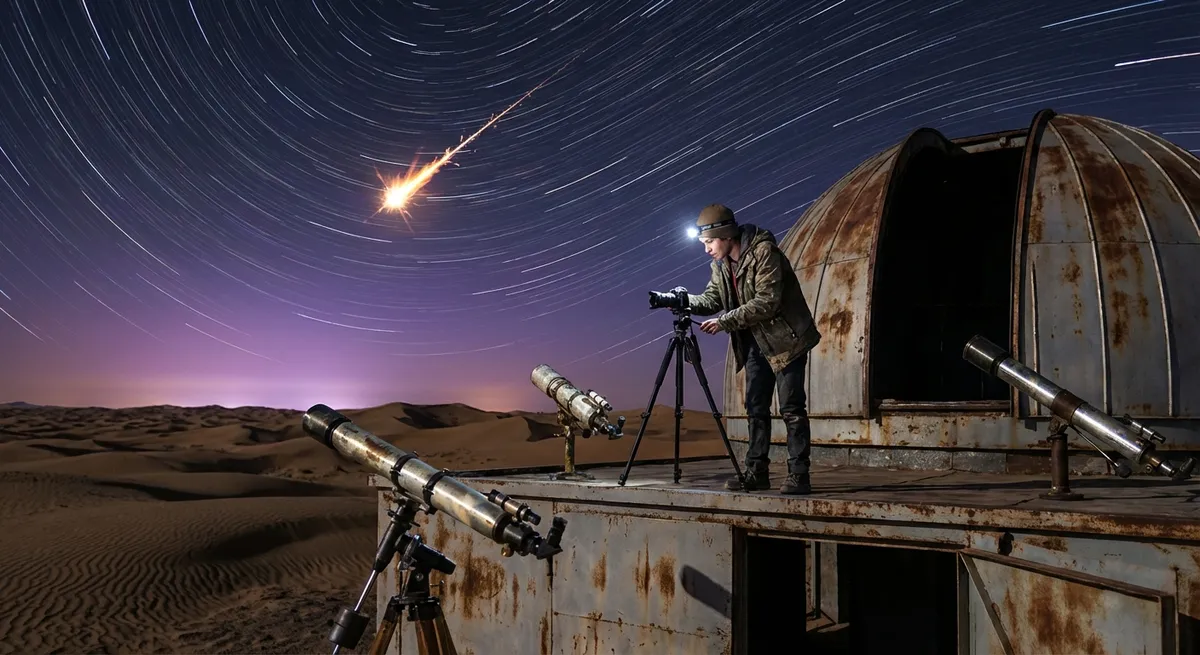
Today, automated telescopes scan the sky night after night, building gigantic “before and after” portraits of the cosmos. Software tracks millions of light sources and flags anything that brightens, dims, appears, or disappears. These changes are called transients and variables, and they include some of the most extreme events in nature.
Why are these flickers so important?
- They reveal how stars live and die, from gentle pulses to catastrophic explosions.
- They expose black holes in action, which are otherwise invisible unless they’re feeding.
- They help map the universe’s structure by tracing where and when extreme events occur.
- They sometimes break our theories, forcing us to rewrite the rules of astrophysics.
Every night, the sky is effectively sending us status updates—from distant galaxies, dying stars, and hungry black holes. We just had to learn how to read them.
Telescopes That Never Sleep: Building a Cosmic Time Machine
To watch the universe evolve, astronomers needed a new type of observatory: not just big telescopes, but persistent ones.
Modern sky surveys like the Zwicky Transient Facility (ZTF) and soon the Vera C. Rubin Observatory do something remarkable. They don’t just point at one glamorous target; they repeatedly photograph huge swaths of the sky, building a layered archive of cosmic history.
The process works like this:
- Scan the sky: Wide-field cameras capture enormous images containing millions of stars and galaxies.
- Compare images: New pictures are digitally compared to older ones of the same region.
- Find differences: If something has changed—appeared, vanished, brightened, or dimmed—algorithms flag it.
- Trigger alerts: Astronomers around the world receive automatic alerts and swing other telescopes toward the new event.
- Follow the story: Observations in different wavelengths (radio, infrared, X-rays) fill in the details of what’s happening.
This constant watch turns the sky into a kind of cosmic “security camera feed.” Where earlier generations might see a static set of stars, we now see a churning, flickering landscape.
These surveys are not just recording spectacular fireworks; they’re cataloging the rhythms of the universe—how often stars explode, how frequently black holes flare, and how turbulent galaxies really are.
Five Astonishing Astronomical Surprises from a Changing Universe
As we’ve started watching the sky in this time-lapse way, the universe has thrown us some unforgettable plot twists. Here are five especially mind-bending discoveries and facts that highlight how dynamic space really is.
1. A Star That Vanished Without a Supernova
For decades, astronomers believed that very massive stars end life in a spectacular supernova explosion. Then one appeared to simply…disappear.
In a nearby galaxy called NGC 6946, astronomers were monitoring a giant star thought to be about 25 times the mass of the Sun. Over time, it brightened, then faded. When telescopes looked again, the star was gone—and there was no obvious supernova.
One leading explanation is that the star may have collapsed directly into a black hole, with only a faint whisper of light instead of a dramatic explosion. If this happens often, it could mean that many black holes in the universe formed in almost complete darkness, without the grand finale we expected.
Suddenly, astronomers realized: sometimes, the most dramatic event is not a burst of light, but the absence of it.
2. Galaxies with “Switching” Black Holes
At the hearts of many galaxies sit supermassive black holes that can shine as some of the brightest beacons in the universe—quasars and active galactic nuclei (AGN). They glow when gas falls inward, heats up, and blasts out enormous amounts of energy.
We used to think these central engines changed slowly. But now we’ve seen galaxies whose cores turn from bright to almost dormant (or the reverse) over just a decade or less. These are called “changing-look” AGN.
In some cases, a galaxy’s bright, energetic nucleus has faded so dramatically that its spectrum—the light pattern used to classify it—no longer looks like an active black hole at all. It’s as if a lighthouse went from blazing to nearly dark in a single human generation.
This suggests that supermassive black holes can dramatically ramp up or shut down their feeding much faster than expected, reshaping not just their own environments, but potentially the evolution of their host galaxies.
3. Kilonovae: When Neutron Stars Collide and Space-Time Rings
In 2017, astronomers saw one of the most important cosmic events in modern history: the collision of two neutron stars, the ultra-dense remnants of massive stars.
First, detectors like LIGO and Virgo caught the ripples in space-time—gravitational waves—from the inspiraling pair. Just seconds later, telescopes spotted a strange, rapidly changing burst of light in a distant galaxy: a kilonova.
This hidden cosmic event taught us several astonishing things:
- Colliding neutron stars forge heavy elements like gold, platinum, and uranium.
- The light from the kilonova evolved over days, changing color as new elements formed and expanded.
- By comparing the gravitational waves and light, astronomers could independently measure cosmic distances, offering a new way to test how fast the universe is expanding.
Every ring of a gravitational wave and every flash of a kilonova is a direct, time-sensitive story about matter under extreme conditions—so extreme they cannot be recreated on Earth.
4. The Milky Way’s Black Hole Has Mood Swings
Our own galaxy hosts a supermassive black hole at its center called Sagittarius A (Sgr A). Most of the time, it’s relatively quiet compared to the brightest black holes in distant galaxies. But “quiet” does not mean boring.
Infrared and X-ray telescopes have caught Sgr A flaring unexpectedly, suddenly brightening by factors of 10 to 100 and then calming down. These flares can last mere hours.
The current thinking is that these outbursts may be caused by:
- Clumps of gas getting too close and heating up before falling in.
- Magnetic fields snapping and reconnecting near the black hole, releasing bursts of energy.
- Small objects, like asteroids or fragments of stars, being torn apart.
These flickers are one of the few ways we can study the “weather” around our own supermassive black hole, in almost real time, from 26,000 light-years away.
5. Planetary Systems Are Still Being Born—and Sometimes Destroyed
Transient astronomy isn’t only about giant explosions; it also captures quieter, subtler changes. In young star systems, astronomers have watched disks of dust and gas dim and brighten as clumps orbit, collide, and occasionally vanish.
In some systems, starlight dims in irregular patterns that suggest disintegrating planets or comets, leaving dusty trails behind them. In others, sudden brightening in infrared light implies fresh collisions that vaporize rock and metal, reshaping the architecture of newborn planetary systems.
These time-lapse views tell us:
- Planet formation is messy and often violent.
- Debris fields and collisions are common, not rare.
- Our own early solar system likely underwent a similar chaotic dance, with worlds forming, merging, and shattering.
In other words, the calm, stable orbits we enjoy today are the end result of a long, tumultuous history we’re only now learning to witness in other systems.
How You Can Watch the Universe Change in Real Time
You don’t need access to a giant observatory to appreciate the changing sky. Many of the same surveys that professionals use release their data publicly, and some organizations invite the public to help classify and explore cosmic events.
Here are ways you can join the cosmic time-lapse:
- Follow transient alert services and sky surveys: Projects like the Zwicky Transient Facility and (soon) the Vera C. Rubin Observatory share discoveries online, letting you see the latest supernovae, flares, and mysterious flashes.
- Use virtual sky tools: Interactive sky maps from major observatories let you compare past and present observations, almost like scrolling through the universe’s photo history.
- Participate in citizen science: Platforms like Zooniverse host projects where volunteers help classify variable stars, identify supernovae, and spot rare events that algorithms might miss.
- Keep an eye on “targets of opportunity”: When a dramatic event occurs—like a nearby supernova or a gravitational wave detection—observatories worldwide coordinate follow-ups, many of which are shared as public images and data.
Over time, you begin to see the sky differently. Not as a static ceiling, but as a shifting ocean of light, with waves, storms, and ripples that can last minutes or millions of years.
Conclusion
The more closely we watch the cosmos, the less still it seems. Stars slip into black holes without a farewell flare. Galactic hearts switch from blazing to quiet. Neutron stars collide and ring space-time, creating the gold in our jewelry. Even our own galaxy’s central black hole flickers with unpredictable moods.
By turning the universe into a time-lapse, we’ve uncovered a truth both humbling and awe-inspiring: the night sky is not a finished story. It’s an ongoing narrative written in light and gravity, unfolding across billions of years—and, with the right tools, across the span of a single human lifetime.
Every new survey, every alert, and every strange, transient flicker is another frame in the greatest time-lapse ever attempted: the evolving universe itself.
Sources
- NASA – Transient Events and Variable Stars – Overview of stellar variability and why changing stars matter to astronomy
- European Southern Observatory – Star Disappears from Distant Galaxy – Research on a massive star in NGC 6946 that appears to have vanished, possibly collapsing directly into a black hole
- LIGO – Discovery of GW170817 and Kilonova – Summary of the first neutron star merger seen in both gravitational waves and light
- Event Horizon Telescope & NASA – Sagittarius A Flaring Activity – Information on the Milky Way’s central black hole and observations of its changing behavior
- Vera C. Rubin Observatory – Legacy Survey of Space and Time (LSST) – Description of the upcoming survey designed to repeatedly image the sky and discover transient and variable cosmic events
Key Takeaway
The most important thing to remember from this article is that this information can change how you think about Cosmic Events.