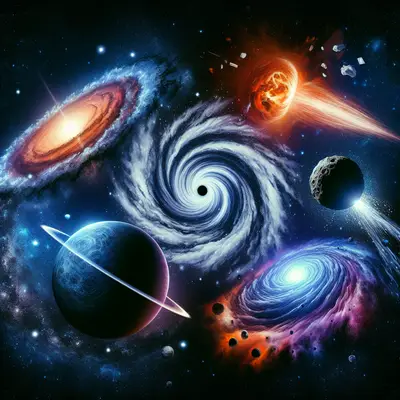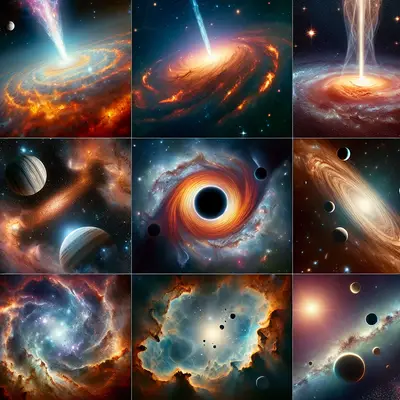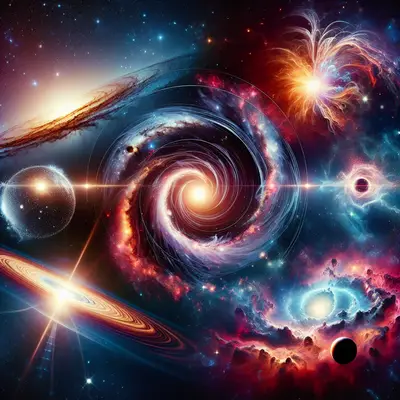
When you look up at the night sky, you’re not seeing “now.” You’re seeing a stitched‑together patchwork of different whens—ancient explosions, newborn stars, and galaxies in scenes so old they predate Earth itself. Cosmic events don’t just light up space; they bend, stretch, and sometimes outright confuse our sense of time. From stars that die twice to explosions powered by black holes, the universe is full of moments so extreme they force us to rewrite what we thought “time” meant.
This is a tour through some of the most mind‑bending cosmic events we know—each one a real phenomenon, grounded in observation, but wild enough to feel like science fiction.
The Sky Is a Time Machine, Not a Mirror
Every cosmic event you’ve ever heard of—supernova, gamma‑ray burst, colliding neutron stars—is a message sent long ago and only now arriving.
Light has a speed limit: about 300,000 km per second (186,000 miles per second). That sounds instant, but across cosmic distances it becomes a delay. When you look at:
- The Moon, you see it as it was ~1.3 seconds ago.
- The Sun, as it was ~8 minutes ago.
- The Andromeda Galaxy, as it was ~2.5 million years ago.
So when telescopes catch a star exploding in a distant galaxy, that event is already long finished. We’re watching the universe’s recorded history, not its live broadcast.
This turns the cosmos into a natural time machine. Massive observatories like the James Webb Space Telescope (JWST) and Hubble aren’t just “looking far away”—they’re looking so far back that some of the galaxies they see are from when the universe was only a few hundred million years old. In cosmic terms, we’re finally watching its baby photos.
Amazing Fact #1:
The most distant galaxies seen by JWST are so far away that their light has been traveling for over 13 billion years—meaning we’re seeing them as they were when the universe was less than 5% of its current age.
Stars That Die with a Bang (And Sometimes a Whisper)
If the universe had fireworks, they’d be supernovae. These are the violent deaths of massive stars, bright enough to outshine an entire galaxy for a short time. But not all stellar deaths are the same, and the details are stranger than they sound.
Massive stars (many times the mass of our Sun) live fast and die young, burning through their fuel in a few million years. When they run out of nuclear fuel in their cores, gravity wins. The star collapses inward, rebounds, and unleashes a shockwave—what we see as a supernova.
Some supernovae leave behind:
- Neutron stars – ultra‑dense objects where a teaspoonful of material would weigh billions of tons.
- Black holes – regions where gravity is so intense that not even light can escape.
But we’ve also discovered failed supernovae: massive stars that simply vanish from the sky, collapsing directly into black holes with little to no explosive display. In a few cases, astronomers watched a star dim and disappear in archival images, with only a faint infrared afterglow as evidence of its quiet end.
Amazing Fact #2:
A single core‑collapse supernova can release more energy in a few seconds than our Sun will emit over its entire 10‑billion‑year lifetime.
Cosmic Flashes That Outshine the Universe
Some cosmic events are so extreme that even other explosions look tame next to them. Enter gamma‑ray bursts (GRBs): short, intense flashes of high‑energy radiation that can outshine the rest of the observable universe—briefly.
There are two main flavors:
- Long GRBs – linked to the collapse of massive, rapidly spinning stars into black holes.
- Short GRBs – usually from merging neutron stars, some of the densest objects in the cosmos.
For a few seconds, a GRB’s jet, if pointed at Earth, is the brightest thing in the sky in gamma‑rays. We’re fortunate these jets are narrow; if a GRB occurred close enough and aimed directly at us, it could have serious consequences for Earth’s atmosphere.
In 2022, telescopes caught one of the most powerful GRBs ever observed, nicknamed the “BOAT” (Brightest of All Time). It was likely caused by a massive star collapsing into a black hole in a distant galaxy. Even from billions of light‑years away, its signal flooded detectors.
Amazing Fact #3:
The brightest gamma‑ray bursts release, in a few seconds, as much energy as our Sun will emit over its entire multi‑billion‑year life—and we can still detect them from billions of light‑years away.
When Space Itself Rings: Colliding Neutron Stars and Black Holes
Some cosmic events don’t just send out light—they send out ripples in spacetime itself. These are gravitational waves, predicted by Einstein in 1916 and directly detected a century later.
When two black holes or neutron stars orbit each other, they gradually lose energy through gravitational waves, spiraling inward until they collide. That final collision is unimaginably violent, converting part of their mass directly into waves in spacetime that travel across the cosmos at the speed of light.
Facilities like LIGO and Virgo act like cosmic seismographs, measuring distortions thousands of times smaller than a proton’s width. In 2015, they detected the first known gravitational waves from two black holes merging over a billion light‑years away.
Even more extraordinary: in 2017, astronomers detected both light and gravitational waves from colliding neutron stars—the same event observed in two completely different “languages” of physics. That single collision created heavy elements like gold and platinum and let scientists study the event across the entire electromagnetic spectrum.
Amazing Fact #4:
The gold in your jewelry likely comes from ancient neutron star collisions—cataclysmic events so powerful they create heavy elements and spray them into space, where they eventually become part of new stars, planets, and you.
The Universe’s Biggest Blackout: Cosmic Dark Ages and First Light
Not all cosmic events are explosions. One of the most profound “events” in the universe’s history was a long, quiet transition: the end of the Cosmic Dark Ages.
After the Big Bang, the universe was hot, dense plasma. As it expanded, it cooled and turned transparent, leaving behind the afterglow we call the cosmic microwave background (CMB). After that, for hundreds of millions of years, there were no stars yet—just hydrogen and helium gas. Space was dark.
Then, the first generation of stars switched on—huge, short‑lived, and incredibly bright. Their intense ultraviolet light began to rip electrons off atoms around them, turning neutral hydrogen into ionized gas. This era, called cosmic reionization, transformed the universe from a dark, neutral fog into the transparent, structured cosmos we see now.
Telescopes like JWST are now peering into this transitional time, finding surprisingly complex galaxies much earlier than expected. That suggests star and galaxy formation may have started sooner—and more vigorously—than our models predicted.
Amazing Fact #5:
The universe spent hundreds of millions of years in near‑total darkness before the first stars formed—meaning there was a time when galaxies, starlight, and even familiar “night skies” simply did not exist.
Earth as a Target: When Cosmic Events Reach Us
Cosmic events feel distant, but Earth is constantly in the crosshairs of milder versions of them.
- Solar flares and coronal mass ejections (CMEs) from our Sun can disrupt satellites, radio communications, and power grids. These are miniature versions of the magnetic outbursts we see from more active stars.
- Cosmic rays, high‑energy particles from supernovae and other sources, regularly strike our atmosphere, creating showers of secondary particles and subtly influencing cloud formation and radiation levels at flight altitudes.
The most dramatic solar storm on record, the 1859 Carrington Event, produced auroras visible near the equator and caused telegraph systems to spark and fail. If a similar event occurred today, it could temporarily disable parts of our technological infrastructure—power grids, GPS, satellites, and more.
We’re learning to treat our star as an active, sometimes volatile neighbor. Space weather forecasting is becoming as crucial as terrestrial weather prediction, especially as we build more infrastructure in orbit and send crewed missions deeper into space.
Conclusion
Cosmic events are not rare “special episodes” in an otherwise calm universe. They are the universe’s story. Stars live and die violently, black holes collide and ring spacetime like a bell, and ancient explosions seed the cosmos with the elements that eventually become planets, oceans, and life.
When you look at the night sky, you’re watching overlapping timelines of these events—a slow‑motion documentary playing out across billions of years. Each point of light is mid‑story: a star still forming, quietly burning, or on its way to becoming a supernova, neutron star, or black hole.
We live on a small world, orbiting an average star, in a galaxy that’s just one of trillions. But the gold in your ring, the oxygen in your lungs, and the calcium in your bones all carry the signatures of cosmic events that happened long before Earth existed. In a very real sense, every human being is a biography written in starlight and explosions.
Sources
- NASA – Gamma-ray Bursts: Energetic Explosions in Space – Overview of GRBs, their types, and recent discoveries
- LIGO – Gravitational Waves Detected from Colliding Black Holes – Explanation of gravitational waves and landmark detections
- NASA – James Webb Space Telescope Discoveries – Updates on early galaxies, reionization, and distant cosmic events
- ESA – Supernovae and Their Remnants – Educational material on types of supernovae and their role in the universe
- NOAA – Space Weather Prediction Center – Information on solar storms, space weather, and their impacts on Earth
Key Takeaway
The most important thing to remember from this article is that this information can change how you think about Cosmic Events.