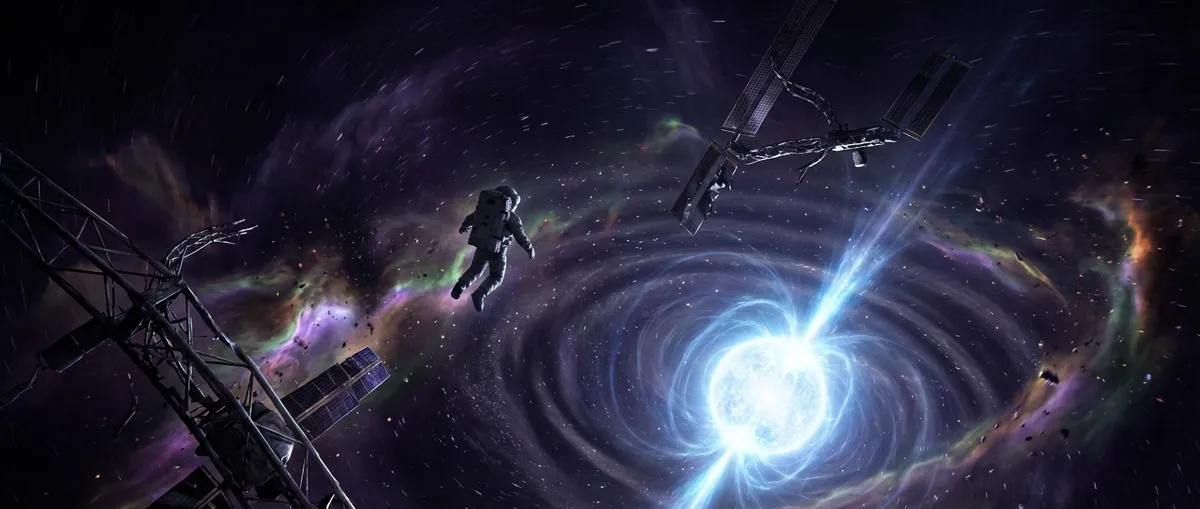
The universe looks calm in the night sky, but that serenity is a lie. Above our heads, entire stars are shredded, black holes collide at half the speed of light, and invisible waves ripple through the fabric of spacetime itself. Cosmic events are the universe’s loudest moments—bursts of energy so extreme that even across billions of light‑years, we can still detect their echoes.
This isn’t just distant drama. These events tell us how galaxies grow, how elements like gold are born, and even how reality itself—space and time—can flex and ring like a cosmic drum. Let’s step into that roaring, invisible universe and explore some of its most astonishing acts.
The Universe’s Brightest Flashes: Gamma‑Ray Bursts
If the universe had camera flashes, they’d be gamma‑ray bursts (GRBs). These are the most energetic explosions we’ve ever detected, outshining entire galaxies for a few fleeting seconds.
Astronomers first discovered GRBs in the late 1960s, almost by accident. Military satellites built to watch for nuclear tests kept spotting mysterious high‑energy flashes coming from space instead of Earth. Those flashes turned out to be cosmic in origin—signals from unimaginably powerful events across the universe.
Most GRBs happen when massive stars—many times heavier than the Sun—run out of fuel. Their cores collapse under their own immense gravity, forming a black hole in a fraction of a second. As matter spirals in, twin jets of energy blast outward at nearly the speed of light. If one of those jets happens to point at Earth, we see a blinding gamma‑ray burst.
Other GRBs come from something even wilder: the collision of two neutron stars. These are city‑size stellar corpses, each with more mass than the Sun. When they spiral together and merge, they unleash a short, intense gamma‑ray burst and send shockwaves through spacetime.
Amazing Space Fact #1
A single gamma‑ray burst can release more energy in 10 seconds than our Sun will emit over its entire 10‑billion‑year lifetime.
Black Hole Collisions: When Spacetime Rings Like a Bell
For most of human history, black holes were pure theory—mathematical ghosts haunting the equations of general relativity. Now, they’re real, observed, and surprisingly noisy. We can “hear” them merge.
In 2015, the LIGO observatories picked up an astonishing signal: tiny, rhythmic distortions in spacetime. Two black holes, over a billion light‑years away, had collided and merged into one, releasing energy as gravitational waves. These waves gently stretched and squeezed Earth by less than the width of a proton, but with exquisitely sensitive detectors, scientists recorded the event.
Gravitational waves are like ripples spreading across a pond, except the “pond” is spacetime itself. When massive objects like black holes or neutron stars orbit each other and then merge, they send out waves at frequencies we can convert into sound. We’ve effectively turned cosmic collisions into audio tracks.
Each detection carries secrets: the masses of the black holes, the distance of the collision, and clues to how these systems formed. We’re no longer just looking at the universe—we’re listening to it.
Amazing Space Fact #2
The first black hole merger detected by LIGO converted about three Suns’ worth of mass directly into gravitational‑wave energy in a fraction of a second—momentarily outshining all the stars in the observable universe combined, but in gravitational waves instead of light.
Stars That Detonate: Supernovae and the Origin of the Elements
Supernovae are the universe’s fireworks shows—but they’re also its forges. When a massive star nears the end of its life, it becomes unstable. For millions of years it’s been fusing lighter elements into heavier ones in its core. Eventually, it builds up iron, which it can’t fuse efficiently to generate energy. Support collapses, gravity wins, and the core implodes.
In a heartbeat, the star rebounds in a titanic explosion, blasting its outer layers into space. That light can outshine an entire galaxy for weeks or months. For ancient astronomers, these “guest stars” seemed to appear from nowhere, brightening the sky and then fading away. For modern astrophysicists, they are the factories for many of the elements around—and inside—us.
The oxygen in your lungs, the calcium in your bones, the iron in your blood: all forged in the hearts of stars and scattered by explosions like these. When supernova debris drifts through space, it can cool, clump, and eventually become part of new stars, planets, and perhaps, life.
Amazing Space Fact #3
Some supernovae are so bright that they can be visible from Earth in daylight. In 1054 CE, one such explosion created the Crab Nebula; Chinese and Middle Eastern astronomers recorded a “guest star” that shone in the daytime sky for weeks.
Tidal Disruption Events: When Black Holes Shred Stars
Black holes are often depicted as silent cosmic vacuum cleaners, but sometimes they feed in spectacularly messy ways. When a star wanders too close to a supermassive black hole—like the one in the center of our galaxy—it can be torn apart in a tidal disruption event (TDE).
The gravity on the star‑side closest to the black hole is much stronger than on the far side, stretching the star like cosmic taffy. At a certain point, the star can’t hold together, and it’s ripped into a stream of gas. Some of that gas spirals into the black hole, heating up and glowing intensely in X‑rays and ultraviolet light.
From Earth, a TDE can look like a suddenly brightening point at the heart of a galaxy that then slowly fades over months or years. Each event offers a fleeting view of otherwise invisible black holes and helps astronomers measure their mass and behavior.
These glimpses aren’t just cosmic horror; they’re precision tools. TDEs act as “flares” that briefly light up dark galactic centers, allowing us to map places where light usually can’t escape.
Amazing Space Fact #4
In 2022, astronomers documented a TDE called AT2021ehb where a supermassive black hole about 10 million times the mass of the Sun partially devoured a star roughly the size of our Sun, releasing energy equivalent to hundreds of millions of Suns over a short period.
When Neutron Stars Collide: Factories of Gold and Heavy Elements
If supernovae build many of the elements we know, neutron star mergers take that alchemy to an even higher level. Neutron stars themselves are already extreme—ultra‑dense remnants of massive stars, packing more mass than the Sun into a sphere only about 20 kilometers wide.
When two neutron stars orbit each other, gravitational waves slowly drain their orbital energy. They spiral closer until, eventually, they smash together. The collision is violent enough to eject neutron‑rich matter at relativistic speeds. As this matter expands and cools, heavy elements form through rapid neutron capture—a process known as the r‑process.
This is where some of the universe’s rarest materials are born: gold, platinum, uranium, and many others. In 2017, astronomers observed a neutron star merger both with gravitational waves (via LIGO/Virgo) and light from telescopes—a cosmic event called a kilonova. The spectrum of the light revealed fingerprints of newly created heavy elements.
The jewelry on your hand, the rare metals in your electronics—some of those atoms likely came from titanic collisions like these, in events that momentarily reshaped regions of space and time.
Amazing Space Fact #5
The 2017 neutron star merger (GW170817) is estimated to have created an amount of gold roughly equal to several times the mass of Earth, in a single event.
Cosmic Events as Time Machines and Laboratories
Cosmic events don’t just make the universe dramatic—they make it knowable. Each explosion, collision, or flare is a natural experiment running under conditions we could never reproduce on Earth.
Gamma‑ray bursts let us peer back to very early epochs of the universe, because their extreme brightness makes them visible across billions of light‑years. Supernovae of certain types act as “standard candles,” allowing astronomers to measure cosmic distances and the expansion of the universe itself. Gravitational waves open a new form of astronomy that doesn’t rely on light at all.
By piecing together signals across the spectrum—radio, infrared, visible, X‑ray, gamma‑ray—and now gravitational waves, scientists are building a multi‑messenger picture of reality. The same event can be “seen” in several ways at once, each revealing a different layer of physics.
We’re living in a rare moment in history: the first time our species can detect these cosmic catastrophes in real time, as they happen across the depths of space.
Conclusion
Cosmic events are the universe at full volume—brief, furious moments when the calm night sky gives way to unimaginable power. They forge elements, reshape galaxies, and send ripples across spacetime that eventually whisper against the detectors on our small planet.
Yet these outbursts aren’t just spectacular. They’re deeply connected to us. The atoms in your body were once part of exploding stars. The gold in our technology and jewelry may have been born in the collision of neutron stars. The invisible shiver of a passing gravitational wave carries stories from black holes we will never see.
Every time we detect one of these events, we’re not just observing distant violence; we’re watching the universe write its own history—and ours—with light, gravity, and time.
Sources
- NASA – Gamma-Ray Bursts Overview – Explains what gamma‑ray bursts are, how they’re detected, and what causes them
- LIGO – Gravitational Waves and Black Hole Mergers – Details the first direct detection of gravitational waves from a black hole collision
- NASA – Supernovae: Explosions that Illuminate the Universe – Describes types of supernovae, their origins, and their role in creating elements
- ESO – Tidal Disruption Events – European Southern Observatory report on a star being torn apart by a supermassive black hole
- LIGO / Virgo – Neutron Star Merger GW170817 – Scientific summary of the first observed neutron star merger and its connection to heavy element formation
Key Takeaway
The most important thing to remember from this article is that this information can change how you think about Cosmic Events.