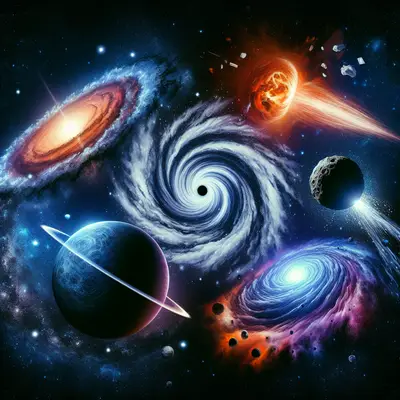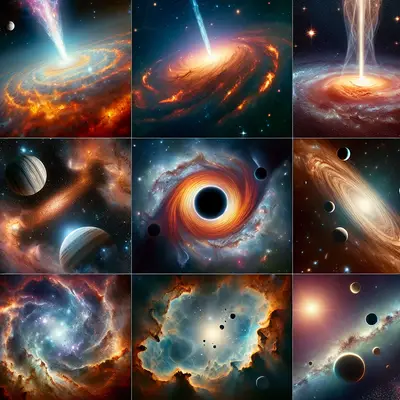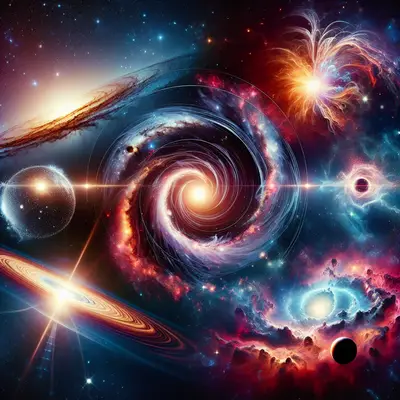
Space looks calm from Earth—a quiet black canvas dotted with stars. But behind that serene backdrop, the universe is roaring. Stars explode, black holes collide, and invisible shock fronts race through galaxies at millions of kilometers per hour. Astronomers call much of this activity space weather or cosmic events, and Earth is not just a spectator—we’re sitting in the blast zone of a dynamic, restless cosmos.
This isn’t just poetry. Solar storms can knock out satellites, gravitational waves literally stretch and squeeze spacetime, and ghostly particles from distant explosions pass through your body by the trillion every second. Let’s dive into the cosmic commotion and uncover how these events reshape the universe—and what they’re quietly doing to our own planet.
The Sun Is Not Peaceful: Our Star Has Weather
The Sun is a nuclear fusion reactor wrapped in magnetism, and it throws tantrums.
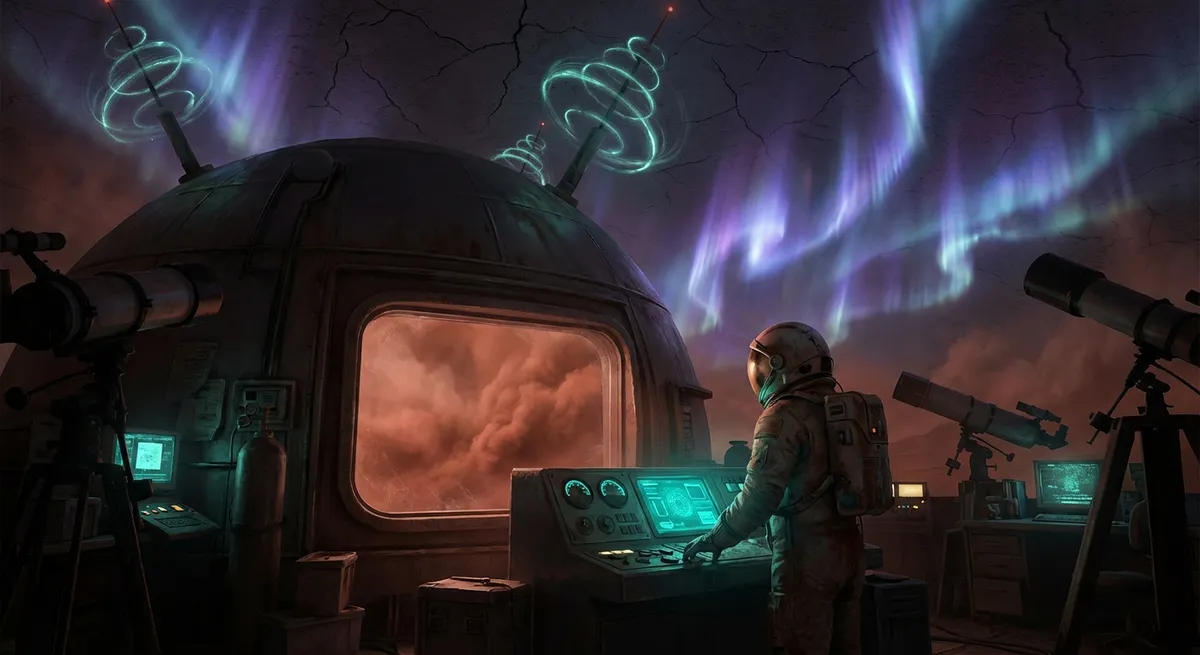
Solar flares and coronal mass ejections (CMEs) are colossal eruptions of radiation and charged particles. When these bursts are aimed at Earth, they slam into our planet’s magnetic field and upper atmosphere, creating geomagnetic storms. These storms can supercharge the auroras, turning polar skies into shimmering curtains of green, red, and purple light. They can also interfere with GPS, radio communications, and power grids.
The Sun follows an approximately 11-year activity cycle, swinging from quiet to intense and back again. During solar maximum, dark sunspots multiply, flares become more frequent, and CMEs blast mass into space more often. Monitoring this solar weather isn’t just about pretty auroras—it’s critical for the safety of astronauts, satellites, and even power infrastructure on the ground.
Amazing fact #1: In 1859, the Carrington Event—the most powerful solar storm ever recorded—sparked auroras as far south as the Caribbean and caused telegraph systems to spark and fail. A similar event today could cost trillions of dollars in damage to modern technology.
Supernovae: Star Deaths That Seed the Cosmos
When massive stars die, they don’t go quietly. They explode as supernovae, briefly outshining entire galaxies and releasing more energy in seconds than our Sun will emit over its entire 10-billion-year lifetime.
Supernovae carve gigantic shockwaves into surrounding space, compressing nearby gas and dust. That compression can trigger new waves of star formation, turning deaths into cosmic births. The elements forged in those dead stars—carbon, oxygen, iron, even the calcium in your bones—are blown out and recycled into new solar systems. In a very literal sense, we are walking supernova dust.
Astronomers watch for the light signatures of different supernova types to understand how fast the universe is expanding and how galaxies evolve. Some supernova explosions are used as “standard candles,” helping cosmologists measure vast cosmic distances.
Amazing fact #2: In 1987, a supernova called SN 1987A exploded in a nearby satellite galaxy of the Milky Way. Neutrinos from that explosion reached Earth hours before the explosion’s light became visible, giving scientists a rare inside look at how a star actually dies.
Gravitational Waves: When Space Itself Ripples
Einstein predicted them. A century later, we finally heard them.
Gravitational waves are ripples in the fabric of spacetime, launched when incredibly massive objects—like black holes or neutron stars—spiral together and collide. These ripples race outward at the speed of light, very subtly stretching and squashing everything in their path. On Earth, the effect is minuscule, changing distances by less than the width of a proton, but with extraordinarily sensitive detectors, we can now sense them.
The Laser Interferometer Gravitational-Wave Observatory (LIGO) and similar detectors listen for these faint signals. Each detection is like catching the “soundtrack” of a cataclysmic event billions of light-years away. It’s a brand-new way of doing astronomy: not by seeing the universe, but by feeling its vibrations.
Amazing fact #3: In 2015, LIGO detected gravitational waves from two black holes merging about 1.3 billion light-years away. At their peak, that collision briefly released more power than all the stars in the observable universe combined—yet on Earth, the resulting distortion was smaller than a fraction of an atomic nucleus.
Neutrino Storms: Invisible Messengers From Cosmic Catastrophes
Every second, trillions of neutrinos are streaming through your body, mostly from the Sun—and you notice none of them.
Neutrinos are nearly massless, electrically neutral particles that rarely interact with matter. They sail through planets, stars, and you as if almost nothing was there. But in gigantic underground detectors filled with ultra-pure water or ice, occasionally one of these ghostly particles collides with an atom and gives off a telltale flash of light.
These neutrinos often come from extreme cosmic events: exploding stars, colliding neutron stars, active black holes, and the Sun’s own fusion core. Because they interact so weakly, they escape directly from the most violent, opaque regions of these objects, carrying unique information that light can’t.
Amazing fact #4: In 2017, scientists traced a high-energy neutrino caught by the IceCube detector in Antarctica back to a distant galaxy hosting a supermassive black hole known as a blazar. It was the first time a single neutrino was directly connected to a specific cosmic object, opening the door to “multi-messenger” astronomy—studying events through light, gravitational waves, and particles all at once.
Fast Radio Bursts: Mysterious Millisecond Flashes From Deep Space
Fast Radio Bursts (FRBs) are one of the universe’s strangest signals. They are ultra-short, ultra-bright flashes of radio waves that last just milliseconds but can outshine entire galaxies in radio light for that brief moment.
Most FRBs come from far beyond our galaxy, and their exact origins remained a mystery for years. Many are one-time events; others repeat unpredictably. As radio telescopes improved, astronomers began to localize some FRBs to specific galaxies and environments, often near intense magnetic objects like magnetars—neutron stars with magnetic fields trillions of times stronger than Earth’s.
Because FRBs travel vast distances, their signals get stretched, scattered, and delayed by the matter they pass through. By carefully analyzing this distortion, scientists can use FRBs as probes, mapping the otherwise invisible gas that fills the space between galaxies.
Amazing fact #5: In 2020, astronomers detected an FRB originating from within our own Milky Way, linked to a known magnetar. It was the first solid evidence that at least some FRBs are powered by these ultra-magnetized stellar remnants, hinting that our galaxy occasionally fires off the same kind of flashes we see from billions of light-years away.
Conclusion
The universe is not a still life—it’s a storm.
Solar flares hurl charged particles at Earth, supernovae seed galaxies with the raw materials for life, black holes merge and ring spacetime like a bell, neutrinos slip silently through everything, and enigmatic radio flashes blink like cosmic Morse code from the deep. Each of these cosmic events is both a hazard and a gift: sometimes dangerous to our technology, always rich with clues about how the universe works.
As our detectors become more sensitive and more diverse, we’re no longer limited to just “seeing” the sky. We are beginning to listen to it, feel it, and even count the invisible particles it sends our way. The more we tune into this cosmic weather, the more we discover that space is anything but empty—it’s alive with events that shaped the stars, our planet, and ultimately, us.
Sources
- NASA – Solar Storm and Space Weather – Overview of solar activity, space weather, and its impact on Earth
- ESA – Supernovae: Exploding Stars – Explains how supernovae work and their role in enriching the cosmos
- LIGO – Gravitational Waves: A New Window on the Universe – Introduction to gravitational waves and how they’re detected
- IceCube Neutrino Observatory – Science Highlights – Summaries of major neutrino discoveries, including blazar-linked events
- NRAO – Fast Radio Bursts – Educational overview of fast radio bursts and what we know about their origins
Key Takeaway
The most important thing to remember from this article is that this information can change how you think about Cosmic Events.