Astronomers used to talk about the death of planetary systems as a thought experiment. Now, thanks to a string of recent observations, we’re actually watching it happen—in real time.
From NASA’s TESS space telescope to the European Southern Observatory’s instruments in Chile, scientists in 2024 have caught stars swallowing planets, tearing apart cosmic debris, and even flickering as they prepare for explosive finales. The universe has always been dramatic; we’re just finally getting front-row seats.
Below are five mind‑bending cosmic events and discoveries that are shaping headlines right now—and quietly rewriting how we think about the life, death, and afterlife of worlds like our own.
1. The Star That Literally Ate a Planet (And Lit Up the Sky)
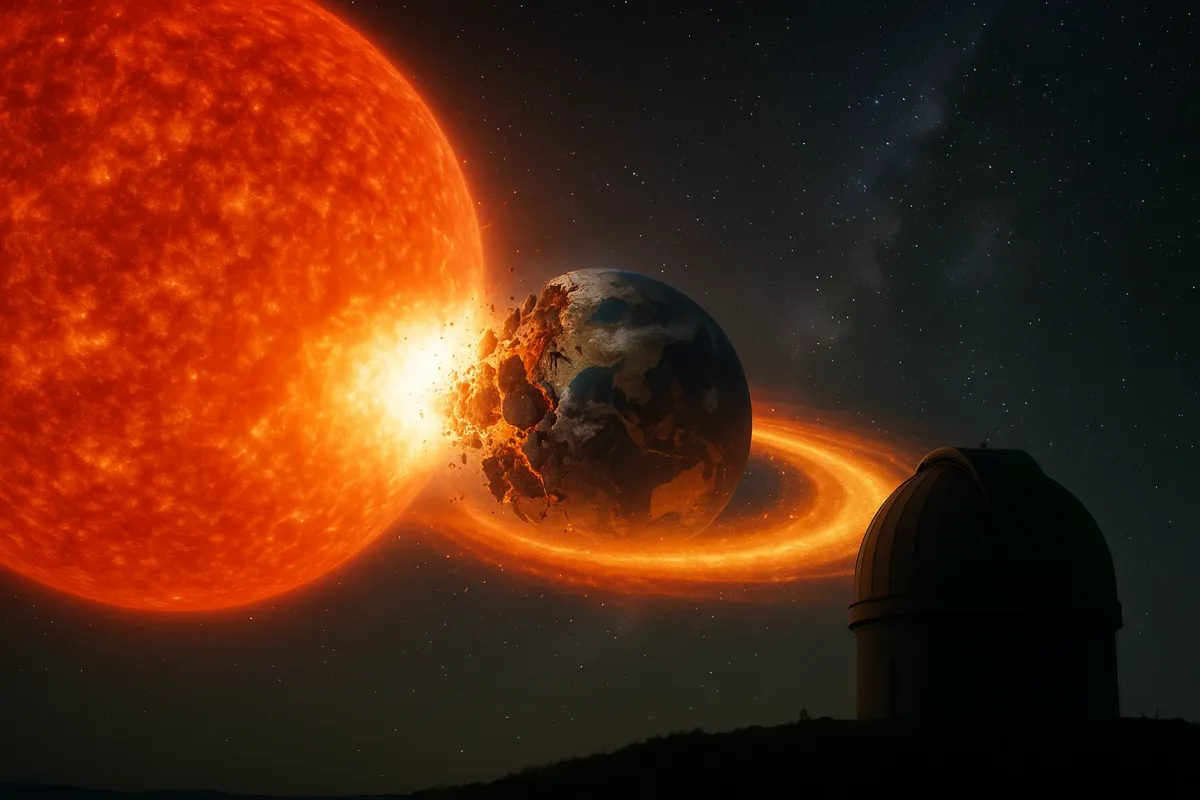
For decades, astronomers predicted that when stars like our Sun grow old and puff up into red giants, their innermost planets would be engulfed. In 2023–2024, a team using the Zwicky Transient Facility (ZTF) plus follow‑ups from Keck Observatory caught something astonishing: a star in our galaxy suddenly brightened…and the data lined up almost perfectly with a star engulfing a Jupiter‑size planet.
The star, cataloged as ZTF SLRN‑2020, didn’t just get a bit brighter; it briefly glowed about 100 times more luminous than normal. Infrared observations from NASA’s NEOWISE showed a surge of dust and gas—like cosmic crumbs from the swallowed planet heating up and expanding outward. For the first time, this wasn’t a simulation or a distant theory; it was observational proof that stars really do eat their planets.
Why this matters right now: our own Sun is on track to become a red giant in about 5 billion years. Mercury and Venus are almost certainly doomed, and Earth’s fate is…uncertain at best. Watching ZTF SLRN‑2020 is like peeking into a possible future, except we’re seeing it play out 12,000 light‑years away instead of in our own backyard.
2. The “Zombie” Star That Won’t Stay Dead
In recent years, astronomers have been tracking a peculiar class of stars that refuse to behave during their death scenes. Normally, a massive star collapses and explodes as a supernova once. Game over. But an object known as SN 2012Z, studied in detail using the Hubble Space Telescope and more recent follow‑up campaigns, appears to have…survived its own explosion.
This star brightened like a supernova and threw off material into space—but when astronomers came back years later, something was still there, shining faintly where the star once stood. It’s been described as a “zombie star”: partially destroyed, partially intact, wrapped in a shimmering cocoon of its own debris. Current work in 2024 with improved instruments is focusing on these strange “failed” or partial supernovae, trying to understand how a star can blow itself up and not fully die.
Why this matters: these weird, underpowered explosions might be far more common than we thought, subtly seeding galaxies with heavy elements without the dramatic fireworks of normal supernovae. It suggests stellar death is not a one‑size‑fits‑all process—some stars fade, some explode, and some seem to stagger on in a half‑alive limbo.
3. White Dwarf Star Systems Reveal the Aftermath of Planetary Destruction
After Sun‑like stars die, they leave behind dense husks called white dwarfs—Earth‑sized stars with the mass of the Sun, so packed that a teaspoon of white dwarf material would weigh tons. For years, astronomers noticed something odd: many white dwarfs show traces of “pollution” in their atmospheres—heavy elements like iron, magnesium, and silicon that should sink quickly out of sight.
Recent detailed studies with telescopes like ESO’s Very Large Telescope (VLT) and NASA’s Hubble Space Telescope have made the story much clearer. Those elements are the fingerprints of shattered planets and asteroids. We’re looking at the remains of rocky worlds that once orbited these stars, now ground into dust and gas and slowly raining down onto the white dwarf.
In some systems (like the famously “polluted” white dwarf G29‑38 and others studied in 2023–2024), the composition of the debris is astonishingly similar to Earth’s crust and mantle. That means those dead systems once had Earth‑like rocky planets. We’re essentially doing cosmic forensics: reading the chemical autopsy of long‑lost worlds.
Why this matters: it confirms that rocky planets are not rare flukes; they’re common enough that their ruins show up all over the galaxy. And it provides a chilling coda to planetary evolution: even after the star dies, the destruction of its planets continues in a slow, gravitational grind.
4. Giant Space Telescopes Catch Stars on the Brink of Explosion
In the last few years, NASA’s TESS (Transiting Exoplanet Survey Satellite) and ESA’s Gaia mission have turned into unexpected supernova scouts. They weren’t built for that purpose—TESS looks for exoplanets, Gaia maps the Milky Way—but their constant scanning of the sky means they catch rare, fleeting events.
Astronomers are now sifting through terabytes of TESS data to study stars before they explode. Some red supergiants, like those similar to Betelgeuse, appear to dim and brighten in subtle ways, possibly hinting at complex internal changes and mass loss in the years or even months leading up to a supernova. Combine that with alerts from robotic sky surveys (like ZTF and Pan‑STARRS), and we’re starting to build a kind of “early‑warning system” for stellar death.
While we still can’t predict an exact explosion date, today’s teams can sometimes catch a star within hours of the moment it detonates, watching the first shock breakout and the rise of the light curve with precision that was impossible even a decade ago. Every new event caught in this early stage—several of which have hit the astronomy news cycle recently—adds another piece to the puzzle of how stars actually blow themselves apart.
Why this matters: understanding supernova timing and mechanics isn’t just academic. These explosions forge elements like calcium in your bones and iron in your blood, and they can also bathe nearby planets in lethal radiation. Knowing how often they happen, how powerful they are, and how close they can safely be is key to understanding where life can survive in the universe.
5. Gravitational Waves Reveal the Invisible Collisions Shaping the Cosmos
If light shows us what the universe looks like, gravitational waves reveal how it moves. Since the first detection of ripples in spacetime in 2015 by LIGO, observatories like LIGO (U.S.), Virgo (Europe), and KAGRA (Japan) have been upgrading and coming back online with steadily increasing sensitivity. The most recent observing runs, including the O4 run throughout 2023–2024, have produced a flood of candidate events.
Many of these are mergers of black holes, some heavier than we expected, colliding in distant galaxies and sending out bursts of gravitational waves that warp spacetime itself. Others come from the collisions of neutron stars—ultra‑dense stellar remnants—that may create heavy elements like gold and platinum. We can’t see these mergers with our eyes, but we can feel them with exquisitely sensitive detectors that can measure distortions smaller than a proton’s width.
Teams working right now are racing to match gravitational‑wave alerts with flashes of light: gamma‑ray bursts, optical afterglows, and X‑ray signals. Each confirmed match gives a 3D view of a cosmic catastrophe, telling us not just that something collided, but what it was made of and how it behaved.
Why this matters: gravitational waves are opening an entirely new sense for astronomy, like suddenly being able to hear in a world where you could only see. They allow us to explore dark corners of the universe—regions dominated by black holes and dense matter—that were previously invisible, turning the cosmos into a dynamic, vibrating landscape instead of a static star map.
Conclusion
The universe isn’t a serene backdrop of twinkling stars—it’s a restless, evolving stage where worlds are born, devoured, shattered, and reborn in an endless cosmic cycle.
Today’s instruments—survey telescopes, space observatories, and gravitational‑wave detectors—have shifted us from guessing to witnessing. We’ve seen a star swallow a planet, watched dead stars dine on planetary leftovers, tracked “zombie” stars surviving their own explosions, and listened to the distant thrum of colliding black holes.
The next time you look up at the night sky, remember: somewhere out there, right now, a star is engulfing a planet, a white dwarf is digesting the remains of a shattered world, and spacetime itself is ringing from a titanic collision. We’re not just passive observers of a static universe—thanks to modern astronomy, we’re following the live‑blog of cosmic events as they unfold.
Key Takeaway
The most important thing to remember from this article is that this information can change how you think about Cosmic Events.