For a few brief minutes, the universe lets us cheat. The Sun goes dark in the middle of the day, the temperature drops, animals get confused—and suddenly, Earth turns into a planet‑sized observatory. Total solar eclipses are not just spectacular sky shows; they’re rare scientific jackpots that let astronomers probe the Sun, Earth’s atmosphere, and even Einstein’s theories in ways we simply can’t on a normal day.
With the recent 2024 total solar eclipse that carved a path across Mexico, the U.S., and Canada, space agencies, universities, and everyday sky‑watchers turned their cameras and telescopes to the heavens. NASA flew research planes through the Moon’s shadow, citizen scientists joined coordinated experiments, and TikTok and X (formerly Twitter) lit up with eerie, mid‑day twilight videos. Let’s dive into why eclipses like this matter—and explore five incredible, eclipse‑powered insights about our cosmic neighborhood.
The Sun’s Ghostly Halo: A Rare Look at the Solar Corona
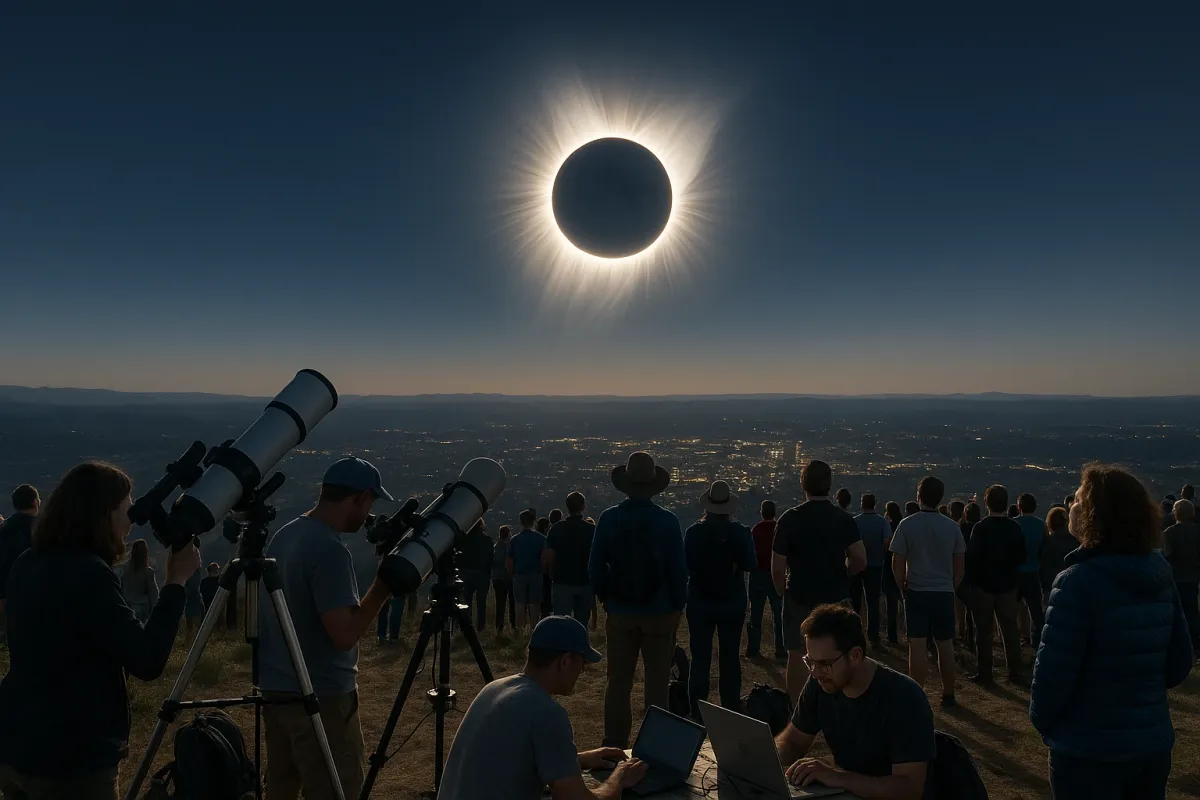
During totality—the brief window when the Moon completely covers the Sun—something ethereal appears: the solar corona. This is the Sun’s outer atmosphere, a faint, ghostly halo of plasma that normally gets drowned out by the brilliance of daylight. But when the Moon perfectly blocks the Sun’s disk, the corona steps into the spotlight.
For the 2024 eclipse, researchers from NASA and several universities used high‑resolution cameras and spectrometers to study the corona’s complex structure. They’re asking questions that sound simple but are still unsolved: Why is the corona hundreds of times hotter than the visible surface of the Sun? How exactly does the Sun launch solar wind and violent outbursts called coronal mass ejections into space? By analyzing the shape, brightness, and motion of filaments in the corona, scientists hope to improve space‑weather forecasting—vital for protecting satellites, power grids, and even astronauts aboard the ISS.
Fun twist: professional astronomers weren’t alone. Amateur astrophotographers along the path of totality coordinated to capture overlapping videos of the corona, creating a time‑lapse of how it changed during those fleeting minutes. In a very real sense, millions of people briefly became a distributed telescope wrapped around the Moon’s shadow.
Chasing the Shadow by Jet: Why NASA Put Eclipses on Airplanes
If totality on the ground lasts a few precious minutes, how do you stretch that time for science? You chase it—literally. For the 2024 eclipse, NASA equipped research aircraft, including high‑altitude jets, with specialized instruments and flew directly under the Moon’s racing shadow. At cruising speed and altitude, the planes could linger in darkness longer than any single ground location.
From the air, the atmosphere is thinner and steadier, which means clearer, sharper observations of the Sun’s corona and inner regions near the solar surface. Scientists used infrared sensors on these flights to search for subtle signatures in the corona that might not be visible from the ground. Infrared light can reveal cooler structures and different layers of solar activity, offering a kind of “thermal X‑ray” of the Sun.
These eclipse flights also tested hardware concepts for future missions that might watch the Sun from high above Earth—or from deep space. In some ways, jet‑mounted eclipse experiments are rehearsal runs for next‑generation solar observatories that will monitor our star around the clock.
Gravity, Bent Light, and Einstein: Eclipses as Relativity Laboratories
One of the most legendary science stories in history began during a solar eclipse. In 1919, astronomers led by Arthur Eddington photographed stars near the eclipsed Sun and discovered that their apparent positions shifted. The starlight had been bent by the Sun’s gravity, confirming a radical new theory at the time: Albert Einstein’s general relativity.
More than a century later, eclipses are still used to test the extreme physics of gravity. While modern experiments typically achieve higher precision using space probes and radio signals, eclipses offer a dramatic, public demonstration that gravity genuinely warps spacetime. During the 2024 eclipse, several international teams attempted modern versions of Eddington’s measurements with digital cameras and advanced image processing, both to refine the technique and to involve students in “hands‑on relativity.”
Even if we no longer rely on eclipses as our primary tool for testing Einstein, they remind us that the sky can be a laboratory. The same alignment that sends millions reaching for eclipse glasses also quietly reveals that space isn’t just emptiness—it’s a flexible fabric, distorted by mass and energy.
Earth’s Shadow Play: Eclipses as Planetary‑Scale Weather Experiments
A total solar eclipse doesn’t just affect the heavens above; it leaves a measurable fingerprint on Earth’s atmosphere. When the Sun abruptly “turns off” over a region, the local environment reacts—and scientists are eager to watch. During the 2024 event, meteorologists, atmospheric physicists, and even ham‑radio operators joined in a global experiment.
Weather stations recorded temperature drops of several degrees Celsius, shifts in wind speed and direction, and changes in cloud formation as the shadow swept by. Researchers monitored how the abrupt loss of sunlight affected turbulence in the lower atmosphere and the stability of the boundary layer—the thin shell of air closest to the ground where we live and breathe.
Meanwhile, radio enthusiasts and space physicists watched the ionosphere, a high‑altitude layer of charged particles that reflects radio waves and responds strongly to solar radiation. As the eclipse dimmed the Sun, the ionosphere temporarily weakened and reshaped. Data from this event will help scientists refine models of how solar activity affects communication systems, GPS accuracy, and even power grids. A fleeting patch of twilight over North America became a planetary‑scale “switch‑off” experiment.
Eclipses as Cosmic Practice Runs for Planet Hunters
Perhaps the most surprising thing about solar eclipses is that they’ve become training wheels for studying worlds beyond our Solar System. When the Moon crosses in front of the Sun from our perspective, it mimics—on a local, spectacular scale—what astronomers see when an exoplanet passes in front of its star, an event called a transit.
The same physics applies: a dark disk blocks part of a bright sphere, light dims in a predictable way, and, if you’re clever, you can learn about both objects from that subtle change. During recent eclipses, including the 2024 event, astronomers used ultra‑precise instruments to treat the Sun as if it were a distant star. By measuring how sunlight filtered through Earth’s atmosphere at the edge of the Moon’s silhouette, they tested techniques that might one day be used to detect signs of life in alien atmospheres.
Think of it this way: every total solar eclipse is a local sandbox where we practice reading the fingerprints of atmospheres—ours today, and maybe a habitable exoplanet’s tomorrow. It’s a cosmic dress rehearsal where Earth plays the role of “exoplanet” and the Sun stands in as a conveniently bright, nearby test star.
Conclusion
When a total solar eclipse sweeps across our world, it feels like a myth come to life: daylight vanishes, the sky turns strange colors, and a silver crown burns where the Sun should be. But hidden beneath the drama is a surge of quiet, coordinated science. Jets chase the shadow, citizen scientists launch weather balloons, telescopes zoom in on the corona, and students recalculate Einstein from a school parking lot.
We often talk about cosmic events as spectacles to watch—but eclipses are also invitations to participate. They stitch together cutting‑edge astrophysics, climate science, radio tech, and exoplanet research into one brief, astonishing alignment of Sun, Moon, and Earth. The next time the sky goes dark at noon, remember: you’re not just witnessing a show. You’re standing inside one of the universe’s most elegant experiments.
Key Takeaway
The most important thing to remember from this article is that this information can change how you think about Cosmic Events.